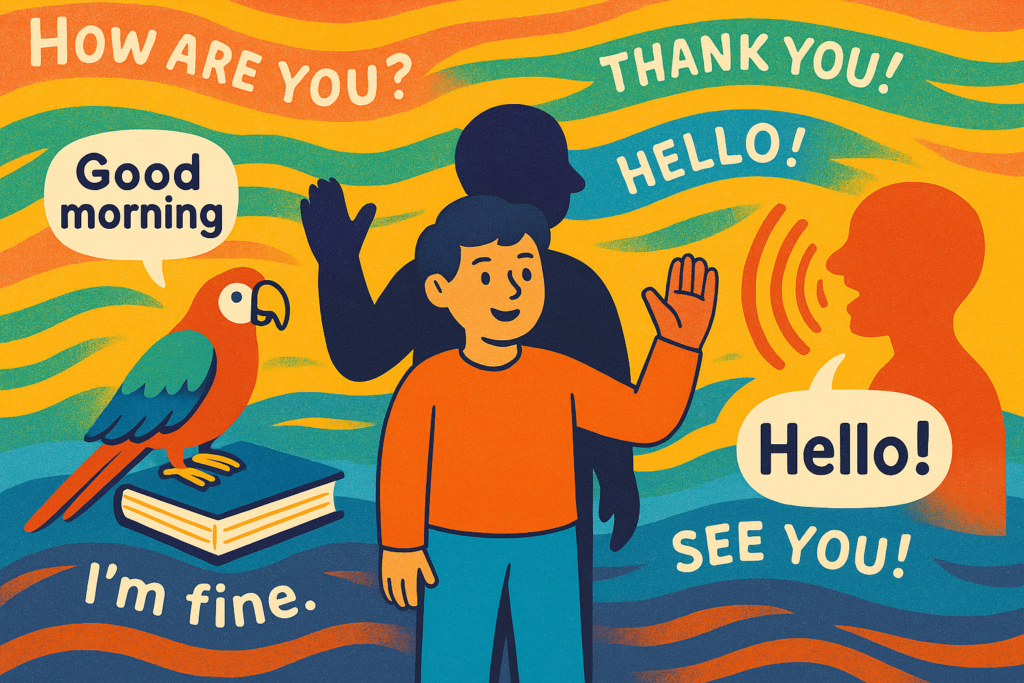
Imagine walking into a bustling street in Mumbai, New York, or Nairobi. Amid the hum of voices, you notice a child mimicking the gestures and intonation of a street performer, or a language learner repeating phrases after a podcast. These acts, so simple, so natural, are often dismissed as mere copying or mimicry. Yet, beneath their surface lies a profound, scientifically supported strategy for mastering English and other languages.
In this post, we will explore how ‘imitation’, far from being a sign of lack of originality, is a cornerstone of language acquisition. Drawing inspiration from neuroscience, theatre, animal behaviour, and real-world examples — especially from India — we will uncover how echoes, shadows, and parrots can be your allies in becoming fluent, confident, and authentic in your English.
‘Stop Copying Me!’: Why Imitation Gets a Bad Rap
For many learners and educators, imitation has a somewhat negative connotation. Schools often emphasise correctness over imitation, discouraging students from ‘copying’ others for fear of losing originality or developing a fake accent. Yet, this perspective overlooks a fundamental truth: all language learning begins with imitation.
Think about toddlers: they spend months mimicking sounds, gestures, and facial expressions of their caregivers. This imitation is not laziness or lack of creativity; it is the very process through which they internalise language and social cues.
Similarly, actors rehearse lines, singers emulate masters, and polyglots often imitate native speakers’ pronunciation and rhythm to achieve fluency. Even parrots — famous for their mimicry — are not simply parrots; they are masters of vocal imitation, able to replicate complex sounds and phrases.
In India, where multilingualism is woven into daily life, children often pick up multiple accents and dialects through imitation, sometimes switching effortlessly between Hindi, English, Tamil, or Marathi, mimicking the speech patterns they observe in their environment. This natural process, if understood and harnessed correctly, becomes a powerful tool rather than a weakness.
The Science Behind Echoing: How Repetition Forms Foundations
Mirror Neurons and the Power of Imitation
Neuroscience offers compelling insights into why imitation works so effectively. The discovery of ‘mirror neurons’, which are specialised cells in our brain that fire both when we perform an action and when we observe others doing the same, has revolutionised our understanding of learning. When you listen to a native speaker and repeat what they say, your mirror neurons activate, helping you internalise pronunciation, rhythm, and intonation.
Auditory Loop and Repetition
Our brains have an ‘auditory loop’, a kind of mental echo chamber, which allows us to rehearse sounds and phrases repeatedly. This repetition is not passive; it is an active practice shaping neural pathways, making speech more automatic over time.
Shadowing Technique: The Interpreter’s Secret
One of the most effective methods rooted in imitation is ‘shadowing’. Developed in the context of interpreter training, shadowing involves listening to speech and simultaneously repeating it without pausing or translating. This technique improves fluency, intonation, and listening skills.
For example, imagine listening to an Indian English speaker on a podcast and repeating their sentence immediately after hearing it. Over time, this trains your brain to produce speech that sounds natural, rhythmic, and native-like.
Why Repeating Without Thinking Works
When you imitate without overanalysing, just echoing what you hear, that is, you bypass the internal critic and allow your brain to absorb patterns intuitively. This is akin to how children effortlessly acquire language: they do not analyse grammar rules; they just imitate and internalise.
Performance, Identity, and the ‘Second Self’
The Role of Imitation in Building Confidence
Many language learners feel awkward trying to sound like a native speaker. They worry about losing their identity or sounding fake. However, imitation, when approached as a performance art, can help you ’embody’ the language and ‘shift your identity’ as a speaker.
Think of actors rehearsing a role: they do not just memorise lines; they adopt the mannerisms, tone, and presence of their character. Similarly, imitating native speakers allows you to step into the shoes of a fluent speaker. Over time, this ‘second self’ becomes more natural.
Theatre and Language Learning
Theatre training emphasises ’embodiment’, meaning using gestures, facial expressions, and voice modulation to bring characters to life. Language learners can borrow this approach by practising ‘mimicry as a form of performance’, making their practice more engaging and effective.
For instance, a student from India might practise delivering a business pitch in English, mimicking the tone, gestures, and pacing of a TED Talk speaker. This not only improves pronunciation but also builds confidence and authenticity.
From Imitation to Innovation
Internalising Patterns and Creating Your Own Style
Once you have internalised the rhythm, intonation, and vocabulary through imitation, you can begin ‘adapting’ and ‘innovating’. Just as artists study masters before developing their own style, language learners can move from copying to personal expression.
For example, after mimicking the speech patterns of a British English speaker, a learner might start blending those patterns with their natural accent, creating a unique, authentic voice.
Exercises to Transition from Copy to Creativity
—Echo Reading: Listen to a short paragraph; then pause and repeat it aloud, trying to match the speaker’s tone and rhythm.
—Dialogue Mirroring: Find dialogues in movies or podcasts, and mimic not just the words but also the gestures and intonation.
—Accent Imitation Challenges: Choose a regional accent (e.g. South Indian English, Indian Bengali English), and practise speaking in that style to internalise different speech patterns.
Practical Tools and Activities
Using Technology for Imitation Practice
—YouTube and Podcasts: Pick videos of native speakers; turn on subtitles; and practise shadowing along with the audio.
—AI Voices and Text-to-Speech (TTS): Use AI tools to generate speech models. Repeat after them to hone your pronunciation and rhythm.
—Recording Yourself: Record your imitation attempts; listen critically; and compare with the original. Notice nuances in pronunciation, intonation, and pacing.
Incorporating Imitation Into Daily Practice
—Daily Shadowing: Dedicate 10 to 15 minutes daily to shadowing a news clip, speech, or conversation.
—Gesture Imitation: Observe and mimic native speakers’ gestures, facial expressions, and body language.
—Storytelling: Retell stories or dialogues, imitating the style and tone of the original speaker.
Conclusion: Embrace the Echo, the Shadow, and the Parrot Within
Imitation is not a shortcut or a sign of inauthenticity: it is the very foundation upon which fluency is built. When you echo native speakers, shadow their speech, and even channel your inner parrot, you are engaging in a powerful, neuroscience-backed process that rewires your brain for language mastery.
In India, as in many cultures around the world, imitation is a natural part of learning — whether through storytelling, theatre, or everyday conversation. Recognising and harnessing this instinct can transform your journey from hesitant learner to confident speaker.
So, the next time you practise English, try this: record yourself imitating a native speaker for 30 seconds. Then read the same lines ‘your way’. What changed? You will be surprised how this simple act can open new doors to fluency, authenticity, and self-expression.
Happy mimicking!
Discover more from Methods and Musings
Subscribe to get the latest posts sent to your email.