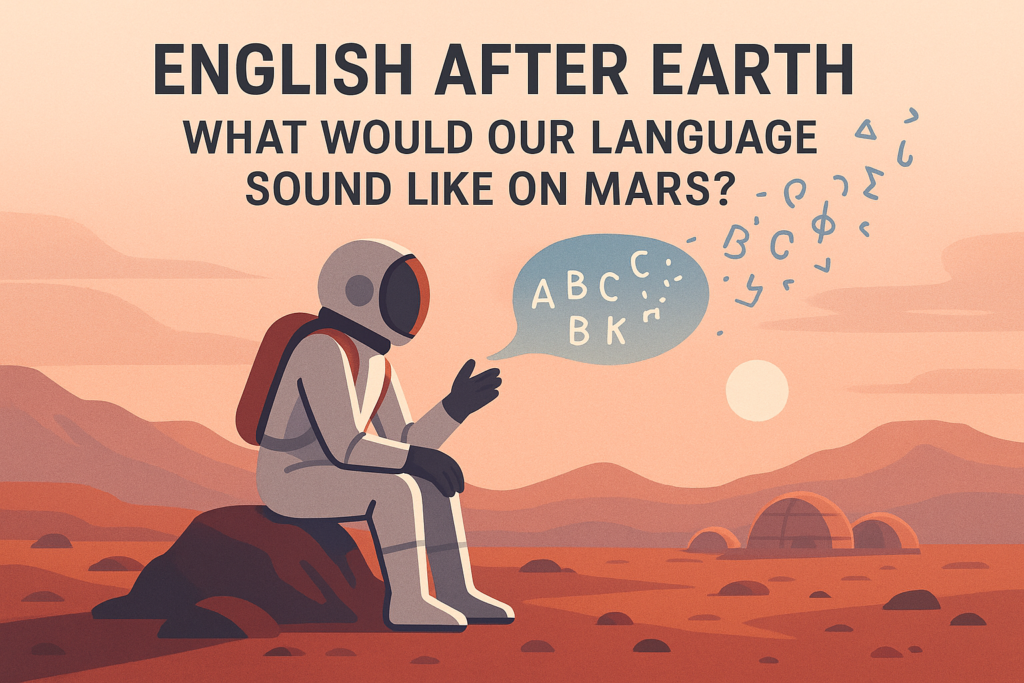
Imagine standing inside a transparent dome on the red plains of Mars, gazing out at a landscape of rust-coloured rocks and dust storms swirling in the thin atmosphere. Inside, children in space suits sit cross-legged on modular seats, their voices muffled yet eager, reciting words in English that carry a faint, unfamiliar echo, almost like a distant memory. The teacher gestures animatedly, and their speech, though rooted in familiar language, sounds subtly altered by the environment.
This scene, though speculative, prompts a compelling question: if humans colonise other planets, will our language change too? For centuries, linguists and anthropologists have observed how language is inherently intertwined with environment and culture. When a community moves into a new physical space, especially one as radically different as Mars, it is natural to wonder how their language might evolve. Would it remain recognisable, or would it transform into something unrecognisably new?
Our exploration of this idea begins with the understanding that language is not static; it is a living, breathing entity that adapts to its surroundings. If humanity’s future includes life beyond Earth, then our linguistic footprints on Mars could be as distinctive as the planet’s landscape itself. This post delves into the fascinating possibilities of what ‘Martian English’ might sound like, how its vocabulary could drift, and how it might reflect new social identities — shedding light on the profound ways environment and culture shape language.
The Gravity of Words: Environment and Sound
Language is fundamentally about sound: an intricate dance of vibrations, airflow, and articulation. The physical environment plays a crucial role in shaping how we produce and perceive speech. On Earth, our atmosphere, gravity, and vocal apparatus have evolved in tandem to facilitate a certain range of sounds. However, on Mars, with its thin atmosphere and reduced gravity, the acoustic landscape changes dramatically.
The Martian Atmosphere and Its Effect on Sound
Earth’s atmosphere is dense enough to carry a wide range of sounds, from the whisper of a breeze to the roar of a jet engine. In contrast, the atmosphere of Mars is approximately 1% as dense as Earth’s, composed mostly of carbon dioxide. This means sound waves are less efficiently transmitted, and speech may need to adapt to be more effective.
Speakers on Mars might instinctively produce ‘more forceful, louder speech’ to ensure their words carry across the thin air. Soft vowels — those that depend on gentle airflow — could diminish, giving way to more clipped, abrupt consonants. Think of a language that emphasises ‘short, sharp sounds’, perhaps with a higher pitch or increased enunciation to compensate for the muffling effect of the atmosphere.
Implications for Speech Patterns
This environment could lead to speech that is ‘faster and flatter’, with less tonal variation, as speakers adapt to optimise clarity. The softer, elongated vowels common in English might be replaced by more staccato forms, akin to how some indigenous languages or speech styles on Earth are more abrupt. Over generations, these acoustic adaptations could become characteristic of Martian English, making it sound distinctly different from its Earth counterpart.
Technology’s Role in Shaping Sound
Moreover, the reliance on communication devices, such as helmets with built-in microphones or AI translation tools, could influence speech patterns further. Speakers might develop a ‘tech-inflected shorthand’, where words are shortened or modified for efficiency, creating a unique linguistic style that balances clarity with technological constraints.
From Oxford to Olympus Mons: Vocabulary Drift
Language is also about words: how we name, describe, and conceptualise our world. When humans move to a new environment, especially one as alien as Mars, they inevitably create new vocabulary. This development is not merely about inventing new terms but also about recontextualising existing words to fit their new realities.
New Words for a New World
Martian colonists will need terminology to describe their environment and daily life. Words such as domes, regolith, terra pods, solar hives, and dust storms will become commonplace. These terms will help build a shared linguistic framework for understanding their habitat and challenges.
Repurposing Old Words
Conversely, familiar words will take on new meanings. For example, the word morning on Earth corresponds roughly to sunrise and early daylight, but on Mars, the period might be called sunset shift or dust dawn. Similarly, home might refer not just to Earth but to specific habitats, such as the habitat, the colony, or the red cradle.
Metaphors and Cultural Expressions
As daily life becomes intertwined with Martian realities, language will reflect this shift through metaphors and idioms. Phrases such as red horizon thinking, oxygen hour, or sunset shift could become idiomatic expressions, encapsulating the experience of living on a planet where the environment defines the rhythm of life.
The Evolution of Technical Vocabulary
Given the technological nature of Mars settlements, technical jargon will likely seep into everyday speech. Terms related to life support systems, AI assistants, or navigation tools may transition from specialised vocabulary to colloquial language, blurring the lines between technical and ordinary discourse.
Dialects in the Dust: Sociolinguistic Divergence
History shows us that language naturally diverges over time and space. On Earth, geographical and social isolation led to the development of distinct dialects and accents: think of the differences between American, British, Australian, and Indian English.
Martian Dialects and Slang
On Mars, similar divergence is inevitable. Different colonies or habitats might develop their own dialects, incorporating local terms, slang, and pronunciation quirks. For instance, a colony near the pole might develop a slang influenced by ice and snow analogies, while another near the equator might favour desert metaphors.
Influence of Artificial Intelligence and Interplanetary Communication
The presence of AI translation devices and interplanetary communication networks could further shape linguistic variation. As colonists communicate with Earth and each other through AI intermediaries, they may develop ‘techno-pidgins’, that is, simplified, hybrid languages that blend human speech with machine-generated grammar and vocabulary.
Language as Identity
Over generations, language becomes a marker of identity. Martian settlers might take pride in their unique dialects, seeing them as symbols of independence and adaptation. Conversely, some may cling to the original English roots, creating a spectrum of linguistic identities: Earther English, Mars English, or even Red Speech.
The Influence of AI and Interplanetary Communication
Modern language is already influenced by technology, and this trend would only accelerate on Mars. The lag in communication — up to 22 minutes between Earth and Mars — would necessitate new ways of speaking and writing, perhaps leading to ‘asynchronous language habits’.
Shorthand and Coded Language
To cope with delays, colonists might adopt shorthand or coded language, as brevity would become essential. Phrases such as ‘RTB’ (return to base) or ‘O2 low’ could evolve into standard expressions.
AI as Linguistic Gatekeeper
AI language models onboard spacecraft or habitats could become influential in shaping Martian English. They might assist in teaching, correcting, or even ‘preserving’ certain linguistic features, leading to a form of ‘AI-mediated language evolution’. Over time, AI could embed specific grammatical structures or vocabulary, creating a ‘machine-influenced’ dialect.
Cultural Identity and the New Martian Lexicon
Language is more than just sounds and words; it is a vessel of culture and identity. As humans adapt to life on Mars, their language will reflect their evolving sense of self.
Martian vs Earthling Identity
Would Martian English speakers still see themselves as ‘English speakers’? Or would they develop a new identity, such as Martians, Redlanders, or Colonials, with language serving as a marker of their unique experience?
Literature, Humour, and Idioms
Over time, literature and humour will mirror life on Mars. Idioms such as red horizon thinking or dust storm days might replace Earth-centric expressions. Humour could be darkened by the harsh environment or become more inventive, reflecting resilience and adaptation.
Nostalgia and Language Loss
Nostalgia for Earth words and idioms may persist, especially among older generations or those longing for home. This emotional dimension adds depth to the linguistic evolution — an echo of Earth amidst the new world.
Return Transmission: What It Tells Us About Language Today
Looking back at Earth, the thought experiment of ‘Martian English’ underscores a fundamental truth: language is inherently adaptable. It morphs in response to our environments, cultures, and technologies. Every linguistic shift, whether subtle or radical, is a testament to human resilience and creativity.
The Future of English on Earth
Interestingly, the diverse, dynamic nature of what might become Martian English reminds us that English today is already a mosaic, with varieties influenced by culture, technology, and geography. It is a living, evolving entity, constantly reshaped by the communities that speak it.
A Reflection for Today
Perhaps the most profound insight is that Martian English might already be forming in digital spaces — social media, online forums, virtual worlds — where language adapts rapidly to new norms and technological influences. These virtual dialects and shorthand forms may serve as precursors to the linguistic landscape of the future.
Conclusion
As we ponder the distant possibility of humans living and thriving on Mars, imagining their language opens a window into the profound relationship between environment and expression. The sounds, words, and identities of Martian English will not only reflect the alien landscape but also embody humanity’s innate capacity to adapt, innovate, and find meaning in new worlds.
In essence, the future of language beyond Earth is a story of resilience: a testament to our enduring desire to communicate, connect, and make sense of the universe. Whether on Earth or Mars, language remains a vital thread weaving the fabric of human experience.
And perhaps, in the distant future, when children on Mars recite their lessons, they will do so in a tongue that, while rooted in English, is uniquely theirs — an elegant testament to our celestial journey.
Discover more from Methods and Musings
Subscribe to get the latest posts sent to your email.