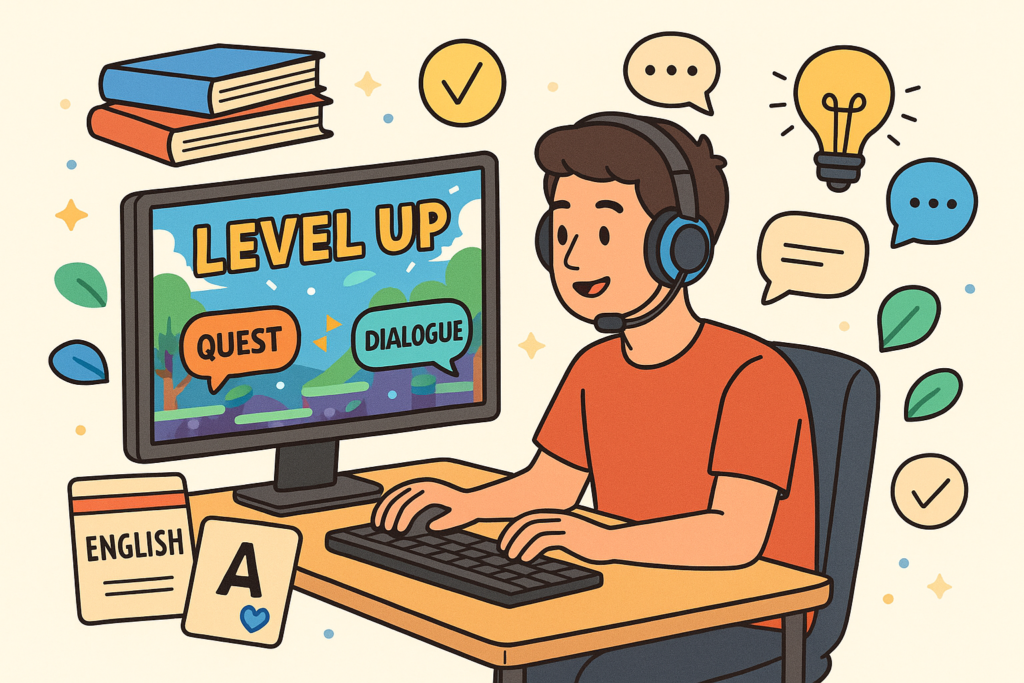
Imagine a young woman from Mumbai, named Anjali, who struggled with her English-speaking confidence. Despite her hard work in traditional classrooms, she found it hard to grasp idiomatic expressions and colloquial speech. One day, she picked up her favourite role-playing game, The Witcher, and started playing in English. Over weeks, she noticed herself understanding dialogues better, picking up idioms, and even practising pronunciation during her gameplay. Today, Anjali speaks with a newfound fluency and confidence, attributing her progress largely to her gaming experience.
This story might sound unusual, but it highlights a compelling truth: video games can be powerful, engaging tools for language learning — especially English, the global lingua franca. With the rise of digital entertainment, millions of gamers worldwide are learning English informally, often without realising it. Whether through immersive storytelling, social interaction, or casual exposure, video games offer a dynamic environment that complements traditional language learning methods.
In this blog post, we will explore how video games can effectively boost your English skills. We will delve into the science behind language acquisition through gaming, discuss practical strategies, review real-life examples, and challenge misconceptions. By the end, you will see gaming not as a distraction but as an innovative way to level up your language proficiency — globally and locally.
Gaming as Immersive Language Input
One of the foundational principles of effective language learning is exposure to authentic, meaningful input — what linguists call ‘comprehensible input’. Stephen Krashen, a renowned researcher in second language acquisition, emphasises that learners acquire language best when they are exposed to language that they understand but that challenges them just enough to stretch their abilities.
Video games, especially narrative-driven ones, naturally provide this kind of input. They immerse players in worlds filled with dialogue, storytelling, and cultural references, often in real time. Games such as Life is Strange, The Witcher, and Red Dead Redemption 2 are more than entertainment; they are rich sources of contextual language.
Narrative-Driven Games and Contextual Learning
Let us take The Witcher as an example. This game features complex storylines, character interactions, and quests set in a richly crafted fantasy universe. As players navigate dialogues, they encounter idiomatic expressions, colloquial speech, and cultural references that mirror real-world language use. When a character says, ‘The road is long and full of perils,’ players absorb the phrase within its narrative context, making it more memorable.
Similarly, Red Dead Redemption 2 transports players to the American frontier, where language reflects historical dialects, slang, and idioms. By engaging with such content, learners naturally acquire phrases such as ‘Hold your horses’ or ‘That’s a whole other story,’ embedded within meaningful situations.
Language in Context: Absorption Beyond Classroom
This contextual exposure allows players to absorb language as it is used naturally, rather than in isolated vocabulary lists. They pick up idioms, slang, and cultural nuances incidentally, much like children do when they learn their first language. For learners from India or elsewhere, this exposure to diverse language registers broadens their understanding and prepares them for real-world communication.
Motivation and Emotional Engagement
One of the key advantages of gaming as a language learning tool is its ability to motivate and emotionally engage learners.
The Psychology of Flow and Intrinsic Motivation
Games are designed to be engaging, often inducing a state of flow — a psychological state where individuals are fully immersed and lose track of time. Mihaly Csikszentmihalyi, a pioneer in positive psychology, describes flow as the optimal experience that fosters learning and growth.
When players are deeply involved in their game, they are motivated to understand and solve problems, which naturally encourages language processing. This intrinsic motivation — driven by enjoyment rather than obligation — leads to more effective and sustained learning.
Stakes, Retention, and Storytelling
Unlike rote memorisation or worksheet exercises, gaming involves meaningful stakes. In a game, failing a mission or solving a puzzle depends on understanding instructions, dialogue, or clues expressed in English. This real-time problem-solving enhances retention because the language is tied to tangible goals and consequences.
Moreover, characters and stories create emotional bonds. For example, players may feel empathy for a character such as Arthur Morgan in Red Dead Redemption 2. These emotional connections make vocabulary and expressions more memorable. When learners care about characters’ fates, they are more likely to remember the language used and replicate it in their own speech.
Real-Time Communication in Multiplayer Games
Multiplayer gaming introduces another layer of language learning — dynamic, real-world communication.
Voice and Text Chat as Language Practice
Popular multiplayer games such as Fortnite, Among Us, and Valorant require players to communicate quickly and effectively. During gameplay, players send messages, coordinate strategies, and negotiate in English, often in informal or slang-rich registers.
For example, in Among Us, players might say, ‘Sus!’ (short for ‘suspicious’) or ‘Eject the impostor!’ These short phrases and abbreviations are part of everyday casual English, especially among younger generations. Listening to and using such language helps learners grasp the colloquial and pragmatic aspects of communication.
Learning Slang, Casual Speech, and Pronunciation
Engaging in voice chat allows players to hear native pronunciation, intonation, and slang, which are often absent from formal learning materials. This exposure is invaluable for understanding how English is spoken naturally in social settings.
Risks and Boundaries
While multiplayer gaming offers rich language practice, it’s essential to set boundaries. Not all online interactions are safe or appropriate, especially for young learners. Using moderated servers, parental controls, and setting privacy rules helps ensure a positive experience. The goal is to engage in authentic communication without exposure to toxicity or harmful content.
Learning Strategies: Making the Most of It
To optimise language learning through gaming, learners can adopt specific strategies, such as the ones below.
Set Your Game Language to English
Even if you are a native speaker of another language, switching the game’s interface and subtitles to English maximises exposure. This ensures that all in-game text, instructions, and dialogue are in your target language.
Keep a Vocabulary Journal
Maintain a notebook or digital app where you jot down new words, idioms, or expressions encountered during gameplay. Review and use these words in your own sentences to reinforce retention.
Use Subtitles and Audio Language Settings
Many games allow you to toggle subtitles and audio language independently. Listening to native pronunciation while reading subtitles in English bridges spoken and written language, improving listening comprehension and spelling.
Leverage Online Resources
Participate in forums, walkthroughs, and fan communities related to your game. These platforms often contain discussions, tutorials, and glossaries that support language development.
Combine Gaming with Formal Learning
Balance gaming with traditional study methods. Use language apps, grammar exercises, or conversation practice to complement your gaming experience.
Research Insights
Research indicates that incidental learning through video games can significantly improve vocabulary, comprehension, and even pronunciation. A 2018 study published in Language Learning & Technology found that students who engaged with narrative-rich games showed greater gains in receptive and productive language skills compared to control groups using traditional methods.
Furthermore, research from Vilnius University, Lithuania, showed that the majority of students who play video games are influenced positively in terms of learning English. Surprisingly, the research reported that a significant number of students said that games such as Counter Strike: Global offensive (a first-person shooter game) and League of Legends (a multiplayer online battle arena) were their main source of English, whereas films and cartoons were secondary sources. It also found that most gamers use the vocabulary they have acquired through gaming in real-life communication.
Common Misconceptions
Let us look at a few common misconceptions about gaming.
‘Gaming Is a Waste of Time’
While excessive gaming can be problematic, integrating gaming into a balanced language learning routine transforms it into a productive activity. When approached intentionally, gaming becomes a fun way to practise authentic language use.
‘It Is Only for Kids’
Many believe gaming is only for children or teenagers. In reality, gamers of all ages benefit. Professional adults use gaming to relax, socialise, and even practice language skills — be it in multiplayer sessions or through content creation.
‘It’s Not “Real” English’
Some sceptics dismiss gaming language as informal or unimportant. However, informal speech, slang, and idioms are vital components of real-world communication. Mastering these enhances overall fluency and cultural competence.
Conclusion
Video games are more than just entertainment; they are versatile tools for learning and cultural exchange. By immersing yourself in stories, engaging in social interactions, and embracing the language naturally used in gaming contexts, you can significantly enhance your English skills.
So, why not start today? Pick a game in English that excites you — be it The Witcher, Fortnite, or Among Us. Keep a vocabulary journal, switch on subtitles, and participate in online communities. Share your experiences and discoveries with friends or fellow learners.
Remember, every game is a new level — so level up your language skills and enjoy the journey. Happy gaming and learning!
Discover more from Methods and Musings
Subscribe to get the latest posts sent to your email.