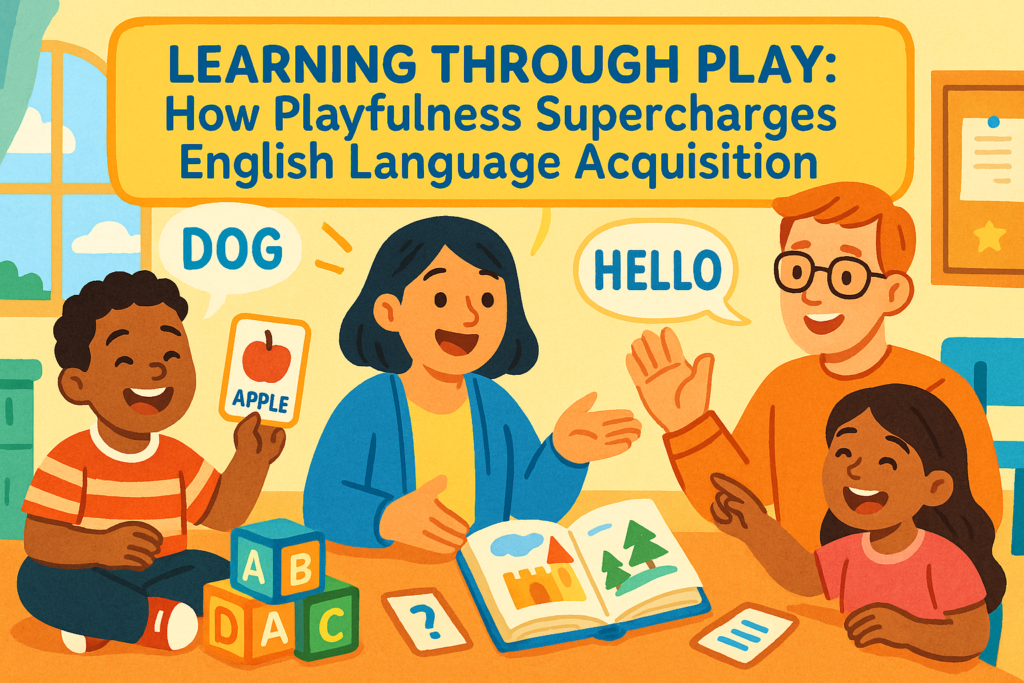
What if your best English lesson didn’t feel like a lesson at all? Imagine a classroom where children giggle while practising vocabulary, or adults confidently improvise dialogues in a fun game rather than rote memorisation. This isn’t just a utopian dream; it’s a reflection of how ‘learning through play’ can transform the way we acquire a new language.
In the realm of English language learning, traditional methods — think grammar drills, vocabulary lists, and exam prep — are undeniably important. However, they often lack the engagement and motivation necessary for sustained progress. What if the secret to how to learn English faster lies in embracing playful learning strategies that tap into our natural instincts to explore, create, and connect?
Throughout this post, we will explore how playful approaches — ranging from games and storytelling to digital activities — serve as powerful catalysts for language acquisition. We will delve into the science behind play, examine global examples, share success stories, and provide practical tips for integrating playfulness into your language journey. Because at its core, ‘learning through play’ isn’t just a method; it’s a mindset that supercharges motivation, retention, and creativity in English language acquisition.
The Science of Play in Language Learning
Why does play make a difference in learning a language? Cognitive science offers compelling answers. Researchers such as Lev Vygotsky, Jerome Bruner, and Anthony D. Pellegrini have extensively studied how play shapes brain development and learning processes.
Vygotsky, renowned for his social development theory, emphasised that play creates a ‘zone of proximal development’ — a space where learners can stretch their skills with support, often through imaginative scenarios. Play activates cognitive flexibility, allowing learners to experiment with language without fear of failure. It also enhances working memory — the mental workspace where language is processed and manipulated — making it easier to internalise new vocabulary and grammar.
Bruner pointed out that play mimics real-life social interactions, which are fundamental to language learning. When children engage in make-believe or storytelling, they simulate real-world conversations in a low-stakes environment, fostering fluency and confidence.
Research by Pellegrini et al. underscores that playful learning boosts motivation and engagement, leading to better retention of linguistic structures.
A notable statement from cognitive scientist Susan Goldin-Meadow encapsulates this idea: ‘Play is the fundamental way children acquire language, and adults can leverage this natural process to accelerate learning.’ This insight underscores that ‘learning through play’ isn’t just for kids — adults benefit too, especially when seeking to ‘learn English faster’.
Types of Play that Enhance English Learning
Different kinds of playful activities stimulate various aspects of language acquisition. Here’s a breakdown of effective ‘playful language learning’ strategies:
Word Games and Puns
Benefit: Vocabulary retention, spelling, and word recognition.
Example: Scrabble, Boggle, Taboo, and crossword puzzles challenge learners to think creatively about words.
Suggested Activity: Set up a weekly vocabulary challenge where learners create puns or riddles using new words they have learnt. For example, using homophones such as flower and flour to craft jokes or riddles.
Tool: Online platforms such as Words With Friends or Wordlink make practice accessible and fun, reinforcing vocabulary in a relaxed environment.
Role-Play & Drama
Benefit: Developing speaking fluency, emotional expression, and social language skills.
Example: Acting out everyday scenarios — ordering food, negotiating prices, or interviewing — helps learners practise contextual language use.
Suggested Activity: Organise role-play sessions where learners assume different characters — perhaps a tourist and a shopkeeper — using English to navigate interactions.
Tool: Use simple props or costumes to make the experience more immersive. Apps such as Flipgrid enable learners to record and share their performances, fostering confidence.
Storytelling and Improv
Benefit: Enhancing fluency, spontaneity, and narrative skills.
Example: Improv games such as ‘What happens next?’ or collaborative storytelling encourage learners to think quickly and use new vocabulary creatively.
Suggested Activity: Start a story with a sentence; then have each participant add a line, building a humorous or adventurous tale together. This promotes active listening and expressive language use.
Tool: Platforms such as Storybird or Story Cubes can serve as prompts for creative storytelling.
Digital Play
Benefit: Accessibility, gamification, and personalised feedback.
Example: Language learning apps such as Duolingo, Memrise, or Busuu incorporate game elements — points, badges, levels — that motivate learners to progress.
Suggested Activity: Encourage learners to set daily goals within these platforms, turning language practice into a game they would want to win. Many apps also feature multiplayer modes, fostering social interaction.
Additional digital tools: Virtual role-play communities, online quizzes, and gamified grammar exercises make learning dynamic and engaging.
Cross-Cultural Examples of Play in Language Classrooms
Play is not confined to any one culture. Across the globe, educators harness culturally specific playful practices that enrich English language learning.
Japan: Karuta Cards
In Japan, karuta — a traditional card game — is used to teach language and cultural literacy. Learners match poetic or linguistic fragments, fostering memorisation and pronunciation. This game-based method combines visual cues with rhythm, making language learning memorable and fun.
Kenya: Singing and Storytelling
In Kenya, storytelling and singing are integral to language transmission. Children learn English through community songs, folktales, and call-and-response chants that enhance listening and speaking skills in an interactive manner.
Italy: Improv Theatre
Italian educators often incorporate improv theatre into language classes. Students perform spontaneous dialogues and skits, which develop fluency, confidence, and cultural awareness in a lively, playful setting.
These examples highlight that playful interaction — adapted to cultural contexts — is a universal catalyst for second language acquisition. When learners are engaged and enjoying the process, they internalise language more effectively.
Real-World Case Studies
To humanise the concept, let’s look at a couple of success stories demonstrating how playful language learning yields remarkable results.
Case Study 1: A Mumbai-Based English Learning Initiative
In Mumbai, a group of adult learners participated in a storytelling-based conversational club. Using simple storytelling prompts, learners practised vocabulary and pronunciation in a relaxed environment. Over three months, participants showed a ‘significant improvement in fluency and confidence,’ with many reporting that they looked forward to sessions because they felt they were ‘playing’ rather than studying.
Case Study 2: A Classroom in Los Angeles
A high school in Los Angeles integrated gamified grammar exercises into their ESL curriculum. Using online platforms such as Kahoot!, students competed in real-time quizzes, earning points and badges. The result? Higher engagement, better test scores, and a more positive attitude towards learning English.
These stories exemplify how learning through play — whether through storytelling, gamification, or role-play — can be a transformative force in English language acquisition.
How You Can Incorporate Playfulness Into Your Own English Learning
Ready to make your language learning journey more playful? Here are a few practical tips to do so.
—Use Flashcards with a Twist: Turn vocabulary flashcards into a matching game or a memory challenge. Use colourful images, puns, or riddles to make them memorable.
—Create a Language Journal: Write short stories, dialogues, or comic strips about your daily life. Illustrations and humour make the process of language learning enjoyable.
—Participate in Online Language Games: Join platforms such as Duolingo or Busuu, which gamify language practice with levels, rewards, and social features.
—Engage in Role-Playing: Practise common scenarios — such as ordering coffee, booking a hotel, or interviewing for a job — with a friend or tutor, using role-play to build confidence.
—Watch and Act Out Films or Plays: Mimic dialogues from your favourite movies or plays. This not only improves pronunciation but also helps understand cultural nuances.
—Join or Form a Language Club: Organise weekly meetups where members share stories, play word games, or do improvisation exercises.
Always remember that learning through play is most effective when it aligns with your interests. If you love music, sing English songs; if you enjoy storytelling, craft your own tales; and so on.
Conclusion
The best learning doesn’t just happen in the mind — it plays out in the imagination. Incorporating playfulness into your English language acquisition journey transforms the process from a chore into an adventure. When learners engage actively, creatively, and joyfully, they not only absorb language faster but also develop a lifelong love for learning.
Whether you’re a teacher designing a classroom activity, a student seeking how to learn English faster, or a language enthusiast exploring new methods, remember that learning through play unlocks a world of possibilities. It taps into our innate curiosity, fosters resilience in the face of challenges, and makes the pursuit of fluency an enjoyable quest.
So go ahead — embrace the playful side of learning. Your journey to fluent, confident English starts where imagination and fun collide.
Interested in more innovative language learning strategies? Check out our related posts on ‘The Joy of ‘Wordplay’: How Puns and Playful Language Can Boost Your English Skills‘ and ‘Unlocking Vocabulary: Effective Strategies for Rapid Language Acquisition‘ and subscribe to our blog for weekly insights into transforming your learning experience.
Discover more from Methods and Musings
Subscribe to get the latest posts sent to your email.