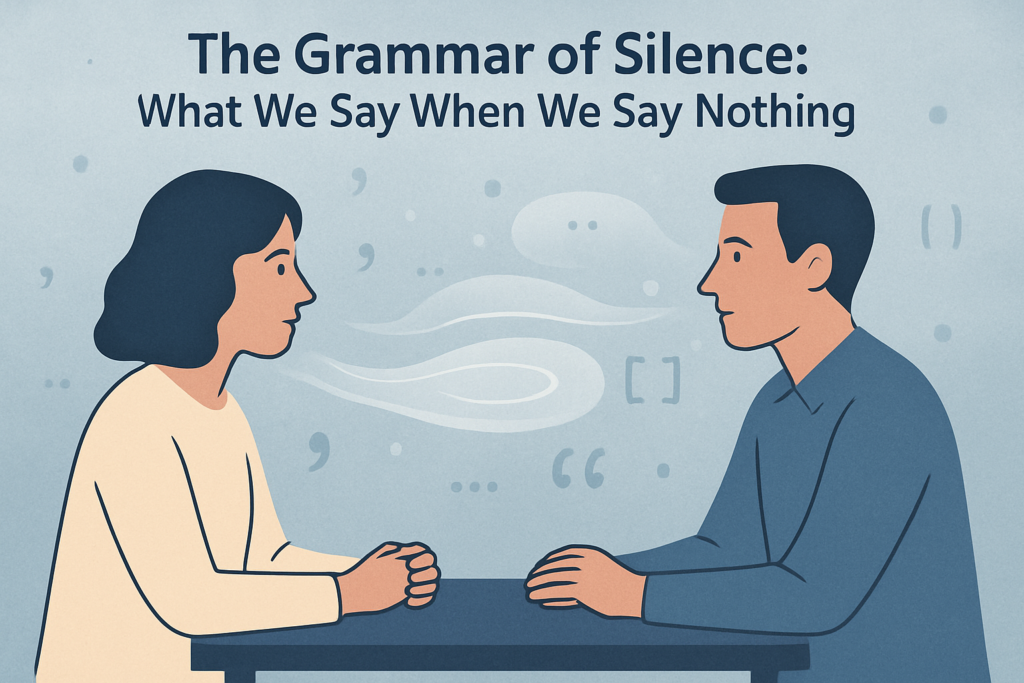
Imagine a quiet room where two friends sit in a moment of shared understanding. One has just delivered difficult news, and the other responds not with words but with a gentle gaze and a lingering pause. Or picture a tense courtroom, where a witness’s silence speaks volumes, revealing truths unspoken. In these moments, silence is not mere emptiness; it is a language in its own right, capable of conveying complex, nuanced meaning that words sometimes fail to express.
Silence, in its many forms, shapes our interactions, influences our relationships, and reflects cultural norms. It can be an act of respect, a sign of disagreement, or a display of emotional restraint. But what does silence truly communicate? And how does it function within the broader grammar of human language?
This leads us to a compelling question: if language is how we communicate, what do we make of the moments when we do not speak? The answer lies in exploring what I call the ‘grammar of silence’ — a set of patterns, conventions, and meanings that govern what is left unsaid. Silence is not simply the absence of speech; it is a form of communication rich with intentionality and cultural significance. It follows its own rules, and understanding these rules allows us to listen more deeply to the unspoken stories around us.
Silence as Speech: The Linguistic Lens
Linguists and communication scholars have long recognised that silence is an integral part of conversation. It is embedded within the fabric of interaction, shaping meaning just as much as spoken words.
One of the foundational concepts in this area is pragmatics, which is the study of how context influences meaning. Here, silence functions as a pragmatic device, helping speakers manage turn-taking, emphasise points, or indicate uncertainty.
For example, consider pause placement in conversation. A brief silence before answering a question can signal hesitation, thoughtfulness, or even disagreement. Conversely, a strategic pause after a statement might serve to let information sink in or to prompt the other person to speak.
Turn-taking pauses are another crucial element. In many languages, the length and placement of silences help determine who speaks next. These pauses are governed by social rules that vary across cultures and contexts. For instance, in Western conversations, a slight pause often indicates the end of a turn, whereas in some Asian cultures, longer silences may be customary and respectful.
Ellipsis and omission — leaving out words or phrases — is a form of silence within language itself. We often omit subjects (e.g. ‘Going to the store?’) or objects (e.g. ‘Want some?’) because the context makes the meaning clear. These silences within language create a rhythm and economy that makes communication efficient and nuanced.
Even at the level of syntax, silence manifests in unfinished thoughts or implied subjects. For example, in the sentence, ‘If I had known . . .’ the silence that follows leaves the listener to infer the unstated consequences or feelings.
In essence, silence is woven into the very structure of language, serving functions that range from grammatical omission to conversational strategy.
The Cultural Grammar of Silence
While silence is a universal phenomenon, its meanings and acceptability vary dramatically across cultures. These differences form what could be called the cultural grammar of silence or, in other words, the unwritten rules that govern when and how silence is used and understood.
In Japan, silence often signifies respect, harmony, or agreement. It is a form of politeness, allowing space for reflection and avoiding confrontation. For example, in meetings, Japanese participants may remain silent to show deference to elders or superiors, trusting that their quiet presence is a form of acknowledgment.
In Finland, silence is associated with trust and comfort. The Finns’ preference for minimal small talk and their comfort with silence in social settings reflect a cultural understanding that silence does not imply discomfort but rather a sign of confidence and ease.
In English-speaking contexts, however, silence can often be perceived as awkwardness, discomfort, or even disagreement. An awkward pause during a conversation might make participants feel compelled to fill the space with words, fearing that silence indicates disinterest or discord.
These cultural differences can lead to misunderstandings in intercultural communication. For example, an Indian businessperson accustomed to a more expressive, talkative style might interpret a Japanese counterpart’s silence as disapproval, when in fact it merely signals respect.
In The Silent Language (1959), Edward T. Hall highlights how misreading silence can cause friction or confusion in international settings. Recognising the grammar behind silence — its cultural rules — enables more effective and empathetic communication across borders.
The Emotional Syntax: What Silence Says in Relationships
Beyond cultural norms, silence also functions as a form of emotional language within personal relationships. It can serve as a mirror reflecting our inner states, often conveying what words cannot.
Silence as empathy involves knowing when to listen rather than speak, to allow space for someone’s feelings or thoughts to emerge naturally. For example, a parent listening to a child’s distress might remain silent, offering comfort through presence rather than words.
Silence as withdrawal manifests in the ‘silent treatment’, a common, though often problematic, way of expressing anger, disappointment, or hurt. Here, silence becomes a form of emotional punishment or boundary-setting, communicating disapproval without explicit confrontation.
Silence as presence is perhaps the most peaceful form of silence — shared quiet moments that affirm companionship and trust. Think of two friends sitting side by side, comfortable in mutual understanding, without the need for words.
In romantic relationships, silence can act as emotional ‘punctuation marks’. A pause after a heartfelt confession can deepen its impact, whereas silence during a disagreement might escalate tension.
In the digital age, new grammars of silence have emerged. Text messaging, social media, and instant messaging have introduced features such as seen receipts, typing indicators, or absence of response, with each a form of digital silence carrying meaning. A delayed reply might suggest hesitation, disinterest, or busy-ness, depending on context.
Understanding these emotional signals, whether spoken or silent, enriches our capacity for empathy and connection.
The Silence Within Language
Silence is not only a feature of spoken interaction but also a powerful device in writing, poetry, and rhetoric. Writers and orators harness silence intentionally to evoke emotion, create rhythm, or emphasise meaning.
Think of a poet pausing deliberately in a line or a speaker leaving a blank space on a page to invite reflection. Such silences, often called pauses or white space, can intensify a message, giving the audience room to ponder.
In rhetoric, strategic silence can serve as a rhetorical device. Winston Churchill’s famous speeches often employed pauses to build tension and emphasise key points. The rhythm of speech, much like music, relies on silence as much as sound.
Even in everyday conversation, the rhythm of speech involves natural silences that mark transitions, highlight important ideas, or provide emotional relief. These pauses form part of our shared communicative music, an unspoken harmony that underpins verbal exchanges.
When Silence Breaks
While silence can be powerful, it can also become ‘too loud’, especially in social and political contexts. Silence can be a form of complicity, resistance, or protection.
In politics, silence from certain groups or individuals may indicate suppression or fear. For example, when marginalised voices remain unheard, silence becomes a form of social control. Conversely, deliberate silence, such as refusing to speak in oppressive regimes, can serve as an act of resistance.
In social movements, silence can be a strategic silence, say, a refusal to acknowledge injustice or withholding participation as a form of protest.
In education, silence in a classroom might indicate student disengagement or confusion, prompting educators to adapt their approach. Recognising the grammar of silence helps us interpret underlying power dynamics and emotional states.
Conclusion: Learning to Listen to Silence
Returning to our opening scene, we realise that silence is a rich, complex language: one that requires attentive listening and cultural awareness to interpret accurately. Being fluent in a language involves not only speaking but also understanding what is not spoken.
In a world overflowing with words, the art of listening to silence becomes ever more vital. It teaches us patience, empathy, and cultural sensitivity. Perhaps, as we learn to ‘hear’ what is not said, we discover that silence is not the absence of language but its most subtle, profound form.
The grammar of silence invites us to become more attentive, more compassionate, and more aware of the unspoken stories that shape our lives. In understanding silence, we deepen our mastery of communication and enrich our human connections.
Discover more from Methods and Musings
Subscribe to get the latest posts sent to your email.