Cultural Sensitivity

Why Every Conversation Has Two Languages: The Difference Between What We Say and What We Mean

In an increasingly interconnected world, understanding communication goes far beyond the literal words exchanged. Every conversation operates on two levels: the explicit language we utter and the implicit meaning we intend or perceive. As industry leaders and communicators, recognising and navigating this duality is essential for clarity, persuasion, and cultural intelligence. This post explores the nuanced layers of human communication, drawing from pragmatics, linguistic theory, and intercultural insights to illuminate the invisible language that underpins every interaction.

Why Every Conversation Has Two Languages: The Difference Between What We Say and What We Mean Read More »

Why We Argue About Words When We Really Disagree About Ideas

Picture this common scene: two people are debating the meaning of a fundamental concept.

A: That’s not what equality means.

B: That’s exactly what equality means.

At first glance, it seems like they are arguing over a dictionary definition. But is that really the case? Or are they, perhaps, talking past each other, each with a different mental model of what the word means?

This question cuts to the core of human communication. When we argue about the meaning of a word, are we really debating language itself? Or are we, in fact, wrestling with contrasting visions of how the world works? Understanding this distinction reveals much about the nature of disagreement and the role language plays in shaping, and reflecting, our worldview.

Why We Argue About Words When We Really Disagree About Ideas Read More »

The Words We Never Invented: What the Gaps in English Reveal About the Way We Think

Languages are often measured by their vocabulary, the lexicons that enable us to articulate colours, emotions, objects, and abstract ideas. Yet, if we want to understand what a language truly reveals about its speakers, we should look beyond what it can say. The most compelling insights may lie in what it cannot say: those silent gaps, the words that do not exist, the concepts that remain unnamed.

The Words We Never Invented: What the Gaps in English Reveal About the Way We Think Read More »

Why English Is So Good at Naming Problems

Imagine this: you have been feeling exhausted, frustrated, and plagued by self-doubt for weeks or even months. The days blur together, and you struggle to articulate what is wrong. You might think, ‘Why do I feel this way? What is this?’ However, words continue to elude you.

Then one day, you hear a term, such as burnout, imposter syndrome, gaslighting, or overthinking, and suddenly, everything shifts. That nebulous, tangled feeling suddenly has a shape, a name. The chaos in your mind condenses into a concept you can grasp.

Why English Is So Good at Naming Problems Read More »

Holi and the Language of Colour: How English Paints the World

Today, the air is colour.

Faces blur into pinks and blues.
Clothes lose their boundaries.
Identity softens under gulal.

Holi reminds us that colour is not merely decoration: it is an experience. It is a language, a way of seeing and feeling. And interestingly, the language we use, particularly English has very specific ways of handling colour, shaping our perception in subtle ways.

Holi and the Language of Colour: How English Paints the World Read More »

English Is Addicted to Clarity: What We Lose When Everything Must Be Clear

Imagine a familiar scene: a teacher tells a student that their answer is ‘unclear’. A boss tells an employee, ‘I need this to be clearer.’ A friend texts, ‘Just say what you mean.’ These moments are commonplace in everyday communication. Clarity, in these contexts, is not merely a stylistic choice; it is a moral imperative.

In English-speaking cultures, the demand for clarity has become almost sacrosanct. It is as if clarity is the moral currency of honesty, trustworthiness, and competence. But when did this obsession with clarity begin? And what might we be sacrificing in the process? More importantly, when did clarity become a virtue, an ethical obligation of sorts, and ambiguity a flaw?

English Is Addicted to Clarity: What We Lose When Everything Must Be Clear Read More »

English Has No Place for the Collective Soul

Imagine you are sitting in a meeting, and someone says, ‘We apologise for the inconvenience.’ Or perhaps, during a national tragedy, they say, ‘We are heartbroken.’

In both cases, the pronoun we appears, invoking a sense of collective unity. Yet, have you ever paused to ask, ‘Who exactly is we?’

Everyone understands the sentence; yet, nobody clearly inhabits it. It is a linguistic gesture, a shared social convention, but not necessarily an experience. We can be a political statement, a diplomatic phrase, or a rhetorical device, but it rarely captures the visceral feeling of a true shared inner life.

This leads us to a fundamental question: why does English, despite its global reach, seem to lack a linguistic space for the collective soul? Why does it struggle to articulate genuine shared emotion, thought, and responsibility?

English Has No Place for the Collective Soul Read More »

English and the Disappearing Body: Why the Language Prefers Minds Over Flesh

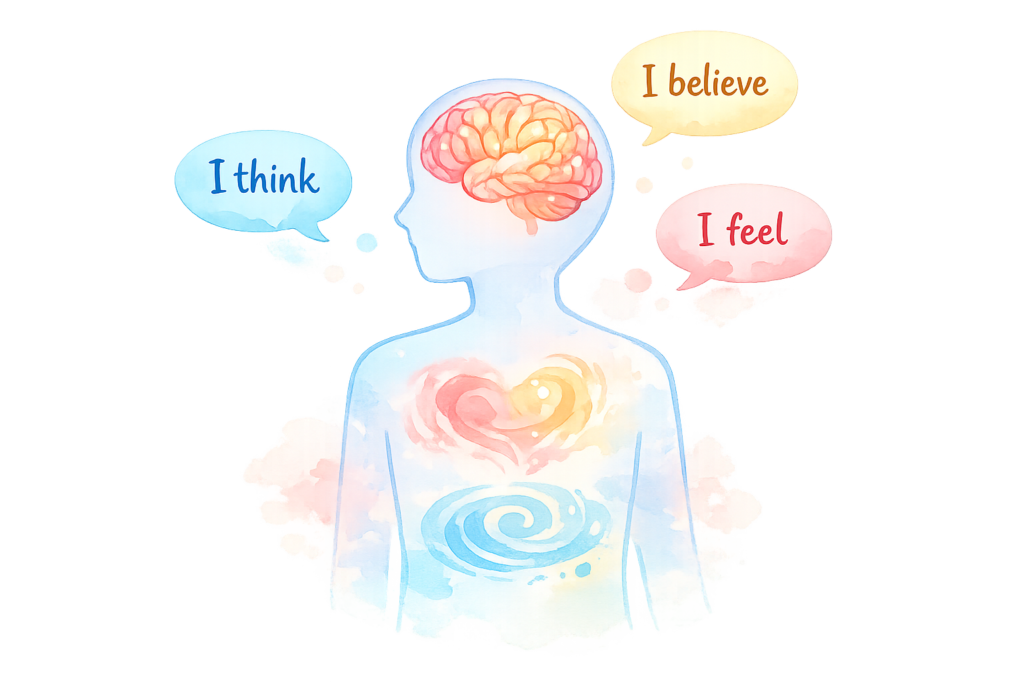
Imagine a typical conversation, whether in a clinic, a classroom, or a casual chat. We often hear expressions such as  ‘I’m stressed,’ ‘I feel anxious,’ or ‘I have a headache.’ Notice, however, that we do not usually say, ‘My heart is tight,’ ‘My chest feels heavy,’ or ‘My stomach is knotted.’  

The body lurks in the background of our language — present, yet often silent. It is as if the flesh and bones that house our experience have been politely asked to step aside or, perhaps, invisibly excised from our linguistic landscape.

This raises a central question: why does English so frequently report and describe human experience from the head, the mind, rather than from the flesh and bones?

English and the Disappearing Body: Why the Language Prefers Minds Over Flesh Read More »

Why English Sounds So Certain (Even When It Isn’t)

Imagine listening to a conversation in English: a friend declares, ‘This is how it works,’ or states confidently, ‘That’s not true,’ or simply says, ‘Obviously.’ These statements seem to arrive with an air of certainty, as though the speaker holds absolute authority over their words. Even when opinions are expressed, they often sound like undeniable facts, leaving little room for doubt.

This phenomenon raises an intriguing question: why does English sound so sure of itself, so confident, even when speakers might be merely guessing, hedging, or uncertain?

Why English Sounds So Certain (Even When It Isn’t) Read More »

Why English Is Awkward About Praise (And What That Says About Us)

Imagine a typical scene: a colleague or friend offers you a compliment. Perhaps they say, ‘That was a fantastic presentation,’ or ‘You did a great job on that project.’ What is your instinctive response? Do you accept it graciously, or do you find yourself quickly dismissing it?

More often than not, many of us instinctively deflect praise with expressions such as ‘Oh, it was nothing,’ ‘I just got lucky,’ or ‘Anyone could have done it.’

This reflexive tendency to downplay positive feedback is so common that it borders on a social script. While we enjoy receiving praise inwardly, since everyone appreciates a kind word, we often find it uncomfortable or awkward to accept compliments outwardly.

This leads us to a paradox: we like being praised, but we do not like receiving praise. 

The central question then arises: is this cultural modesty, or something deeper rooted in the very structure of the English language?

Why English Is Awkward About Praise (And What That Says About Us) Read More »