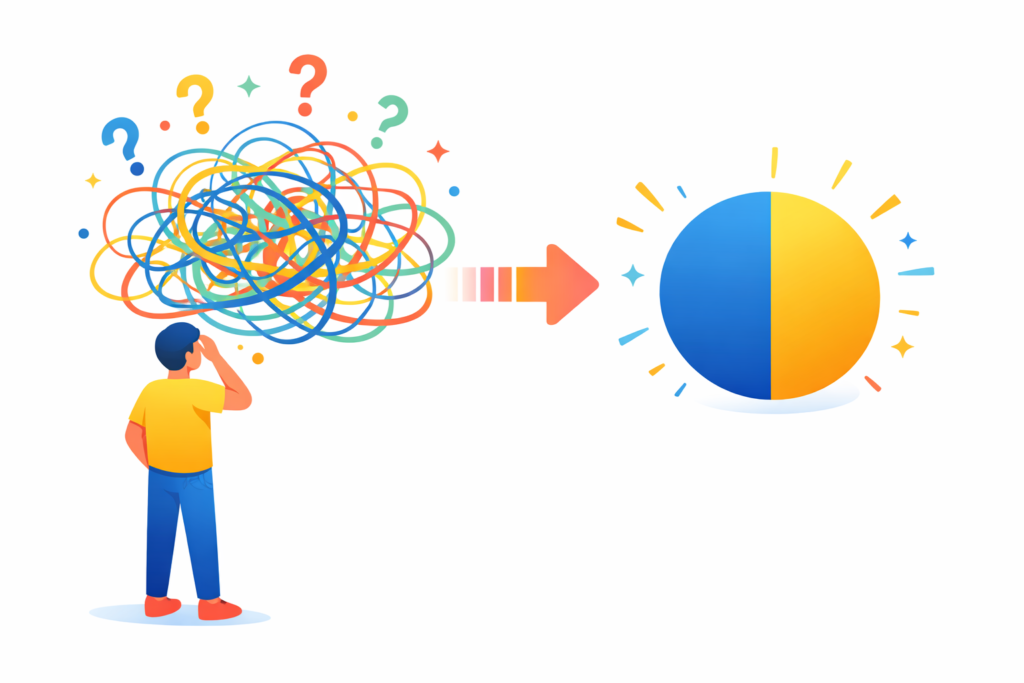
Have you ever found yourself saying:
— ‘I’m struggling to explain this.’
— ‘I know what I mean, but I can’t say it properly.’
— ‘Let me try that again . . . ‘
And then, after a few attempts, you feel frustrated, as if the words are just out of reach. Most of us assume that this is a communication problem. That if only we could find the right words, everything would be clear. However, here is the surprising truth: most of the time, the problem is not communication; it is decision. It is not a failure of language. It is a lack of definition.
The Illusion of Knowing
We often feel like we know something long before we actually do. That vague intuition, a direction, a cluster of loosely connected ideas, they give us a false sense of certainty. We think we understand because of a gut feeling. We believe we have a grip because of a general sense of ‘this much is true’. But that is just the surface. Beneath it, the idea is still in motion. Language struggles because the idea itself is not settled yet.
How This Shows Up in Language
When ideas are still in flux, our words betray us. Sentences get longer as we try to clarify. Explanations become repetitive; for example, ‘It’s like this, but also like that . . . ‘. We replace definitions with examples, hoping they will do the work. Clarity slips away, again and again.
You are not failing to explain the idea. You are trying to explain something that has not stabilised yet.
The Real Work
Clear communication is built on clear decisions. Before you can explain, you need to decide the following:
—What exactly is this?
—What is it not?
—What is the core idea?
—What can be removed?
Every good explanation is a map of these invisible decisions.
Why People Avoid This
Deciding is harder than explaining. Why? Because
—it forces you to exclude possibilities.
—it requires commitment to a specific definition.
—it risks being wrong. What if your decision is not right?
It feels easier to keep rewriting sentences than to confront the ambiguity head-on.
This is not just theory. It shows up everywhere, such as in the following scenarios:
—Founders who cannot clearly articulate what their company does.
—Consultants who over-explain frameworks, trying to cover all bases.
—Educators with content but no clear structure.
—Teams caught in endless revisions, unable to settle on a single narrative.
The surface problem looks like communication. The real problem is undecided thinking.
At a deeper level, language work is not about making your words better. It is about forcing clarity, defining boundaries, stabilising meaning. The goal is not to say it more beautifully. It is to decide what ‘it’ actually is.
Why This Matters
Why should you care? Because
—unclear ideas lead to unclear communication;
—poor clarity weakens your positioning;
—it slows decision-making; and
—ultimately, it damages your credibility.
Undefined ideas are not just vague They are ineffective.
Closing Reflection
Next time you feel stuck trying to explain something, resist the instinct to rewrite or rephrase. Instead, ask yourself, ‘What is the hardest question I can ask about this idea?’ And the, finally, ask yourself, ‘Have I actually decided what I mean?’
If you are working on something where the idea still feels unstable, remember: it may not need better wording; it may need clearer decisions.
Decide first. Then communicate.
Discover more from Methods and Musings
Subscribe to get the latest posts sent to your email.