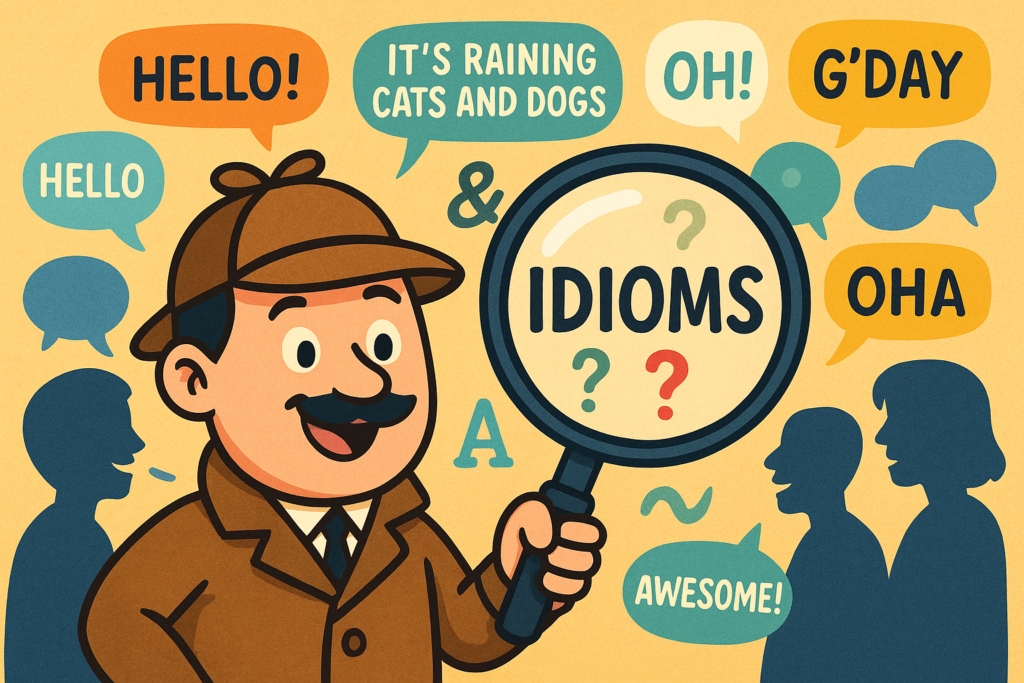
Imagine walking into a room and overhearing a conversation. The words, tone, and rhythm immediately give you hints about the speakers’ backgrounds, feelings, and intentions, even if you do not understand every word. What if you could sharpen that skill? What if, as a language learner or teacher, you could become a ‘linguistic detective’, noticing subtle clues that reveal more than just the literal meaning of words?
Welcome to the fascinating world of sociolinguistics and discourse analysis — fields that explore how language functions in social contexts. This blog post will guide you through the art of ‘reading’ people through their English, transforming everyday listening into an investigative adventure. By paying close attention to word choice, grammar, tone, and pragmatics, you can unlock a treasure trove of social cues, cultural insights, and emotional states that lie beneath the surface of spoken language.
Let us embark on this journey, one clue at a time. Whether you are a learner eager to deepen your understanding or a teacher aiming to make your classes more engaging, this exploration will help you listen more deeply and think more critically about the language you encounter every day.
The Language Clues We All Miss
Most of us focus on understanding ‘what’ is being said, or on comprehending vocabulary and grammar. But the real treasure lies in ‘how’ it is said. Every conversation is a puzzle, filled with small clues that, when pieced together, reveal the speaker’s identity, mood, or intent.
Word Choice: The Subtle Signatures
Words are like fingerprints. They carry traces of a person’s background, education, and social influences. For example, consider two speakers discussing the same topic:
—’I need to complete the task.’
—’I gotta finish this thing.’
The first statement sounds formal and precise, perhaps reflecting a professional setting or a person from a more conservative background. The second, with ‘gotta’ and ‘thing’, suggests informality, possibly a younger individual or someone from a casual environment.
In India, for example, you might hear a professional say, ‘We need to strategise our approach,’ while a student might prefer ‘Let’s plan how to do it.’ The choice of words can reveal regional dialects, levels of education, or even social class.
Accent vs Word Choice
While accent is often the first clue to someone’s origin, it is not always the most revealing. People can modify their pronunciation over time, but their word choices tend to remain more stable and indicative of their background.
For example, an Indian professional working in the United States may adopt a neutral accent but still prefer local terms or idioms. Conversely, someone with a strong regional accent might choose vocabulary that aligns with their community.
Therefore, while accent often signals regional origin, such as the distinct pronunciations of ‘th’ sounds in Indian English dialects, word choice can sometimes tell a more nuanced story. For example, two speakers from Kerala might share a similar accent but differ in their vocabulary, with one using more Sanskrit-derived words and the other favouring colloquial terms. Similarly, a person from Australia might say ‘arvo’ for ‘afternoon,’ while someone from the UK might say ‘afternoon’ in a different tone and context. These choices help us understand not just where someone is from, but also their social circles and their exposure to different forms of English.
The key takeaway is to pay attention to ‘what people say’ as much as ‘how they say’ it. Both clues together provide a fuller picture.
Grammar as a Fingerprint
Small grammatical structures can be surprisingly revealing. They often serve as linguistic fingerprints, revealing regional, social, or educational influences.For instance, the use of ‘done’ in place of ‘did’, common in Indian English, can indicate regional influence:
—’I done it yesterday.’
This construction is often seen in certain dialects and regions, and recognising it helps you pinpoint a speaker’s linguistic background.
Similarly, the use of present perfect versus simple past can hint at different language influences:
—’I have seen that movie.’ (general American or British English)
—’I saw that movie.’ (more straightforward, possibly regional or informal)
Paying attention to these small details can help you identify where a speaker might be from or what kind of English they are using. Moreover, recognising these patterns helps you understand not just individual speakers but also broader linguistic trends.
How People Reveal Where They Are From, Their Level of Formality, and Even Their Confidence Through Subtle Language Choices
Language is not just a communication tool; it is also a mirror reflecting personal identity, social context, and emotional state. Here is how different aspects of language offer clues about the speakers.
Regional and Cultural Origins
Regional accents are the most obvious clues, but vocabulary and idioms can be equally telling. For example, in India, a speaker from Punjab might say ‘Chalo‘ (meaning ‘Let’s go’), whereas someone from Tamil Nadu might prefer ‘Vandhaal‘ (meaning ‘If you come’). Recognising such words and phrases can help you identify regional origins even if accents are subtle.
Formality Levels
The choice of polite markers, titles, and sentence structures signals formality:
—’Could you please assist me?’ (formal, polite)
—’Can you help me?’ (casual, direct)
In many cultures, including India, using titles such as ‘Sir,’ ‘Madam’ or their regional equivalents can indicate respect or social hierarchy. Conversely, dropping these markers might reflect familiarity or casualness.
Confidence and Uncertainty
Hesitations, fillers, and certain modal verbs reveal emotional states.
—’I think maybe we should . . . ‘ (uncertainty)
—’We will definitely succeed.’ (confidence)
A speaker might say, ‘I think it’s probably right,’ indicating politeness or uncertainty, whereas in another context, directness might signal confidence or assertiveness.
Politeness Markers
In many cultures, politeness is integral. In Indian English, speakers often use ‘please’ and ‘kindly’, with the latter as a synonym for ‘please’ being an exclusively Indian usage. For example:
—’Please do the needful.’
This expression, common in Indian bureaucratic language, might seem formal or old-fashioned elsewhere but signals respect and formality.
Hesitation and Fillers
Words such as ‘uh’, ‘um’, or ‘well’ usually indicate hesitation or uncertainty. However, they sometimes also indicate politeness. A speaker’s use of these can reveal their comfort level or emotional state.
Directness and Indirectness
Some cultures value direct communication, whereas others favour indirectness to preserve harmony. Recognising this in English can help you interpret whether someone is confident, diplomatic, or avoiding confrontation.
Your Turn: Become a Language Sleuth
Now that you understand the clues — word choice, accent, grammar, tone — it is time to practice.
Practical Listening Exercises
1. Choose a Conversation: Select a short clip of natural speech, such as an interview, a casual chat, or a speech.
2. Listen Actively: Focus not only on the main message but on specific details, such as words, phrases, pronunciation, and tone.
3. Jot Down Clues: Write down at least three observations about the speaker’s background, mood, or social context, based solely on their English.
4. Reflect: Consider how these clues fit together. Do they suggest regional origin? Confidence? Formality?
Final Thoughts
Language is a rich tapestry woven with threads of history, culture, personality, and emotion. As language detectives, your goal is to notice the details, which are those subtle clues that reveal more than the words themselves. This skill not only enhances your understanding of others but also deepens your appreciation for the diversity and complexity of English worldwide.
By sharpening your listening and observation skills, you become more empathetic and effective communicators. Remember, every conversation is a mystery waiting to be unraveled.
Discover more from Methods and Musings
Subscribe to get the latest posts sent to your email.