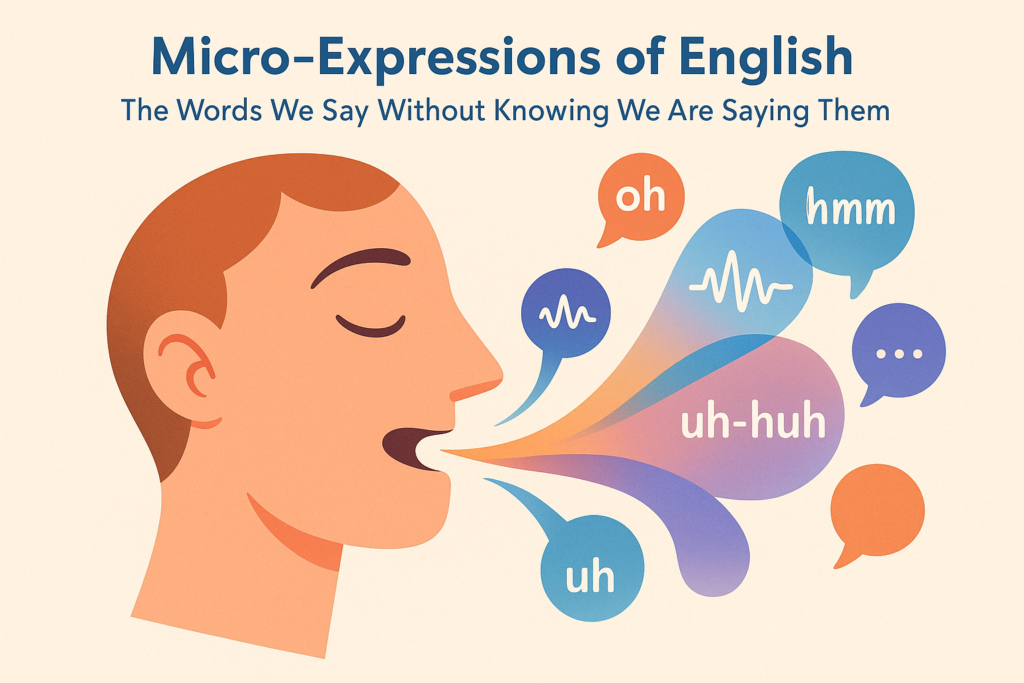
Before we speak in full sentences, before we articulate complex thoughts, there exists a subtle layer of communication that often goes unnoticed: the tiny sounds and utterances we produce, those fleeting syllables, sounds, and cues that are so ingrained in our speech that they pass by almost invisibly. These micro-expressions of language form a hidden fabric woven into our everyday conversations, shaping meaning, emotion, and social connection in ways that words alone cannot fully capture.
Imagine a conversation where someone says, ‘That’s interesting,’ but their tone, facial expression, and accompanying sounds reveal scepticism or doubt. Or consider how a simple ‘huh?’ can signal confusion, challenge, or curiosity, depending on context and intonation. These small verbal cues are the sounds beneath the words — the ‘micro-expressions’ of language — that often happen unconsciously but hold immense communicative power.
This leads us to a compelling question: what can these tiny sounds tell us about how English and other languages truly work? How do these micro-expressions shape our interactions, reveal our inner states, and influence communication beyond the literal meaning of words? Exploring this hidden layer of language offers not only linguistic insight but also a path towards deeper cultural understanding.
What Are Linguistic Micro-Expressions?
Linguistic micro-expressions are the subtle, non-lexical vocalisations, discourse markers, and minimal response cues that punctuate speech. They are not part of the core vocabulary but serve essential functions in managing conversations, expressing attitudes, or signalling emotional states.
Some common examples include the following:
—Non-lexical vocalisations (NLVs): ‘oh’, ‘ah’, ‘huh’, ‘hmm’, ‘uh-huh’, ‘mm’, ‘right’, ‘OK’, ‘like’, ‘you know’.
—Prosodic features: uptalk (rising intonation at the end of statements), breathy laughter, sighs.
—Discourse markers: ‘so’, ‘well’, ‘anyway’, ‘actually’, ‘basically’.
—Minimal responses: ‘yes’, ‘no’, ‘really’, ‘sure’, ‘yeah’.
It is crucial to understand that these are not mere fillers or hesitations but functional signals that help structure conversation, express agreement or disagreement, convey engagement, or manage social harmony. They often carry more meaning than their surface form suggests, acting as micro-expressions of attitude, emotion, or social intent.
The Psychology of Tiny Sounds: What They Reveal Even When We Do Not Mean Them To
Emotional Leakage
Micro-expressions often reveal genuine feelings beneath the surface of spoken words. For example,
—an ‘oh’ uttered with rising intonation might indicate surprise or realisation;
—a drawn-out ‘hmm’ can show evaluation or scepticism; and
—soft laughter can express warmth, friendliness, or mild embarrassment.
These cues are often involuntary, revealing emotional states that the speaker might not consciously intend to disclose. Such ’emotional leakage’ provides listeners with a window into the speaker’s true feelings.
Cognitive Load
People tend to produce more disfluencies, such as ‘uh’, ‘um’, and ‘huh’, when processing difficult or unfamiliar information or when formulating complex ideas. For instance, a student explaining a challenging concept might frequently say ‘uh’ or ‘huh?’ These sounds indicate cognitive effort, not incompetence, but they often get misinterpreted by learners or listeners unfamiliar with their function.
Affiliation and Rapport
Micro-expressions also serve social functions. Consider the following examples:
—’Mm-hmm’ or ‘uh-huh’ signals attentive listening and agreement.
—Soft laughter or chuckles can foster rapport, soften disagreement, or signal shared understanding.
The way we use these cues helps us navigate social hierarchies, establish trust, and maintain politeness.
The Sociolinguistics of Micro-Expressions
Every Community Has Its Own Micro-Sound Signature
Different cultures and communities develop their own ‘micro-sound signatures’, which are the specific sounds and cues they use to manage conversation. Take the following for example:
—British English speakers may frequently end statements with ‘right?’ to seek confirmation.
—American speakers often use ‘OK?’ or ‘you know’ as discourse markers.
—In India, words such as ‘haan [yes/yeah]’ or ‘achha [OK/understood]’ serve similar functions, embedded within English speech because of linguistic contact.
Similarly, teenagers may pepper their speech with ‘like’ or ‘literally’, whereas academics might favour ‘so’ or ‘therefore’ to introduce arguments, while workplace communication often relies on ‘right’ or ‘OK’ to maintain flow.
Power, Status, and Gender
Micro-expressions are also intertwined with social dynamics.
—Uptalk (or rising intonation at the end of statements) has been stereotyped as indicating uncertainty but, in fact, can serve as a tool for ‘keeping the speaker in the conversational floor’ or ‘checking for alignment’.
—The use of backchannels (‘mm’, ‘uh-huh’) varies with power and status. Higher-status speakers may produce fewer, whereas lower-status speakers produce more to signal engagement and avoid interruption.
—Gendered differences are also notable. Women, historically, have been socialised to use more affiliative cues, such as soft laughter or frequent backchannels, to maintain social harmony.
Micro-Sounds as Social Glue
Beyond individual expression, these micro-expressions regulate turn-taking, politeness, and face-saving strategies. They act as social glue, ensuring conversations flow smoothly and avoiding face-threatening acts such as abrupt interruptions or disagreements.
Why Learners Struggle With Micro-Expressions
Despite their importance, micro-expressions are rarely taught explicitly in language classrooms. Learners often focus on vocabulary, grammar, and pronunciation, neglecting the vocal nuances that carry social and emotional meaning.
This oversight can lead to misunderstandings. For example,
—interpreting ‘hmm’ as approval when it actually signifies doubt;
—missing signs of disagreement masked by a polite ‘OK’;
—failing to recognise when a speaker is hesitating or evaluating, leading to misjudging their confidence or attitude; and
—taking a ‘sure’ said with a flat tone as genuine agreement, while the speaker’s tone and accompanying sounds might reveal reluctance or sarcasm.
The Global Variation of Tiny Sounds
Micro-expressions are not universal; they vary across languages and cultures. Recognising this diversity is vital for effective intercultural communication.
—In Japanese, ‘hai [yes]’ can be a simple acknowledgment, whereas ‘ee’ or ‘un’ serve as backchannels.
—French speakers often use ‘mm’ or ‘ben [well/so]’ as filler or acknowledgment.
—Hindi speakers frequently use ‘achha [right]’ or ‘ha [yes]’ in conversational turns.
English itself has absorbed micro-expressions from immigrant communities:
—Indian English speakers often incorporate ‘yaar [friend]’ or ‘wala [used as a possessive particle]’ into speech.
—Middle Eastern immigrants may use ‘inshallah [God willing]’ or ‘habibi [my dear]’ as social signals within English conversations.
This linguistic melting pot makes the micro-soundscape of English especially rich and diverse, reflecting global interconnectedness.
AI, Voice Assistants, and the Challenge of Non-Lexical Sounds
As artificial intelligence (AI) advances, voice assistants and chatbots are increasingly expected to understand and produce natural speech. However, capturing micro-expressions remains a significant challenge:
—Many AI systems misinterpret ‘mm-hmm’ or ‘uh-huh’ as background noise rather than meaningful responses.
—They struggle with prosody, that is, the rise and fall of intonation that conveys intent.
Consequently, AI often produces unnatural or contextually inappropriate responses, highlighting the depth of human micro-expressions. This technological gap underscores how embedded these tiny sounds are in human communication, so much so that replicating them remains an ongoing frontier for AI development.
Can Micro-Expressions Be Taught? (And Should They?)
Given their importance, should language educators attempt to teach micro-expressions explicitly? Considering how crucial micro-expressions can be in everyday conversations and how interpreting them correctly can be a useful social tool, introducing them to learners can be rather beneficial.
A few practical strategies are as follows:
—Listening to authentic conversations: podcasts, interviews, and dialogues, to attune learners’ ears to natural cues.
—Shadowing exercises: mimicking speech patterns, intonation, and micro-expressions.
—Noticing prosodic contours: paying attention to pitch, rhythm, and pauses.
—Cultural awareness: understanding the micro-sound signatures of different communities.
However, it is essential to approach this teaching with cultural sensitivity. Not all cues translate directly across cultures, and overemphasis on imitation can lead to unnatural speech. Instead, focus on increasing learners’ awareness, fostering perceptive listening, and encouraging authentic interaction.
Conclusion: The Secret Language Inside English
Micro-expressions are the hidden grammar of our emotional and social worlds. They shape how we reveal and interpret feelings, build rapport, and navigate social hierarchies — all beneath the surface of our words. By becoming aware of these tiny sounds, language learners deepen their listening skills and cultural competence. They learn not just to understand words but to grasp the unspoken, the subtle cues that give language its richness and depth. In essence, these micro-expressions embody a secret language, one that reveals the core of human connection. Sometimes, the most meaningful parts of language are the ones we never consciously learn but are instinctively wired to perceive.
So next time you listen to a conversation, pay attention to the tiny sounds, or the ‘micro-expressions of English’, and discover the subtle art of saying without words.
Discover more from Methods and Musings
Subscribe to get the latest posts sent to your email.