English has long enjoyed a reputation for being a language of efficiency, logic, and emotional restraint. Unlike some languages that are celebrated for their poetic expressiveness or passionate tone, English often appears to be reserved, even stoic. It is the language of science, technology, business, and diplomacy — domains where clarity and precision are prized over raw emotion.
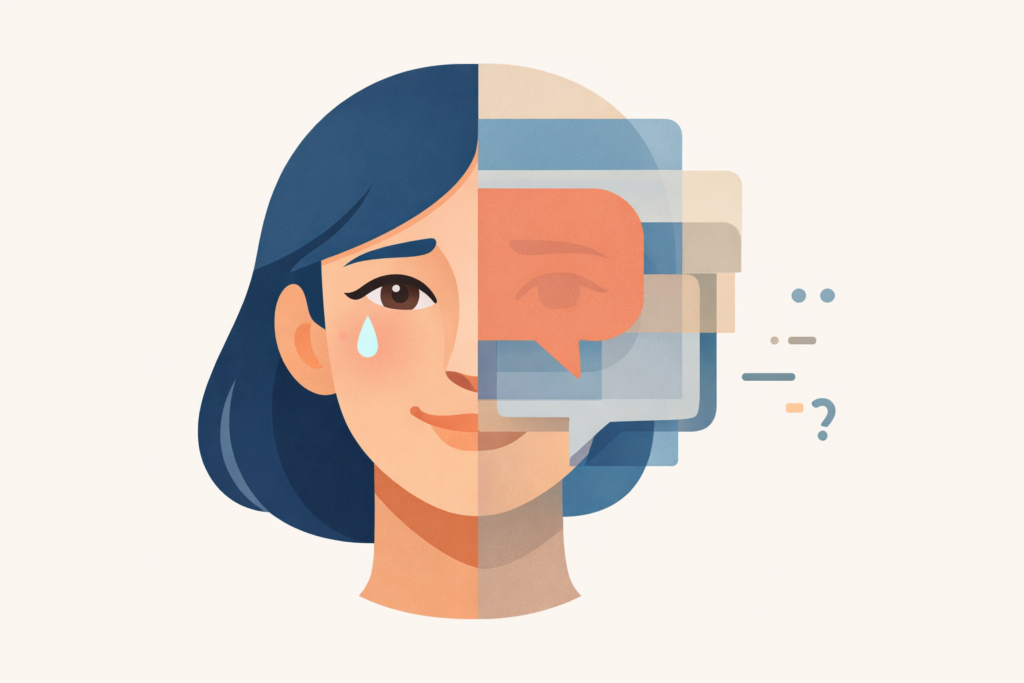
However, beneath this veneer of rationality lies a complex web of subtle emotional signals. What if the reason English feels so restrained is not because it lacks emotion but because it chooses to hide it, particularly in its grammar? What if the very structures of English serve as a kind of emotional filter, allowing speakers to express feelings carefully, indirectly, or even invisibly?
In this exploration, we will see how English’s grammatical choices serve as emotional shields and channels, revealing and concealing feelings in ways that are both deliberate and nuanced. This is not about language that is emotionless; it is about language that is emotionally careful.
Emotion Without Emotion Words
In many languages, emotions are explicitly named and vividly expressed through vocabulary: for example, love, anger, joy, sorrow. English, however, often expresses feelings indirectly, relying on grammatical structures and pragmatic cues rather than emotional lexicon.
Consider a few common expressions:
—’I’m fine.’
—’It’s a bit much.’
—’That’s . . . interesting.’
These are not overt declarations of emotion. Instead, they use neutral or vague language, often supported by tone, context, or subtle grammatical cues. The expression ‘I’m fine’ does not necessarily mean the speaker is truly untroubled. It is a guarded response that can mask a storm of feelings.
In English, grammar and pragmatics (the context of use) do much of the emotional work that adjectives or explicit words might do in other languages. The language’s structure often acts as a filter, allowing speakers to hint at, hide, or soften their feelings.
The Grammar of Distance: Protecting the Self
English employs various grammatical strategies to create distance between the speaker and their feelings:
—Passive voice: ‘I got hurt.’
Instead of ‘I hurt myself’, the passive construction makes the emotion less direct, less personal.
—Dummy subjects: ‘It bothers me.’
The use of ‘it’ as a placeholder shields the speaker from explicitly owning the feeling.
—Abstract nouns: ‘There’s some tension.’
Here, feelings are packaged into abstract concepts, making them less immediate.
These structures serve as emotional buffers, allowing speakers to acknowledge feelings without full exposure. They can express vulnerability while maintaining social or personal safety. This reflective distance is particularly valuable in formal contexts or cross-cultural interactions where direct emotional expression might be considered inappropriate or uncomfortable.
Modality: Feelings as Possibility, Not Fact
Modal verbs (e.g. might, could ) and words and phrases employed for ’emotional hedging’ (e.g. seems, feels like) are central to this emotional moderation. Contrast the following two sentences:
—’I’m angry.’ (a definitive statement)
—’I might be a little frustrated.’ (a tentative, hedged statement)
The first asserts an emotion as an undeniable fact; the second softens it, making it negotiable and less threatening. This hedging allows speakers to express feelings while maintaining social harmony or avoiding confrontation.
By framing emotions as possibilities, English speakers negotiate emotional risk. Feelings become more socially acceptable when they are presented as uncertain or tentative, which encourages openness without vulnerability.
Tense and Aspect: How Long Feelings Last
The tense and aspect system of English further modulate how feelings are perceived:
—’I was upset.’ (past, completed feeling)
—’I’ve been feeling low.’ (ongoing, recent experience)
—’I get anxious.’ (habitual or current state)
The choice of tense and aspect frames emotions as transient, ongoing, or habitual. For example, ‘I was upset’ suggests a feeling that has passed, whereas ‘I’ve been feeling low’ indicates a current, ongoing state. This grammatical framing influences how listeners interpret the intensity and duration of feelings.
Prepositions and Emotional Direction
Prepositions in English specify the target or source of emotion. For example:
—Angry at/angry with
—Hurt by/hurt over
—Happy for/happy about
Prepositions help specify the emotional focus, such as whether someone is angry at a person, or upset over an event, or happy for someone. They also reflect moral or social alignment, positioning the feeling within a relational context.
Pronouns and Emotional Exposure
English offers different ways to express emotions, from highly personal to more detached:
—’I feel hurt.’ (personal, vulnerable)
—’That was hurtful.’ (impersonal, less vulnerable)
The first offers a first-person expression of emotion, whereas the second is an impersonal framing of the same emotion.
Similarly, English often favours shared or abstract forms of emotion, which can serve as a buffer against personal vulnerability:
—’We’re concerned.’ (shared/collective emotion)
—’I’m concerned.’ (individual emotion)
Expressing feelings through collective or impersonal language can diffuse the emotional impact, and English understands as well as utilises that.
Politeness as Emotional Masking
English speakers frequently use politeness strategies to cushion emotional expression, such as the following:
—Apologies: ‘Sorry to bother you.’
—Indirect requests: ‘Could you please . . . ‘
—Understatement: ‘It’s just a small issue.’
Taking the first exmaple, saying, ‘Sorry to bother you,’ is less direct and emotionally vulnerable than a blunt demand. It is a softening strategy that acts as a social buffer that preserves harmony and moderates potential conflict.
This tendency reflects cultural norms around emotional regulation, politeness, and social harmony, which are values deeply embedded in English-speaking societies.
Why English Learners Find Emotion Hard
Many language learners find English’s emotional subtlety perplexing. Literal translations often fail because they miss the grammatical cues that carry emotional meaning.
Mastering emotional expression in English involves more than vocabulary. It requires understanding how grammar shapes feelings. Emotional fluency is, in essence, grammatical fluency.
Digital English: Emotion Finds New Channels
In the digital age, new tools and platforms provide alternative channels for emotional expression, for example:
—Emojis and GIFs
—Voice notes and audio messages
—Reaction buttons (like, love, angry, laughter)
—Informal punctuation (e.g. exclamation marks)
These digital elements compensate for the grammatical restraint of traditional English. They allow speakers to communicate emotion directly and vividly, often bypassing the subtle grammatical filters discussed earlier.
Teaching and Learning Implications
A few things that teachers can do are
—teaching emotional grammar explicitly, highlighting structures such as passive voice, hedging, and abstract nouns; and
—comparing direct expressions (‘I am angry’) with indirect or hedged ones (‘I might be upset’).
As for learners,
—focus on mastering grammatical structures first, then add emotional nuance; and
—practise recognising and using different grammatical ways to express feelings.
A practical tip for teachers would be to encourage learners to read between the lines, that is, identify how grammatical choices signal emotion, before trying to express their own feelings.
Conclusion: Feeling Between the Lines
English does not deny emotion; it simply asks us to read between the lines, between structures, and within context. Its grammar acts as both a shield and a subtle communicator of feelings — sometimes hiding, sometimes revealing.
In English, emotion is not announced; it is negotiated.
By understanding these grammatical nuances, learners can develop a richer, more sophisticated emotional literacy, one that balances authenticity with social harmony, clarity with subtlety. As we navigate the careful emotional landscape of English, we learn not only a language but also the art of feeling wisely and wisely feeling.
Discover more from Methods and Musings
Subscribe to get the latest posts sent to your email.