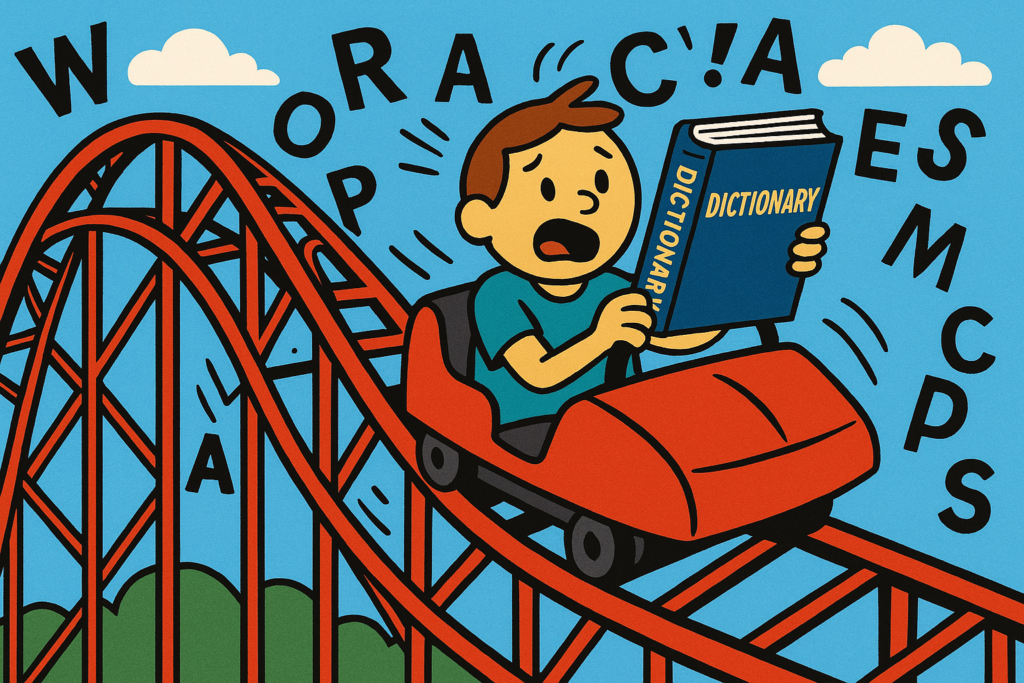
Imagine this: you are confidently chatting in English, perhaps telling a funny story or expressing your thoughts with ease. The words flow; your pronunciation feels natural; and you are riding high on a linguistic wave of accomplishment. Then, suddenly, the next day, or even just a few hours later, you find yourself staring blankly at a sentence, struggling to recall simple vocabulary, and feeling like your brain has hit a brick wall. Welcome to the wild, unpredictable rollercoaster of learning English.
If this scenario sounds familiar, you are not alone. The emotional highs and lows of acquiring a second language are universal, often leaving learners feeling both frustrated and strangely hopeful. But what is really happening beneath the surface? Why does English sometimes feel like an effortless breeze and other times a daunting mountain? In this blog post, we will explore the fascinating science and psychology behind this phenomenon, along with practical strategies to ride the rollercoaster with confidence.
The Highs and Lows of Learning: Stories Learners Will Recognise
Let us start with some common stories that resonate across the globe. You might have experienced a day where everything clicked: you nailed a presentation, understood a joke, or had a fluid conversation with a native speaker. Maybe you even received compliments on your fluency or pronunciation. It felt like your brain had unlocked a secret door, revealing your hidden language prowess.
But then, just days later, you are in a different situation — perhaps trying to understand a new slang term or recall a word you used effortlessly before — and suddenly, everything feels foreign. You stumble over basic vocabulary, hesitate, or revert to your native language. These fluctuations can seem random, leaving learners questioning their progress or self-worth.
In India, for example, many learners experience this when transitioning from classroom learning to real-world communication. They might excel in grammar exercises but freeze when trying to speak spontaneously with a native speaker in a bustling market. The inconsistency can be disheartening, but it is a natural part of the process.
The Brain at Work: Cognitive Foundations of Language Fluctuations
So, what is happening inside our brains during these peaks and valleys? To understand this, we need to delve into some fundamental concepts from cognitive psychology and neuroscience.
Memory Retrieval and Interference
Language learning relies heavily on memory, especially the ability to retrieve words, phrases, and rules quickly. When you learn a new vocabulary set, your brain encodes these words into long-term memory. However, retrieving them is not always straightforward. Sometimes, your brain gets ‘confused’ by similar words from your first language (L1), leading to ‘interference’.
This phenomenon, which is called ‘interference’, is a normal part of bilingual or multilingual cognition. During moments of high cognitive load, that is, when you are trying to speak quickly or think on your feet, interference can cause retrieval failures, making you feel like you have ‘lost’ your English.
Mental Fatigue and Cognitive Load
Another factor is ‘mental fatigue’. Language processing is demanding, especially when juggling multiple tasks, namely listening, speaking, thinking, and monitoring accuracy simultaneously. When your cognitive resources are stretched thin, for example after a long day or during stressful situations, you are more prone to forgetfulness and errors.
This is why you might feel confident in the morning but struggle after a tiring day. It is like trying to run a marathon on empty: you simply do not have the mental energy to perform at your best.
The Role of Emotions: Confidence, Stress, and Sleep
Your emotional state plays a crucial role in language performance. Think of your brain as a sensitive instrument. Its ability to function optimally depends on your feelings and physical well-being.
Confidence and Anxiety
High confidence can unlock your fluency, making speech feel natural and spontaneous. Conversely, anxiety and fear of making mistakes activate the ‘affective filter’, a concept introduced by Stephen Krashen, which hampers your ability to process and produce language. When you are nervous, your brain filters out input and output, leading to the ‘blank mind’ moments.
Stress and Sleep
Stress increases cortisol levels, impairing memory and cognitive flexibility. Similarly, lack of sleep hampers your ability to recall vocabulary and process complex language structures. That is why you might find it hard to remember a word after a restless night but recall it easily after a good night’s sleep.
Plateaus and Illusions: Why Progress Is Not Linear
One of the most frustrating aspects of language learning is hitting plateaus — periods where it feels like you are not making any progress. This is a common misconception: progress is not always linear or obvious. Instead, it is often messy, with periods of apparent stagnation followed by leaps forward.
These illusions can be discouraging, but they are essential markers of deep learning. During plateaus, your brain is consolidating new knowledge, strengthening neural pathways, and integrating skills. It is like planting a seed; growth is underground before sprouting above ground.
In India, many learners experience this when preparing for language proficiency exams like IELTS or TOEFL. They may get stuck on certain grammar points or pronunciation challenges, feeling like they are not improving. However, with consistent effort, these hurdles eventually give way to noticeable progress.
Riding the Rollercoaster: Practical Tips to Stay Steady
Understanding the science behind these fluctuations can empower you to navigate them more effectively. Here are a few practical strategies.
Embrace Micro-Habits
Small, daily habits are the building blocks of fluency. Instead of overwhelming yourself with massive study sessions, incorporate brief but consistent activities, such as listening to a song in English, jotting down new words, or practising a quick conversation. Over time, these micro-habits create a resilient foundation that withstands mood swings and fatigue.
Track Wins and Celebrate Small Victories
Keeping a journal of your achievements, whether it is successfully ordering food in English or understanding a complex article, can boost your confidence. Recognising progress, even in tiny steps, reinforces positive emotions and motivates continued effort.
Reframe ‘Bad’ Days
When you hit a low point, remind yourself that inconsistency is normal. Instead of viewing mistakes or forgetfulness as failures, see them as part of the learning process. Think of it as riding a rollercoaster: ups and downs are expected, and the ride itself is what makes the experience exciting and meaningful.
Manage Stress and Prioritise Sleep
Create a supportive environment for language learning. Practise mindfulness, breathing exercises, or short breaks during study sessions. Prioritise good sleep hygiene, as adequate rest is crucial for memory consolidation and emotional resilience.
Use Context and Multiple Modalities
Engage with English in various ways, such as reading, listening, speaking, and writing. Contextual learning helps your brain form stronger associations, making retrieval easier during high-pressure moments.
Final Thoughts: You Are Not Alone on the Ride
The emotional rollercoaster of learning English — feeling confident one day and lost the next — is a shared human experience. It is driven by complex cognitive, emotional, and physiological factors that are well understood in the fields of psychology and neuroscience. Recognising that these fluctuations are natural can help you develop patience, resilience, and a compassionate attitude towards yourself.
Remember, language learning is not a straight line but a winding journey filled with surprises, setbacks, and breakthroughs. Each ‘impossible’ day is a sign that your brain is working hard, consolidating skills, and moving towards mastery, even if it does not feel like it in the moment. After all, every rollercoaster ride makes for a memorable story — and a stronger learner.
The ups and downs are part of the adventure. Keep riding, keep learning, and trust that every twist and turn is bringing you closer to fluency.
Discover more from Methods and Musings
Subscribe to get the latest posts sent to your email.