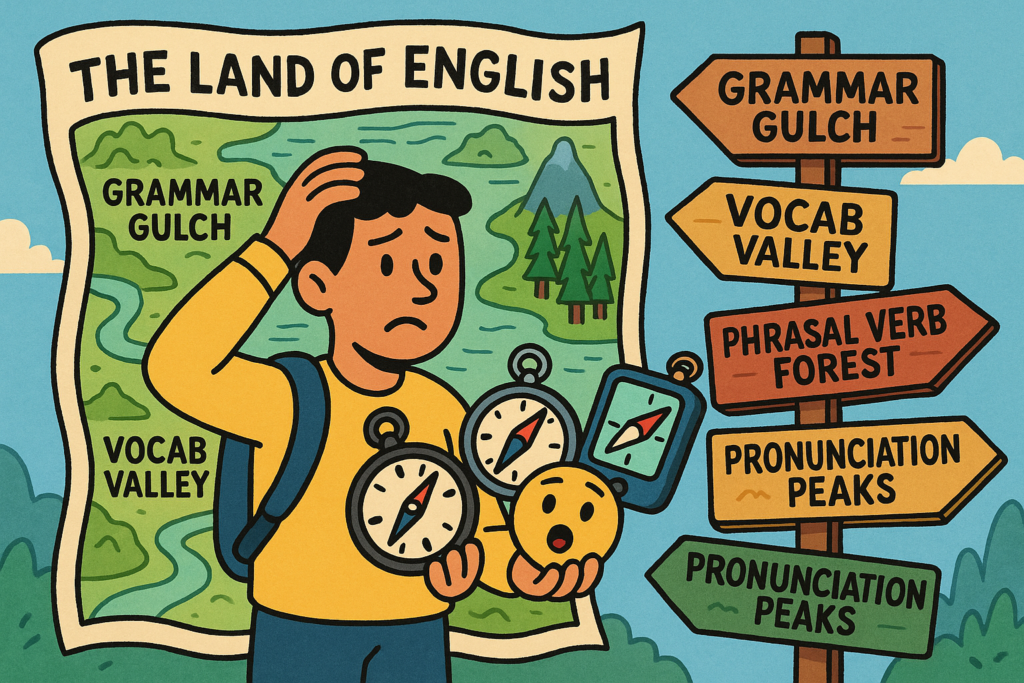
Imagine standing in the middle of a vast, unfamiliar city. You want to find your way to a famous monument, but all you have is a map that seems to show only narrow alleyways and distant landmarks. Frustrated, you might feel you are simply not cut out for navigation or perhaps the city is too complex. But what if the problem is not your ability to find your way? What if it is that you are reading the wrong map or using the wrong compass?
This metaphor captures a profound truth about language learning: it is not about climbing a mountain or conquering a peak; it is about exploring a vast, intricate landscape. If you feel lost in learning English, it is not because of a personal failure; it is because your mental map might not match the terrain you are trying to navigate.
In this post, we will explore how viewing language as a map, or a form of mental geography, can transform your approach to learning. Instead of seeing yourself as a struggling climber, you will understand yourself as a traveller with a different map, a different compass. With this perspective, you will realise that you are not lost; you are just reading the wrong compass.
The Language Map: What Kind of Learner Are You?
Every traveller needs a map suited to their journey. Similarly, every language learner has a unique style, a preferred way of navigating the linguistic terrain. Recognising your own type is the first step in avoiding frustration and charting a more effective course.
Visual, Auditory, and Kinaesthetic Travellers
Think about how different travellers explore a new city:
—Visual learners prefer to see the landscape: maps, signs, landmarks.
—Auditory learners rely on sounds: street music, conversations, audio guides.
—Kinaesthetic learners need to physically experience the environment: walking, touching, tasting.
In language learning, these preferences translate into different strategies:
—Visual learners might enjoy flashcards, charts, and written dialogues.
—Auditory learners might benefit from podcasts, conversations, and listening exercises.
—Kinaesthetic learners may prefer role-plays, language games, or real-world practice.
Comparing Learner Types: Explorers, Commuters, Tourists, and Settlers
Let us classify learners as different types of travellers:
—Explorers venture into unknown neighbourhoods, eager to discover new words and idioms.
—Commuters focus on daily routines, mastering practical language for work and errands.
—Tourists enjoy sightseeing, along with learning cultural expressions, slang, and idioms.
—Settlers aim for deep immersion, understanding the language in all its nuances.
Mini Self-Diagnostic Quiz
What kind of traveller are you?
(1) Do you feel excited when discovering new idioms and slang?
(a) Yes — you are an explorer.
(b) No — you prefer practical usage.
(2) Do you learn best through listening to conversations?
(a) Yes — auditory.
( b) No — visual or kinaesthetic.
(3) Are you comfortable navigating with a map or do you prefer to find your way by intuition?
(a) Map — structured learning.
(b) Intuition — immersive learning.
Answering these questions helps you identify your style, so you can choose the right tools and avoid feeling ‘lost’.
Getting Stuck in the Grammar Gridlock
Many learners approach English as if it were a complex city governed solely by rules and signs. They rely heavily on grammar charts, rules, and memorisation, believing that mastery of these will unlock fluency.
However, here is the paradox: over-reliance on rule-based learning can cause ‘gridlock,’ especially in real conversations. Rules are like city regulations: useful, but not sufficient. Real language flows through context, intuition, and cultural nuances.
Let us consider an example from India. Many students learn formal Hindi or English rules in school but struggle with colloquial speech when chatting with friends or colleagues. They memorise rules but miss the rhythm of natural conversation.
So what should be done instead?
—Shift from rigid rules to immersive experiences.
—Engage with stories, movies, and conversations.
—Embrace mistakes as part of navigation, not failures.
Think of it like exploring a city: you do not need to memorise every street sign; sometimes, you follow your ears or your instincts to find your way.
Shortcut Highways vs. Hidden Alleys
In the language landscape, there are main roads and hidden alleys.
—Shortcut Highways: memorised vocabulary, common phrases, and set expressions. These are quick routes to basic communication.
—Hidden Alleys: idioms, slang, cultural nuances, and nuanced expressions. These are often overlooked but add richness and authenticity.
Memorisation can be helpful for quick communication, but deep usage involves exploring alleys, which are the subtleties that make language vibrant.
For example, in India, the term ‘timepass’ (meaning casual activity or passing time) is a slang expression that enriches conversations but may not appear in textbooks. Recognising and using such idioms can make your language more natural and engaging.
Therefore, use the main roads to get around, but venture into alleys to discover hidden gems.
Language Fog: What To Do When Everything Looks Foreign
Learning a language often involves periods where progress seems to stall. You might feel you are in a ‘language fog,’ unable to see your way clearly.
This is normal. Think of it as being between landmarks on your mental map. You are not lost; you are in a phase of transition.
Tips for Navigating the Fog
—Celebrate small wins: such as mastering a new phrase or understanding a joke.
—Reset your goals: focus on achievable objectives, such as holding a five-minute conversation.
—Stay motivated: remind yourself why you started and what your destination is.
—Seek new landmarks: watch a favourite show; read a short story; or have a friendly chat.
In India, many learners find that watching regional films or listening to regional music helps them reconnect with the language in a joyful way, creating new landmarks on their map.
Build Your Own Compass
Ultimately, the key to successful navigation is ‘creating your own compass,’;’ which is a personalised strategy that guides your learning journey.
How to Build Your Language Compass:
—Identify your goals: Do you want to speak fluently, understand movies, do business, or study abroad?
—Choose your tools: Input (reading, listening), output (speaking, writing), or a mix.
—Design your routine: Daily practice, conversation exchanges, cultural immersion.
—Adapt and evolve: Your map and compass should change as you progress.
Learner agency is vital. Instead of relying solely on textbooks, decide what methods resonate with you. If you are an Indian learner who loves storytelling, focus on narrative-based learning. If you prefer practical conversations, prioritise speaking practice.
Final Thoughts: You Are Not Lost; Just Reading the Wrong Map
Learning a language is an exploration, not a destination. When you feel ‘lost,’ remember that it is often because you are reading the wrong map or holding the wrong compass. Recognise your unique style; explore the landscape with curiosity; and craft a navigation system that suits your journey.
Your language map is yours to create. With patience, flexibility, and a sense of adventure, you’ll find your way — perhaps discovering shortcuts, hidden alleys, and new landmarks along the way.
If you are interested in visual or interactive maps to guide your learning, I recommend exploring tools such as language learning blogs, apps, and communities that help you chart your personal course.
Remember: you are not lost. You are just reading the wrong compass. Happy exploring!
Discover more from Methods and Musings
Subscribe to get the latest posts sent to your email.