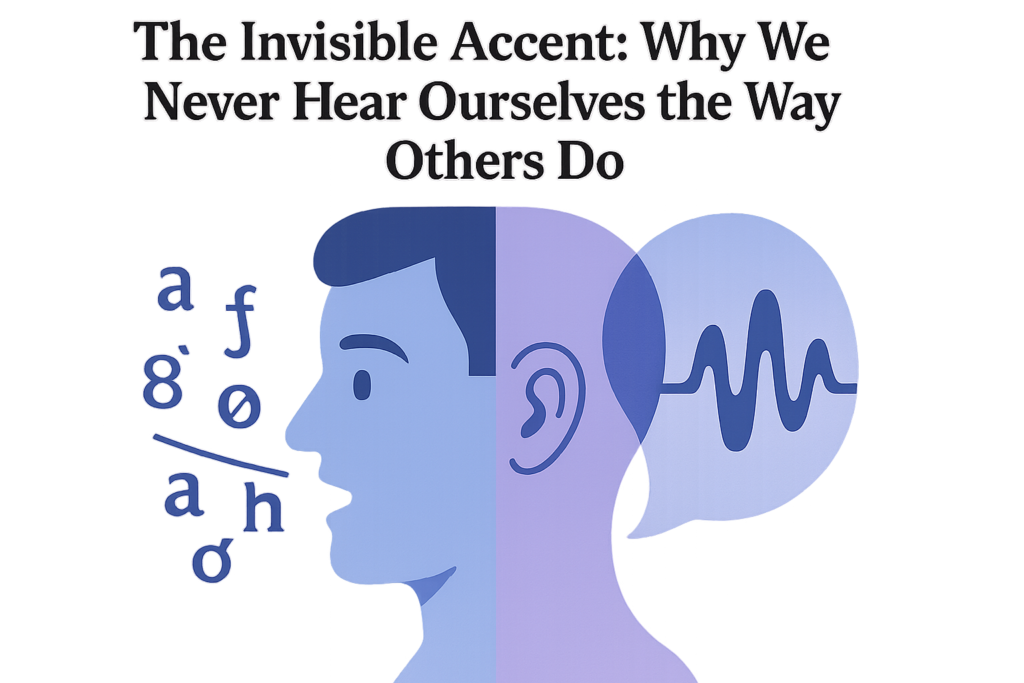
Imagine this: you record a voice message or listen to a video of yourself speaking. Instantly, you notice something strange. You sound different from what you thought you sounded like. Maybe your voice sounds nasal, nasal, or foreign. Perhaps you are surprised at the accent that emerges, one you have never consciously noticed before. This experience is universal. Most of us believe we have no accent, until we hear ourselves objectively, and suddenly, everything sounds different.
This paradox is rooted in a fascinating linguistic and psychological phenomenon: ‘everyone has an accent’, yet most individuals perceive theirs as ‘neutral’ or ‘standard’. It is as if our own voice and speech are invisible, hidden behind a mental veil that filters how we perceive ourselves versus how others perceive us. The question then arises: why does our brain treat our own accent differently from how others hear it?
Understanding this paradox not only deepens our appreciation of language and identity but also reveals the subtle ways in which social power, culture, and cognition shape our perceptions. It invites us to reflect on the invisible layers of our speech, those silent markers of who we are and where we come from, and how they influence our interactions in a globalised world.
What Even Is an Accent? (And Why We Misunderstand It)
Before delving into the mysteries of perception, it is crucial to clarify what we mean by ‘accent’. Often used interchangeably with ‘dialect’, ‘idiolect’, or ‘register’, the term ‘accent’ specifically refers to patterns of pronunciation, that is, the way sounds are articulated, stressed, and intonated.
An accent is shaped by a complex interplay of factors: geography, social class, education, cultural identity, and even personal history. For example, an Indian English speaker might pronounce ‘tomato’ as /təˈmɑːtoʊ/ with a distinctive intonation, while a British RP speaker might say /təˈmɑːto/. Both are Indian and British accents, respectively, but the differences are rooted in regional and social influences.
It is important to distinguish accents from dialects, which also include vocabulary, grammar, and syntax. An accent is primarily about pronunciation patterns. For instance, the difference between American English and Australian English includes accents, vocabulary, and grammar, but the accent component specifically refers to how sounds are produced.
Now, why do many of us perceive our own accent as ‘neutral’? Historically, certain accents, such as Standard British English (RP), General American, or urban educated registers, have become dominant in media, education, and institutions. These ‘standard’ accents are often invisible to those who speak them, leading to the illusion that they are ‘no accent at all’, a notion that is both socially constructed and linguistically misleading.
Why We Cannot Hear Our Own Accent: The Brain’s Default Setting
Bone Conduction and Internal Sound Perception
When we speak, we are not just producing sound vibrations that travel through the air to reach our listener’s ears; we a’re also hearing ourselves through bone conduction. This process involves vibrations travelling through the skull bones, which transmit sound directly to our inner ear. As a result, we perceive our own voice as deeper and richer than others do.
In effect, we are hearing a combination of external sound (what others hear) and internal resonance (bone conduction). This internal mix mutes certain aspects of our speech, particularly the higher frequencies, making our voice sound different from the recording or the external perception.
Cognitive Familiarity → ‘My Voice = Normal’
Our brains are remarkably good at familiarity bias. From childhood, we are exposed to a particular way of speaking, such as our parents, the community, and the education system, and this becomes our linguistic baseline. The accent, intonation, and rhythm we hear daily normalise in our minds.
This mental ‘filter’ means that when we hear ourselves, the version that seems ‘normal’ is the one we are most familiar with. Any deviation from that becomes noticeable, strange, or ‘foreign’. Conversely, when we listen to recordings, we are hearing a version of ourselves that is unfiltered by internal resonance and out of our comfort zone.
The Illusion of Self-Neutrality
Since we rarely listen to ourselves objectively, we assume that our speech is neutral. The accent we hear internally is perceived as the default or standard. This illusion is reinforced by social factors: if our accent aligns with the dominant or prestigious form in our community or society, we are less likely to scrutinise it.
Prestige, Power, and the Social Invisibility of Certain Accents
Why Some Accents Feel ‘Natural’ and Others ‘Strong’
In many societies, accents associated with social power, such as Received Pronunciation (RP) in Britain, Standard American English, or the urban educated registers, are invisible to their speakers. They are perceived as neutral because they dominate formal settings, media, and institutions.
These accents are often perceived as ‘better’ or ‘more professional’, leading speakers to feel no conscious awareness of their pronunciation. Conversely, accents linked to marginalised communities or regions, such as rural dialects or non-standard urban accents, are often loudly marked and conscious.
Media, Schooling, and Authority
The pervasive portrayal of standard accents in television, movies, and educational materials shapes our perception of what ‘correct’ or normal speech sounds like. For example, in India, the Indian English accent taught in schools often aligns with a neutral accent; yet, in reality, India boasts a vast array of regional accents, each with its own musicality and rhythm.
When a speaker from Mumbai, for instance, communicates with a standard accent, they might perceive their own speech as correct, whereas their regional accent might be considered ‘strong’ or ‘foreign’, even though both are valid forms of expression.
Accent Bias: Often Unconscious, Always Influential
Research shows that people unconsciously judge others based on their accent, assuming traits such as intelligence, warmth, or competence. An accent perceived as ‘prestigious’ can open doors, whereas a ‘marked’ accent might inadvertently carry stereotypes.
This bias influences how individuals perceive their own accent. If they believe their way of speaking is less ‘acceptable’, they might try to erase or mask it, often without realising the social pressures involved.
The Shock of Hearing Ourselves: Why Recordings Sound Wrong
Hearing recordings of ourselves often triggers surprise or discomfort. Why? Because listening to an external recording removes the brain’s internal filtering, exposing the raw, unfiltered sound of our voice — accent, pitch, and all.
This external perspective often feels ‘alien’, leading us to conclude that our natural speech is ‘not us’ or that ‘we sound different’. In truth, the recording reveals the very accent we carry, but are usually unaware of on a conscious level.
This moment of discomfort is actually a revelation: our accent has always been there, shaping our speech and identity, but we have never fully heard it until now.
Learners, Identity, and the Myth of the ‘Ideal Accent’
Learners Often Aim for ‘Accentless’, But That Does Not Exist
Many language learners aspire to speak ‘like a native’ or ‘without an accent’, but linguistic experts warn that ‘accentless’ speech is a linguistic mirage. Every speaker’s voice bears traces of their linguistic and cultural background.
Trying to erase an accent often results in a strain and can undermine authentic communication. Instead, focusing on clarity, intelligibility, and expressiveness is more productive.
Identity and Accent Ownership
For many learners, their accent is intertwined with their cultural identity. Negotiating between their first language (L1) and second language (L2) involves complex feelings of pride, aspiration, and sometimes, insecurity.
In India, for example, a person might feel proud of their regional accent but also face societal pressure to adopt a more standard or neutral English accent for professional reasons. This tension underscores the importance of ‘owning one’s linguistic identity’.
The Global Rise of ‘Acceptable Intelligibility’
Modern linguistics emphasises effective communication over ‘native-like’ pronunciation. The goal is not to erase accents but to ensure clarity and mutual understanding. This perspective fosters inclusivity and celebrates linguistic diversity.
When Accents Become Visible: Migration, Mobility, and Online Life
Moving to a new country or community often makes individuals more acutely aware of their accent. The process of adaptation can involve conscious effort to modify pronunciation, or conversely, pride in one’s original speech.
In the digital age, recordings, reels, voice notes, and AI voice assistants have amplified ‘accent awareness’. For instance, AI models trained on diverse speech data reveal biases, with some accents being recognised more accurately than others, highlighting the ongoing challenge of global speech diversity.
Towards Accent Awareness, Not Accent Erasure
Instead of striving for ‘accent elimination’, we should cultivate linguistic self-awareness. Recognising and understanding our own accent enhances empathy and communication.
Embracing your accent as an integral part of your identity ‘destigmatises linguistic variation’. After all, the ‘invisible accent’ is a cultural illusion, one that obscures the rich tapestry of human speech.
Conclusion: Listening to Ourselves More Honestly
The journey to understanding our accent is ultimately a journey towards self-awareness. As language learners, teachers, and native speakers, acknowledging the accents we carry can enrich our interactions and deepen our appreciation for linguistic diversity.
Perhaps the greatest insight is this: the real challenge is not changing our accent but learning to hear it more honestly. When we listen with open minds and hearts, we begin to see that our voices, and our accents, are not obstacles but bridges to connection, understanding, and identity.
In the end, the invisible accent is a mirror of our cultural and personal histories. The more we listen, the clearer our voice becomes, not in spite of our accent but through it.
Discover more from Methods and Musings
Subscribe to get the latest posts sent to your email.