A Journey Beyond the Known
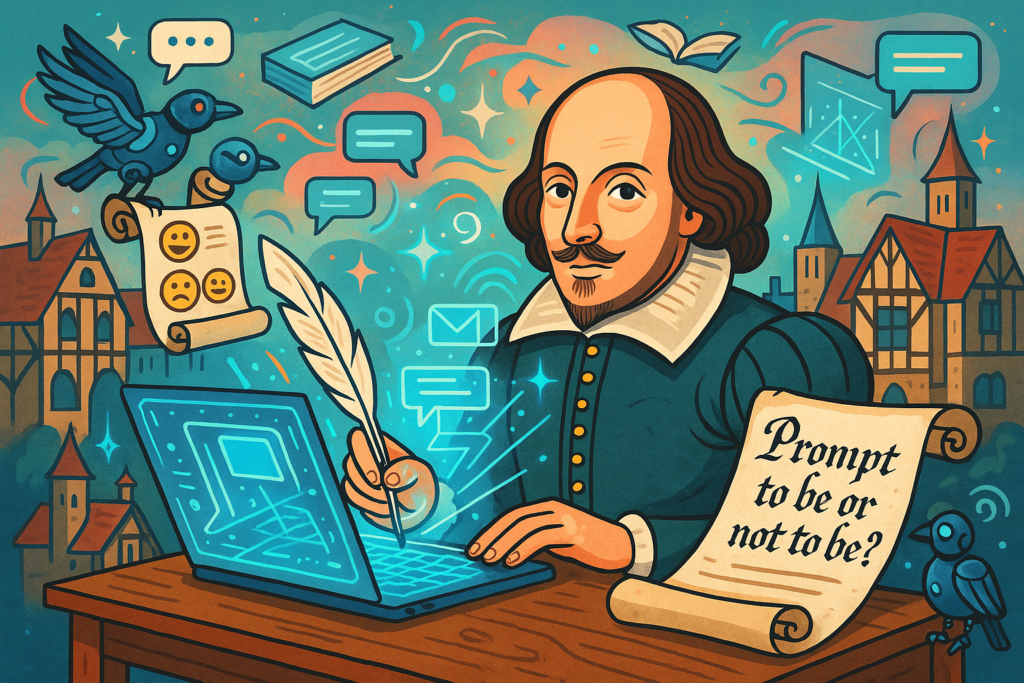
Imagine for a moment that William Shakespeare, the quintessential bard of the English language, had access to a modern AI assistant, say, ChatGPT, during his lifetime. Would his mastery of words have deepened? Would his sonnets have evolved into new forms of expression? Or picture a young English learner in a post-apocalyptic world, where printed books and digital archives are relics of a bygone era. How would they navigate the complex terrain of language without the vast repositories of knowledge we take for granted today?
These speculative musings are not merely flights of fancy; they serve as powerful lenses through which we can examine the intertwined relationship between language, culture, and technology. By exploring alternative timelines — parallel universes where language learning unfolds differently — we can gain profound insights into the nature of language itself and the tools we use to master it.
In this blog post, we will embark on a thought-provoking journey through four imagined worlds: the Elizabethan AI era, a pictorial-dominant communication universe, a scenario where English never became the global lingua franca, and a post-apocalyptic landscape of language survival. Along the way, we will reflect on how these alternate realities inform our understanding of language learning today and inspire innovative approaches for the future.
Alternative Timeline 1: Elizabethan AI — Learning English With a Feather Quill and a Neural Net
Let us begin in the age of Shakespeare, approximately the late 16th and early 17th centuries, a time when the English language was still taking shape, enriched by the Renaissance’s rediscovery of classical texts and poetic invention.
Shakespeare as a Learner and Teacher in the Age of ChatGPT
Imagine Shakespeare himself as a learner, sitting in the Globe Theatre, but instead of scribbling notes with a feather quill, he consults a neural network, that is, an AI language model, on a portable device. This AI, pretty much like ChatGPT, would offer instant explanations of archaic words, suggest poetic metaphors, and even generate new sonnets based on prompts.
For Shakespeare, such a tool could serve as an unparalleled language tutor, mapping the nuances of Elizabethan idioms, puns, and metaphors in real time. It might even assist in refining tone, helping him craft lines that resonate with both the court and the common folk.
Evolving Vocabulary, Idioms, and Tone
In this universe, the vocabulary of English would evolve differently. For instance, idiomatic expressions such as ‘break the ice’ or ‘bite the bullet’ might develop further or take on new shades of meaning, influenced by AI-generated suggestions and contemporary usage. Tone, often dictated by context and audience, could be fine-tuned with AI prompts, fostering a more dynamic and adaptive language mastery.
Playful Rewrite: A Sonnet Reimagined
To illustrate, let us take Shakespeare’s famous ‘Sonnet 18’:
Shall I compare thee to a summer’s day?
Suppose an AI assists him, suggesting modern slang and metaphors:
Should I compare you to a summer vibe?
You’re hotter than a trending TikTok clip,
Your beauty’s viral, no need to subscribe,
Forever fresh, no fade, no script.
While playful, this exercise underscores how technological augmentation might have transformed not only vocabulary but also the cultural context of language.
Implication for Today
If historical figures such as Shakespeare had such tools, their creative output might have been even more diverse and accessible. For language learners today, AI can serve as a personalised mentor, adapting to individual needs and cultural contexts, making language acquisition more engaging and effective.
Alternative Timeline 2: The World Where Emoji Is the First Language
Now, leap forward to a universe where emojis, those colourful pictographs ubiquitous in written digital communication these days, are the primary mode of communication. In such a realm, written English morphs into a visual language, where images convey emotions and ideas directly.
English in a Pictorial Universe
Imagine a world where children learn to express themselves with a limited but expressive palette of emojis. Complex ideas such as ‘I’m running late, but I’m trying my best’ might be expressed as follows:
🕒🚶♂️💨👍
This shift places greater emphasis on context, inference, and emotional understanding, rather than on syntax or vocabulary alone.
Role of Context, Inference, and Emotion
In this universe, language learning involves interpreting symbols and understanding their interplay. Learners develop heightened skills in reading between the lines, deciphering nuance through visual cues. For example, the combination of a crying face 😢 and a broken heart 💔 might communicate heartbreak more effectively than words.
Implications for Learning
Emoji-based communication fosters intuitive understanding and emotional literacy, which are essential components of language proficiency. For learners, especially in digital-native generations, mastering emoji language becomes a gateway to broader literacy, including understanding tone, humour, and cultural references.
Alternative Timeline 3: The English That Never Was — If English Never Became a Global Lingua Franca
What if history took a different turn? Suppose English never rose to dominate the world stage. Instead, other languages might have become the global lingua franca, say, Mandarin, Spanish, or Arabic.
Alternative Global Languages
In such a universe, English might have remained a minority language, spoken primarily in academic or cultural circles. The global flow of information, commerce, and diplomacy would revolve around different linguistic systems.
The Impact on Language Learning
In this scenario, English as a second language (ESL) would look quite different. Learning English might be akin to studying a specialised code or niche dialect, with fewer native speakers and less cultural dominance. The resources, pedagogical approaches, and even the cultural content would adapt accordingly.
Re-Imagining ESL
For example, in India, a nation with a rich tapestry of local languages, English often functions as a bridge language. If English had remained a regional language, learners might turn to other lingua francas, or develop entirely new pidgins and creoles blending local dialects with global languages.
Reflection
This thought experiment highlights how language dominance is shaped by historical, political, and technological forces. It prompts us to consider the importance of cultural context in language education and the resilience of linguistic diversity.
Alternative Timeline 4: Post-Apocalyptic English Learning
Finally, envision a post-apocalyptic world where traditional sources of knowledge have vanished. Books are destroyed; digital servers are offline; and language must be reconstructed through oral tradition, graffiti, and repurposed artefacts.
Language in Survivalist Cultures
In such a universe, language survival relies on memory, storytelling, and improvisation. English, if still in use, might be transmitted through mnemonic devices, chants, or even coded graffiti on abandoned walls.
Memory-Based and Gamified Learning
Survivors might develop gamified methods, such as mnemonic puzzles or interactive storytelling, to pass down language skills. For instance, a community might use a series of symbols and chants to teach essential vocabulary and grammar, ensuring their language endures despite technological collapse.
Simplified, Essential English
In this context, a simplified version, akin to the ‘Global English Core 200,’ could emerge, focusing on essential vocabulary and structures for survival communication. Think of phrases such as the following:
—’Need food’
—’Danger nearby’
—’Help me!’
—’Where is water?’
These core expressions become the foundation for rebuilding language in a world where complexity is a luxury.
Language as Legacy and Possibility
Throughout these imagined universes, one truth remains constant: language reflects and shapes our world. Whether as a tool of art, a mode of emotion, or an instrument of survival, language is both a mirror and a maker of culture.
Exploring these alternate timelines encourages us to appreciate the complexities and contingencies of our current linguistic landscape. It challenges us to consider what we might take for granted and what opportunities exist for reinvention.
Your Turn: Imagine Your Own Language Universe
What if your personal circumstances or the future of humanity led to a radically different way of learning and using language? Perhaps in a society where music carries meaning, or where virtual reality immerses us in language-rich worlds, the possibilities are endless.
As language learners, educators, and thinkers, embracing this sense of possibility can inspire innovative approaches — blending tradition with technology, culture with creativity — to build the language worlds of tomorrow.
In conclusion, whether Shakespeare wielded a neural net, emojis became universal, or language was reborn amid ruins, one thing is clear: our capacity to imagine, adapt, and reinvent language is limitless. Let us continue to explore these parallel universes, for they hold the keys to understanding ourselves, and each other, in this ever-evolving global tapestry.
Discover more from Methods and Musings
Subscribe to get the latest posts sent to your email.