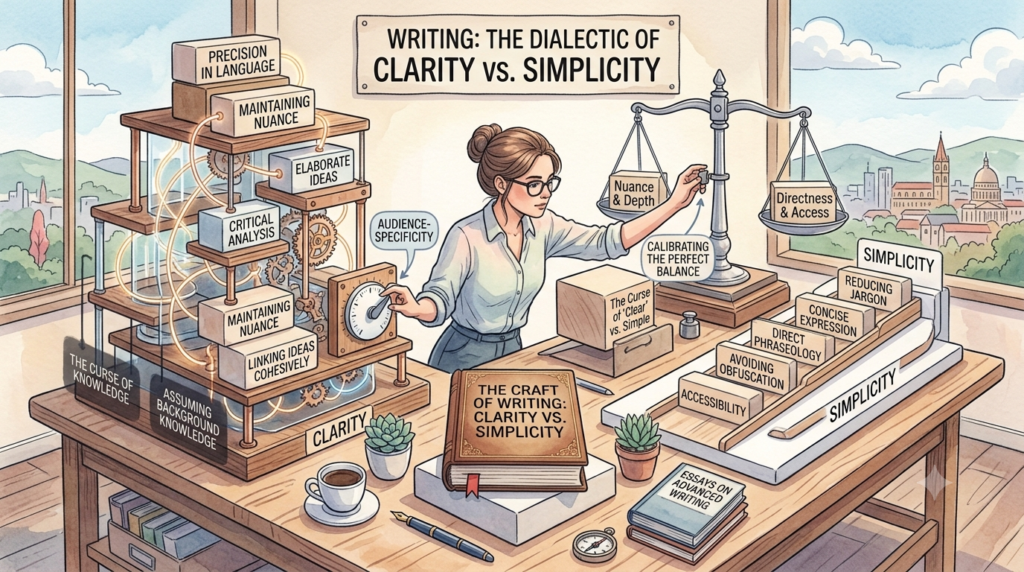
There is a familiar piece of advice for anyone who wants to write well: keep it simple.
The advice is useful, until it isn’t. ‘Simple’ can mean direct, economical, and easy to follow. But it can also become a demand to remove qualifications, flatten distinctions, and make difficult ideas sound easier than they are. In the first sense, simplicity serves clarity. In the second, it competes with it.
The difference matters because readers do not need ideas to be easy at any cost. They need to understand what an idea claims, what it depends on, and where its limits are. A sentence can be short and still obscure those things. A paragraph can be accessible and still leave the reader with a distorted picture.
Contrary to what seems to be a widely held belief, clear writing is not writing with the fewest possible words. Clear writing is writing that gives readers the right amount of complexity to understand the subject without being distracted by unnecessary complexity in the expression.
The Seduction of ‘Simple’
Simple writing is easy to praise. It feels efficient. It promises that a writer can take something difficult and make it immediately graspable. In a crowded information environment, that promise is attractive to both writers and readers.
But simplicity is not a single quality. It can describe an idea, a sentence, an explanation, or the experience of reading. Confusing these meanings leads to a common mistake: assuming that if the writing feels easy, the thinking must be clear.
That is not always true. Some ideas are simple, while others are complicated because they involve many moving parts. Still others are complex in a more fundamental way: their parts interact; their outcomes are uncertain; or their meaning depends on context. A clear explanation can make these ideas easier to follow. It cannot always make them simple without changing what they are.
The writer’s task is not to make every subject feel uncomplicated. It is to make the subject’s actual complications legible.
Simple Is Not Simplistic
This distinction is important because the two often get interchanged even by people who have the best of intentions. A simple explanation identifies what matters and removes what does not, whereas a simplistic explanation removes whatever makes the story harder to tell.
The difference between the two lies in judgement. A useful simplification preserves the relationships that define an idea. A simplistic one preserves the headline while discarding the conditions that make it true.
Consider the statement ‘Remote work improves productivity.’ It is simple, and perhaps persuasive. But it leaves crucial questions unanswered: productivity for whom, doing what kind of work, measured how, and over what period? The statement may be accurate in some settings and misleading in others. A clearer version might say, ‘For some teams, remote work improves productivity by reducing interruptions. For others, coordination costs offset that gain.’ The second claim is less tidy, but it gives the reader a more accurate map.
This is not an argument for hedging every sentence. It is an argument for preserving distinctions that change the meaning. If a qualification materially affects the claim, removing it does not clarify the claim but changes the claim entirely.
Concise Is Not Incomplete
Concision is often treated as a virtue in itself. But is it truly? Concision is valuable when it removes repetition, throat-clearing, and detail that does not help the reader. It becomes a liability when it removes the information needed to interpret a conclusion.
A short sentence can carry a large claim. ‘The policy failed’ is concise. It is also incomplete unless the reader knows what success was supposed to look like, what evidence supports the judgement, and whether the policy failed completely or fell short in a particular way.
This does not mean every sentence needs a footnote. Rather, it is a call for writers to distinguish between unnecessary detail and necessary context, as the former slows comprehension, whereas the latter makes comprehension possible.
A useful test is to ask ourselves what a reader would reasonably infer from the shortened version. If the omission causes readers to infer something stronger, broader, or more certain than the evidence supports, the writing has become shorter by becoming less accurate.
Accessible Is Not Dumbed-Down
Accessibility is sometimes mistaken for a low reading level. But accessible writing is not writing that assumes readers cannot handle difficult ideas. That idea seems misguided at best and patronising at worst. Truly accessible writing is writing that does not make the reader work unnecessarily hard to reach those ideas.
Inaccessibility in writing can be due to jargon, tangled syntax, unexplained references, or an argument that reveals its point only after several paragraphs or even pages. Removing those obstacles is not dumbing the writing down but rather respecting the reader’s attention.
Dumbing down happens when the writer removes the substance instead and, for example, replaces a meaningful distinction with a slogan, uncertainty with certainty, or a causal explanation with a convenient story. The reader may find the result easier to consume but has less reason to trust it.
Removal of avoidable barriers, and not the absence of intellectual demands, is what accessibility is. A reader can follow a complex argument when its terms are defined, its steps visible, and its implications explained. The idea may remain challenging. However, the route through it need not be needlessly obscure.
Clear Is Not Shallow
Clarity is often associated with confidence and decisiveness. Strong verbs, declarative sentences, and memorable contrasts, among others, can make an argument feel clear. But a statement can be clear in form and shallow in substance.
‘Technology is changing everything’ is easy to understand. It is also too broad to explain much. ‘This technology reduces the cost of producing a first draft, but shifts more work towards judgment and revision’ is narrower and more useful, but at the same time more ‘wordy’. It tells us what is changing, what is not, and where the consequences may lie.
Shallow writing often offers conclusions without showing the structure beneath them. It says what to think without making clear why, or presents a recommendation without naming the conditions under which it applies. The reader receives a verdict but not a way to evaluate it.
Clear writing does more than make a conclusion visible. It makes the reasoning inspectable. Readers should be able to see how the writer moved from evidence to claim and where that movement depends on assumptions, trade-offs, or incomplete information.
The Idea Can Be Complex; The Expression Need Not Be
A complex idea does not require complicated prose. In fact, when the subject is difficult, the writing should be especially disciplined. Shorter sentences, concrete examples, familiar words, and a clear sequence of points can help readers hold the argument in mind.
But simplifying the expression is different from simplifying the idea. The writer can remove friction from the explanation without removing the features that make the subject complex.
This is where craft matters. An explanation might begin with a concrete case, then introduce the general principle. It might separate two concepts that are often confused, or explain a technical term before using it. It might state a conclusion plainly, then add the qualification that makes it accurate. These choices make complexity navigable rather than invisible.
The goal is not to display complexity. Complexity for its own sake can be as obstructive as oversimplification. The goal is to retain the complexity that does explanatory work and remove the complexity that merely burdens the reader.
When Does Simplification Become Distortion?
There is no universal amount of complexity that can be removed from an idea. The answer depends on what the idea is meant to do and who the idea is for. For instance, a quick orientation can leave out details that a decision memo cannot, or a public explanation may need different examples from a technical paper. The standard is adequacy for the reader’s purpose, not completeness in the abstract.
Still, there are useful signs that can serve to warn us. Simplification is likely to distort when it
—turns a conditional claim into a universal one,
—presents correlation as causation,
—removes a trade-off that affects the decision,
—hides uncertainty that would change how much confidence to place in the conclusion,
—collapses distinct cases into one category, or
—makes a recommendation sound independent of context when it is not.
More than being just cosmetic losses, they alter what the reader can reasonably believe or do.
A writer can test a simplification by asking, “What has been left out? Would including it change the conclusion, the confidence readers should have in it, or the action they might take?” If so, the omitted complexity may be essential. If not, it may be safe to leave out, or move elsewhere.
Clarity Is a Responsibility, Not a Style
Clear writing is sometimes reduced to a set of surface rules, such as use shorter words, cut adverbs, and prefer active voice. While these techniques can definitely help, clarity is ultimately a responsibility to the reader. It requires the writer to decide what the reader needs to understand, not simply what can be deleted.
That responsibility cuts in both directions. Writers should not make an idea harder than it is through jargon or self-conscious complexity. Nor should they make it easier than it is by hiding the conditions, tensions, and uncertainties that give it shape.
The best writing is not always the simplest writing. It is writing in which the complexity of the expression is lower than the complexity of the idea, without being so low that the idea is misrepresented. That is a demanding balance. It asks the writer to know which details are incidental and which are load-bearing.
The Measure Is Fidelity
The practical question is not ‘Can I make this simpler?’ Almost any explanation can be made shorter, smoother, and more confident. The more important question is this: ‘Can I make this easier to understand without making it less true?’
Sometimes the answer is to cut. Sometimes it is to define a term, add an example, or make a qualification explicit. Sometimes the clearest sentence is longer because the shorter one would invite the wrong inference.
Clarity is not the elimination of difficulty. It is the reduction of unnecessary difficulty while preserving what the reader needs to see. Simplicity can help achieve that. But when simplicity becomes the measure of good writing, it can reward the very thing good writing should resist: an explanation that feels complete because it has left out what matters.
The aim is not to make every idea simple. It is to make each idea as clear as it can be without making it smaller than it is.
Discover more from Methods and Musings
Subscribe to get the latest posts sent to your email.