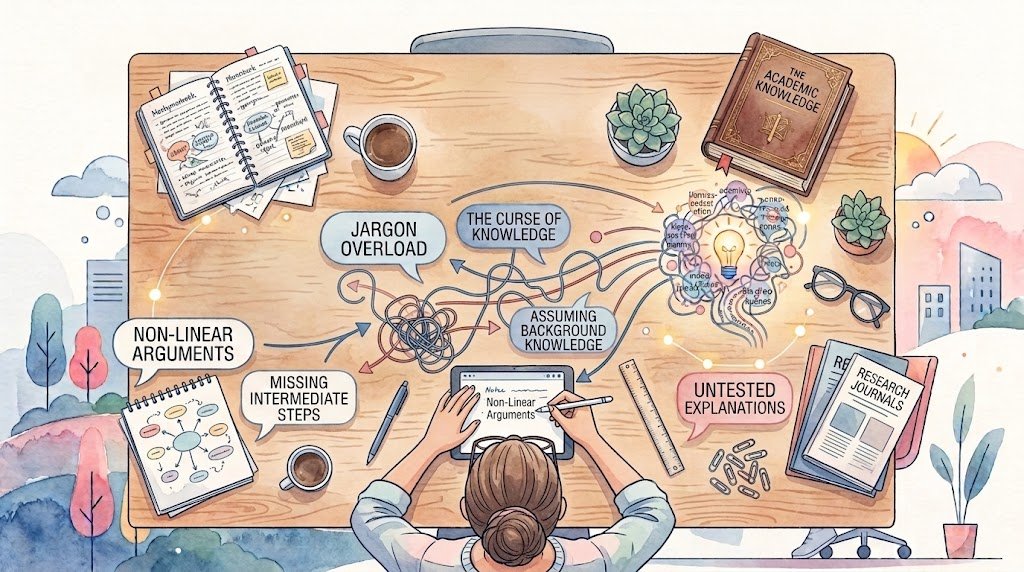
The gap between expertise and communication is often misunderstood. Many brilliant minds struggle to articulate their ideas, not because they lack intelligence but because their thinking and their expression operate on different planes.
The catalyst for this week’s blog post was a conversation I had with a former colleague who is neurodivergent. They are talented, insightful, creative, and able to generate innovative ideas and solve complex problems with ease. Yet, when it comes to articulating their thoughts, they face persistent challenges.
They contacted me after reading my last blog post, where I talked about why intelligent people sometimes make their ideas harder to understand, and told me that it made them feel seen. I could not be more glad that it did, as having faced the same problem myself at times, though not to the same degree, I could empathise with them. We will talk more about them a little later in the post.
The Myth of the Natural Communicator
In every field, be it science, technology, design, or leadership, we celebrate mastery. We admire those who can solve complex problems, innovate, or create with ease. Yet, I often come across a common misconception that expertise automatically translates into effective communication, particularly regarding the field of said expertise. The reality is more nuanced.
Some of the most accomplished professionals, such as neuroscientists, engineers, and creatives, find themselves at a disadvantage when it comes to explaining their work. They may be brilliant, but their ideas can be opaque to others. This disconnect is not a reflection of their intelligence or competence. Rather, it signals a fundamental distinction: that expertise and communication are different skills, each requiring its own development.
Expertise and Communication: Different Abilities, Different Challenges
Expertise: The Internal Model
Expertise often resides within an individual’s mental model, deep within an intricate web of knowledge, associations, and intuition built over years of experience. This internal model enables mastery, creativity, and rapid problem-solving. It is often characterised by the following:
—Richness and Depth: an extensive repository of facts and insights.
—Associative Thinking: non-linear, often intuitive leaps.
—Automaticity: skills and insights that operate below conscious awareness.
Communication: The External Bridge
Conversely, communication involves translating that internal model into language, visuals, or other formats accessible to others. It demands the following:
—Sequential Processing: organising ideas into a logical flow.
—Simplification: filtering complexity without losing essential nuance.
—Audience Awareness: Adjusting the message to fit the listener’s context, background, and expectations.
While both skills involve cognition, they engage different mental processes. A person can be a virtuoso within their domain yet struggle to craft a clear explanation, simply because their mode of thinking does not naturally align with the conventions of communication.
A Personal Example: My Neurodivergent Colleague
I witnessed this disconnect firsthand with a former colleague who is neurodivergent, and about whom I spoke at the beginning of the post.
Their internal model of any problem they were dealing with was rich, detailed, and multi-layered. But translating that into linear language, whether in presentations, emails, or casual explanations, was a struggle for them. It was never a matter of intelligence or effort for them, as they never lacked in either. It was a matter of cognitive style. Their way of thinking was more associative, visual, and non-linear, making traditional communication frameworks feel constraining.
This experience gave me a live example of my perspective, namely that it is not enough to assume that expertise naturally leads to clarity. We must recognise that diverse cognitive styles require different tools and approaches. It is about creating bridges, to use a phrase I used in my last post, and not fixing deficiencies.
Why Do Experts Struggle to Explain?
This leads us to the question: why do experts struggle to explain even those topics that are of their field? There are a few possible reasons for it.
Assumption of Shared Context
Experts often assume their audience shares the same foundational knowledge. This ‘curse of knowledge’ leads them to skip steps, omit definitions, or jump straight into complex concepts. They tend to forget that their internal model is built upon assumptions that others have not yet internalised. Take a seasoned data scientist, for example, who might leap into discussing advanced algorithms without clarifying basic principles first, leaving non-experts lost.
Skipping Intermediate Steps
Because they think in non-linear or associative ways, experts tend to bypass the intermediate stages that make reasoning transparent. Their internal processes are seamless, but their explanations can seem abrupt or fragmented.
Visual, Spatial, or Associative Thinking
Some individuals think in a more holistic manner, visually or spatially, rather than a linear manner. They might conceive ideas as a network or a landscape rather than a step-by-step narrative. So when it comes to explaining, they struggle to translate this complex internal image into sequential language.
Rich Internal Models and Sequential Expression
Having an intricate internal understanding does not inherently equip someone to express that understanding sequentially. For example, a scientist may have a vivid mental simulation of a process but find it difficult to narrate it in a way that others can follow.
The Idea–Expression Gap
There is a fundamental difference between having an idea and translating that idea into accessible language. This gap is often misinterpreted as a lack of intelligence or effort, when in reality, it is a divergence of cognitive pathways.
Responsibility: Who Holds the Key?
So then who holds the key to ‘good communication’?
The Speaker’s Role
While it is ideal for experts to develop their communicative skills, it seems unfair to a certain degree to place the entire burden on them. It is crucial that their unique cognitive style be recognised. They may need tailored tools, such as visuals, metaphors, and analogies, to bridge their internal model with external understanding.
The Listener’s Role
Equally important is the responsibility of the audience to seek clarification, ask questions, and engage actively. Effective communication is a two-way street and is not solely the speaker’s burden.
Shared Responsibility and Adaptive Strategies
The most effective communicators recognise their audience’s background and adapt accordingly. This requires humility and awareness, which are skills that can be cultivated.
Making Communication More Accessible: Moving Beyond Deficiency
Rethinking ‘Good Communication’
Accept that different thinking styles require different approaches. Effective communication is not about conforming to a single model but about expanding our repertoire to include diverse methods, namely visuals, stories, analogies, and demonstrations.
Tools for Translating Complex Ideas
Certain tools can help experts make complex ideas easily understandable.
—Analogies and Metaphors: bridge unfamiliar concepts with familiar ones.
—Visual Aids: diagrams, models, or spatial representations.
—Stepwise Decomposition: breaking ideas into digestible parts.
—Interactive Dialogue: engaging the audience to co-construct understanding.
Cultivating Empathy and Self-Awareness
Encouraging experts to understand their own cognitive styles and limitations is a vital step in them becoming better communicators. Equally, teaching audiences to ask clarifying questions fosters inclusivity and makes the expert feel at ease when they realise that the entriety of the onus is not on them alone.
The Broader Implication: Rethinking Communication in the Knowledge Economy
This conversation touches a profound truth: many people are labelled ‘bad communicators’ when the real issue is a mismatch between their internal thinking and external expression. Recognising this opens avenues for more compassionate, effective, and inclusive communication strategies.
In my work with executives and leaders, I see this every day. Highly competent individuals often struggle to convey their insights in ways that resonate. By reframing the challenge, as a different skill set rather than a deficiency, we help them unlock their potential to lead, influence, and innovate more effectively.
Conclusion: Bridging the Gap with Intent and Awareness
Expertise and communication are different skills, each requiring intentional development. Understanding that a brilliant mind may not naturally translate thoughts into words is the first step towards more empathetic, effective dialogue.
Rather than viewing communication as a sign of intelligence or effort, we should see it as a craft that can be learned, adapted, and personalised. In doing so, we empower not just the communicators but also the audiences they seek to engage.
Because at the end of the day, the goal is not simply to be understood. It is to be understood well enough to inspire action, foster collaboration, and drive progress.
Discover more from Methods and Musings
Subscribe to get the latest posts sent to your email.