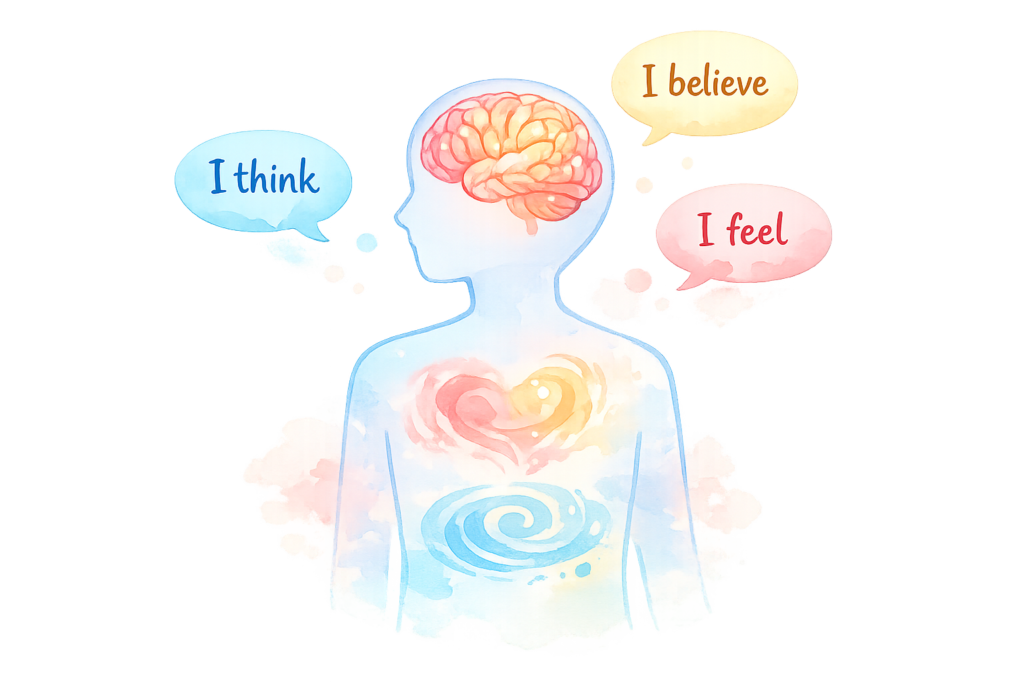
Imagine a typical conversation, whether in a clinic, a classroom, or a casual chat. We often hear expressions such as ‘I’m stressed,’ ‘I feel anxious,’ or ‘I have a headache.’ Notice, however, that we do not usually say, ‘My heart is tight,’ ‘My chest feels heavy,’ or ‘My stomach is knotted.’
The body lurks in the background of our language — present, yet often silent. It is as if the flesh and bones that house our experience have been politely asked to step aside or, perhaps, invisibly excised from our linguistic landscape.
This raises a central question: why does English so frequently report and describe human experience from the head, the mind, rather than from the flesh and bones?
The thesis I explore here is that English, both structurally and culturally, privileges the cognitive self over the embodied self. This tendency influences not only how we speak but also how we perceive and experience emotion, pain, and identity itself.
Theoretical Frame: Embodiment in Cognitive Linguistics
To understand this phenomenon, we must turn to the insights of cognitive linguistics and embodiment theory.
Lakoff and Johnson (1980), in their seminal work Metaphors We Live By, argued that our conceptual system is fundamentally metaphorical and rooted in bodily experience. For example, we often talk about understanding as ‘grasping’ or ‘holding’ ideas, tying abstract thought to physical action. These metaphors are not arbitrary; they reflect the way our brains process experience through bodily schemas.
Further, research in embodied cognition emphasises that the mind is not separate from the body. Cognitive processes, such as perception, memory, and reasoning, are deeply intertwined with sensorimotor systems. Language, as a window into thought, thus mirrors this embodied basis.
Yet, paradoxically, while bodily metaphors are pervasive, everyday language often abstracts experience away from direct bodily reference. We say, ‘I am stressed,’ rather than ‘My shoulders are tense,’ and ‘I feel anxious,’ rather than ‘My stomach is knotted.’
This tension — a dissonance between bodily grounding and linguistic abstraction — is at the heart of the ‘disappearing body’ in English.
Grammar and the Abstract Self
The ‘I’ as Mental Centre
English syntax and discourse tend to centre the individual as a conscious, rational agent. Phrases such as ‘I think,’ ‘I believe,’ and ‘I feel’ are foundational. These expressions position the self as an active, thinking subject, with mental states as properties or possessions. Emotions are framed as internal states, for example, ‘I feel sad’ or ‘I am anxious,’ which emphasises internal cognition rather than bodily experience.
Contrast this with languages that embed emotion within bodily states, say Hindi or Bangla, where expressions such as ‘My heart is hurting’ (from Indian languages) directly reference bodily parts to convey emotional states.
Emotion as Property
In English, emotion often takes the form of possession:
— ‘I have anxiety.’
— ‘I have pain.’
— ‘I have stress.’
This language objectifies feelings, transforming them into things that can be owned or experienced, rather than embodied processes occurring within the flesh.
By framing emotion as a property or object, English distances the experience from immediate physical sensation, positioning it instead as an internal condition to be managed or controlled.
The Passive Body in English Syntax
Moving into syntax and discourse, we observe further evidence of this trend. Medical and institutional language frequently abstracts bodily experience:
— ‘There is discomfort.’
— ‘The patient reports pain.’
— ‘Symptoms present . . .’
— ‘The subject experiences . . .’
In these constructions, the lived, subjective body becomes a data point, a symptom to be catalogued and analysed rather than felt directly.
Linguist Michael Halliday’s work on nominalisation highlights how processes, such as ‘experiencing,’ ‘suffering,’ or ‘feeling,’ are turned into nouns, further distancing the individual from their bodily sensations.
This linguistic pattern is not accidental but reflects a broader cultural tendency to treat bodily experience as external, objective, and secondary to the cognitive or analytical.
The Cultural Preference for Mental Control
The language we use is deeply intertwined with cultural values. English-speaking cultures, particularly in Western contexts, often prioritise rationality, emotional restraint, and cognitive clarity. The body is associated with excess, vulnerability, or loss of control.
Language mirrors this hierarchy:
—The mind is the seat of authority, reason, and identity.
—The body is often backgrounded, associated with physical needs, instinct, or weakness.
For example, expressions such as ‘Get a grip,’ ‘Keep your composure,’ or ‘Mind over matter’ reinforce the notion that mastery over the body is a sign of strength and civility.
In this cultural framework, the body’s language is often seen as less refined, more emotional, or even unruly — traits that are often discouraged in formal or professional settings.
Digital English and Further Disembodiment
The digital age adds a new layer to this disembodiment. Online communication, especially in text form, strips away tone, gesture, and bodily cues. We communicate through words alone, which heavily favour cognition and abstraction.
Emojis have emerged as symbolic attempts to reintroduce embodiment; yet these are limited and often superficial. They serve as symbols rather than direct expressions of bodily sensation.
The more we rely on digital English, the more it seems to reinforce a disembodied model of communication, one that privileges mental representation over physical experience.
Psychological and Social Consequences
This linguistic trend has significant implications for our emotional literacy and well-being.
1. Emotional literacy may become overly cognitive, making it harder for individuals to recognise and articulate bodily sensations associated with emotions.
2. Many people struggle to identify physical cues, such as a racing heart or tight chest, that signal emotional states.
3. Therapists increasingly encourage clients to ‘drop into the body,’ cultivating somatic awareness — a practice that suggests a prior disconnection.
Research from somatic psychology and trauma studies (e.g. the works of Bessel van der Kolk) indicates that reconnecting with bodily sensation is vital for healing; yet the language we predominantly use may hinder such reconnection.
Counterpoint: The Body Is Not Fully Gone
While the dominant patterns are clear, it is important to acknowledge that the body is not entirely absent from English.
Poetry, literature, and colloquial idioms often foreground embodiment:
— ‘Gut feeling’
— ‘Cold shoulder’
— ‘Heartbroken’
These expressions reveal that, despite formal tendencies, bodily metaphors and references continue to animate English language and culture.
However, these are often poetic or idiomatic, more foregrounded in expressive or literary contexts than in everyday, institutional discourse.
Why This Matters
Understanding this disembodiment in language is not merely academic. It invites us to reflect on what we foreground and background in communication.
If language shapes perception, then a focus on cognition over embodiment may subtly influence how we experience ourselves and others — living ‘from the neck up,’ so to speak.
In language education and intercultural communication, awareness of these tendencies can foster more embodied, holistic approaches, integrating body and mind, emotion and thought.
Closing Reflection
The body has never truly left English. It waits, often quietly, at the margins of our words and expressions. But perhaps, more than anything, the question is whether we have learned to listen to the body’s whispers, sensations, and signals that remain behind the linguistic curtain.
In a world increasingly inclined towards abstraction and digital communication, cultivating awareness of our embodied experience might be one of the most vital acts of reconnecting with ourselves and others.
In conclusion, the seeming disappearance of the body from English language and discourse reveals deep cultural and cognitive patterns. Recognising these tendencies offers an opportunity, not only for language learners and teachers but for anyone committed to a more integrated, embodied way of living and communicating.
Discover more from Methods and Musings
Subscribe to get the latest posts sent to your email.