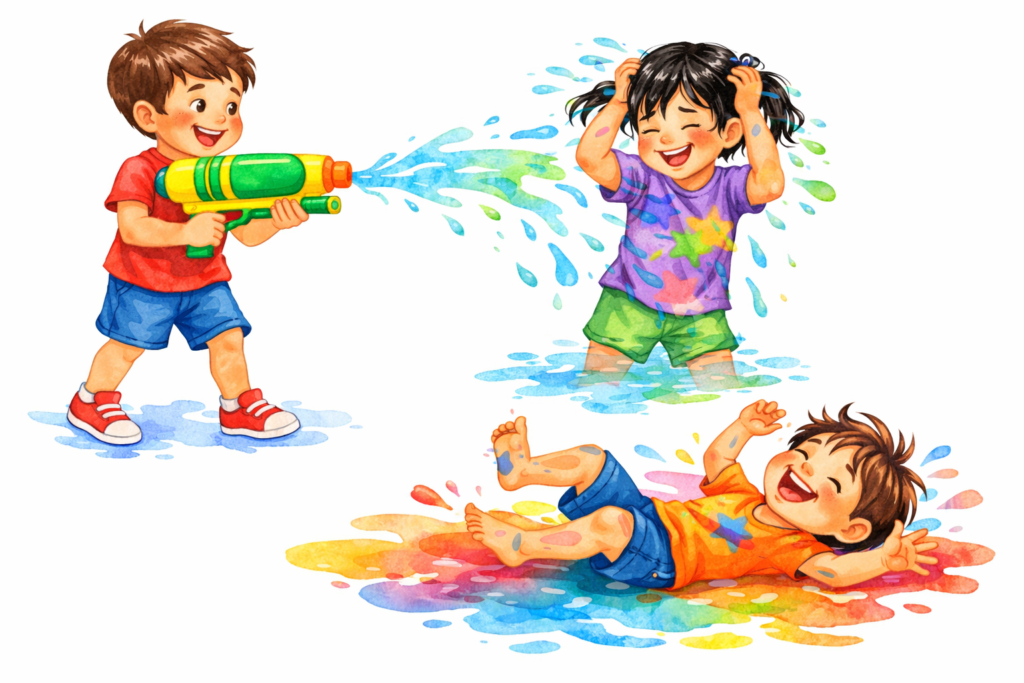
Today, the air is colour.
Faces blur into pinks and blues.
Clothes lose their boundaries.
Identity softens under gulal.
Holi reminds us that colour is not merely decoration: it is an experience. It is a language, a way of seeing and feeling. And interestingly, the language we use, particularly English, has very specific ways of handling colour, shaping our perception in subtle ways.
Colours as Categories: The Cognitive Layer
In linguistics, colour words are more than just descriptive terms. They are cognitive tools that influence how we think. English, for example, divides the spectrum into neat, distinct categories: red, blue, green, yellow, purple, pink, brown, black, white.
However, the natural world presents a continuous spectrum. The visible spectrum is a smooth gradient; yet language imposes boundaries. When we say something is blue, we are not just describing a hue; we are categorising it. This segmentation shapes our perception, training us to see colours as discrete segments rather than flowing shades. In essence, language helps us carve the rainbow into manageable, familiar pieces.
Colour as Metaphor: The Conceptual Layer
Beyond description, colours serve as powerful metaphors in English, shaping our emotional and moral landscapes. We talk about ‘feeling blue‘, ‘being green with envy’, ‘telling a white lie’, or ‘having red flags warning us’.
Colours become symbols — moral, emotional, political. They stop being visual cues and transcend into conceptual realms. This metaphorical use of colour enriches language, allowing us to communicate complex ideas and feelings through simple hues. It is a testament to how deeply colour is woven into our way of thinking.
Colour and Clarity: The Boundaries We Draw
English often prefers clarity and fixed labels. We like our categories stable, our definitions clear. Nevertheless, Holi — celebrated with blurring boundaries — embodies a different philosophy. During the festival, colours blend and mix; boundaries dissolve; and red turns into orange, then into something unnamed.
In those fleeting moments, the familiar lines fade away. Yet, English, comfortable with certainty, sometimes struggles to articulate what lies in the in-between. It prefers neat divisions over fluid blends, which can make the experience of Holi all the more striking: a reminder that not everything fits into fixed categories.
The Academic Insight: How Language Shapes Perception
Research in cognitive linguistics suggests that language influences how we group and remember colours. Having specific words for colours sharpens our categorical perception: they help us distinguish and remember shades more precisely.
Language, then, does not change what we see; it shapes how we organise what we perceive. English, with its emphasis on clarity and segmentation, tends to sharpen edges. Holi, on the other hand, invites us to blur them, reminding us that perception is often a dance between clarity and ambiguity.
Closing Reflection: The Freedom of Blurring Boundaries
Perhaps that is why festivals of colour such as Holi feel so liberating. For a few joyful moments, we step outside the constraints of neat categories:
—Not this shade or that shade
—Not this identity or that identity
—Not this label or that label
Just colour. And maybe, in a sense, language could use its own Holi: occasions where meaning blurs, boundaries dissolve, and we embrace the fluidity of perception and identity. After all, isn’t life often richer in its colours when we allow them to blend?
Discover more from Methods and Musings
Subscribe to get the latest posts sent to your email.