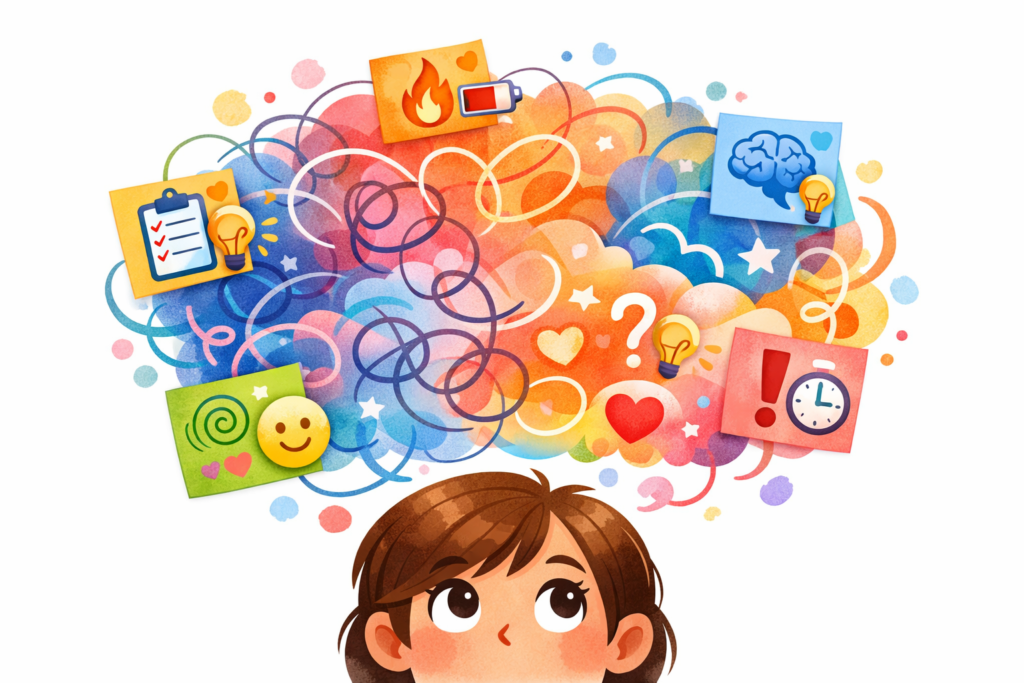
Imagine this: you have been feeling exhausted, frustrated, and plagued by self-doubt for weeks or even months. The days blur together, and you struggle to articulate what is wrong. You might think, ‘Why do I feel this way? What is this?’ However, words continue to elude you.
Then one day, you hear a term, such as burnout, imposter syndrome, gaslighting, or overthinking, and suddenly, everything shifts. That nebulous, tangled feeling suddenly has a shape, a name. The chaos in your mind condenses into a concept you can grasp.
Nothing about the sensation has changed; your experience remains the same. Yet, the very act of naming it transforms your understanding. The experience, once private and confusing, becomes a shared phenomenon. The feeling that once felt like a personal failing now fits into a familiar pattern.
This is the subtle but profound power of language. Words do not just describe problems. They often ‘create the shape’ of the problem itself. When we give a feeling or a struggle a name, we do more than label it: we define it.
The Linguistic Power of Naming
At the core of this phenomenon lies a simple yet profound linguistic principle: humans understand the world through categorisation. Our minds are natural classifiers, constantly grouping sensory inputs and internal experiences into mental bins.
Words act as cognitive containers. They hold complex, often messy, phenomena into manageable units. When a phenomenon receives a label, several psychological processes are triggered:
(1) It becomes discussable: We can talk about it openly.
(2) It becomes shareable: Others can understand and relate.
(3) It becomes recognisable: We identify patterns in ourselves and others.
This process transforms private confusion into public vocabulary, bridging individual experiences with collective understanding. It allows us to articulate what previously felt unarticulated, fostering empathy and awareness.
In cognitive linguistics, discourse analysis, and sociolinguistics, scholars have long noted that ‘naming is a powerful act of social and cognitive organisation’. It shapes how we interpret reality and how reality is shaped in turn.
Why English Excels at This
English demonstrates a remarkable facility for creating compact, precise labels for complex human experiences. Several linguistic features contribute to this capacity.
Morphological Flexibility
English is highly adaptable morphologically, meaning it can easily form new words or modify existing ones. This flexibility enables rapid creation of psychological shorthand.
—Compounding: Words such as overthinking, self-sabotage, mindfulness are seamlessly formed words, combining familiar roots.
—Metaphor: Burnout, for example, likely originated from physical exhaustion, but it has been extended metaphorically to emotional and psychological states.
—Borrowing: English readily adopts terms from other languages, for example trauma (Greek) and karma (Sanskrit), which enrich its expressive palette.
—Nominalisation: Processes that turn actions into nouns, for example alienation, anxiety, and depression, allow abstract states to be conceptualised as objects.
This morphological richness creates a toolkit for capturing nuanced human states efficiently, turning complex feelings into memorable, digestible units.
The Influence of Psychology and Therapy Culture
Modern English discourse is deeply intertwined with psychology, self-help, and therapy language. These domains are dedicated to naming and classifying patterns of human behaviour and emotion.
Terms such as toxic relationship, emotional labour, boundaries, and resilience have transitioned from academic or clinical contexts into everyday conversation. Their widespread use reflects a cultural shift towards self-awareness and mental health literacy.
This proliferation of psychological vocabulary in English amplifies its capacity to produce and disseminate new labels for emotional states, reinforcing a shared language for inner experiences.
The Media and Internet Effect
In the digital age, social media, blogs, podcasts, and online communities accelerate the spread of new terminology. When a term resonates, such as gaslighting, microaggressions, and emotional hijacking, it can go viral within days.
Once a word gains momentum, it shapes public discourse, influencing how millions interpret their feelings and experiences. Hashtags, memes, and viral videos serve as vectors for linguistic innovation, embedding new concepts into everyday life.
For example, the term gaslighting, originally from a 1938 play by Patrick Hamilton, has become a common way to describe manipulation and emotional abuse in personal relationships and societal discourse globally.
When Naming Helps
Naming is not merely an act of linguistic convenience. It can be empowering, fostering validation and understanding.
Validation
A label can affirm that an experience is real. When someone hears a term like burnout or imposter syndrome, they recognise their feelings as legitimate rather than personal failings.
This validation can be profoundly relieving, reducing shame and silence around difficult experiences.
Shared Understanding
Concepts enable us to communicate complex emotional states efficiently. Instead of lengthy explanations, a single word encapsulates a pattern of behaviour or feeling, saving time and fostering connection.
Social Recognition
Some issues only gain visibility once they are named. For instance, microaggressions — subtle, often unconscious insults — were not widely acknowledged until the term emerged, allowing collective awareness and social change.
Language acts as a mirror and a lens, bringing hidden patterns into view and enabling societal dialogue.
When Naming Becomes Limiting
While naming has many benefits, it also carries pitfalls.
Oversimplification
A single label may flatten the complexity of human experience. Life rarely conforms neatly to a single category. Someone might be anxious, but their experience could involve a mixture of trauma, depression, and existential doubt.
Reducing these to one term risks ignoring the nuances that make each person’s experience unique.
Concept Inflation
As new terms multiply rapidly, some lose their specificity. Not every difficult moment warrants the label trauma or toxic. Overuse might dilute the power of these words or lead to over-pathologising normal struggles.
Identity Through Labels
People can begin to identify with the label itself, conflating the word with the person. For example, someone saying, ‘I have imposter syndrome,’ risks making the experience part of their identity rather than a temporary state.
This can lead to a fixed mindset about oneself, potentially hindering growth and resilience.
A Linguistic Perspective: Words Shape Attention
Research in linguistic relativity suggests that language influences ‘how we organise attention and interpret our experiences’. While language does not confine thought, it guides perception.
When English offers a ready-made label, it
—focuses attention on the pattern described by the term,
—organises social discussion around that concept, and
—shapes social narratives and cultural understanding.
The act of naming acts as a cognitive shortcut, streamlining complex phenomena into accessible, shareable units.
The Paradox of Naming
Naming is a double-edged sword. It clarifies by giving form to chaos, yet it simplifies by compressing complexity.
Words can illuminate our experiences, making them easier to understand and communicate. However, they can also frame our understanding in ways that might limit perspectives or impose artificial boundaries.
For example, recognising imposter syndrome helps articulate feelings of fraudulence, but it might also encourage individuals to see those feelings as fixed or universal, potentially obscuring other aspects of their experience.
In essence, language helps us see ourselves more clearly, but it also shapes the way we see ourselves.
Closing Reflection
Perhaps one of English’s quiet strengths lies in its remarkable ability to take the tangled, messy threads of human experience and weave them into compact, memorable concepts. This capacity fosters understanding, empathy, and social cohesion.
Sometimes, having a label helps us see our struggles more clearly. Other times, it risks boxing them into predefined categories. Yet, the act of naming remains a powerful tool, transforming invisibility into visibility.
As we navigate our internal worlds and shared societies, the words we choose — particularly in English — shape not only how we think about problems but also how we confront them.
In the end, when a feeling receives a name, it stops being invisible. And in language, as in life, what has a name becomes easier to notice.
Discover more from Methods and Musings
Subscribe to get the latest posts sent to your email.