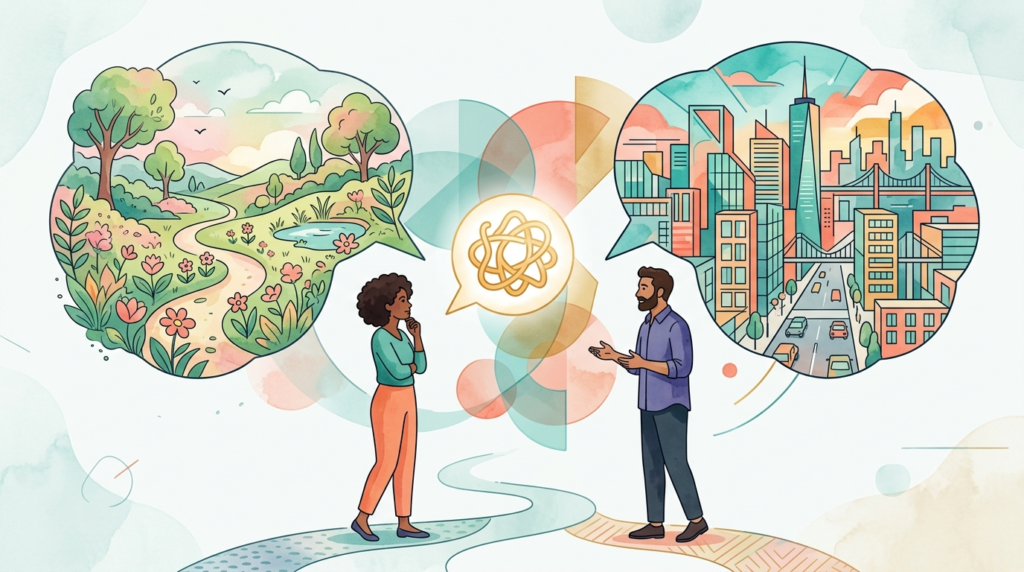
Picture this common scene: two people are debating the meaning of a fundamental concept.
A: That’s not what equality means.
B: That’s exactly what equality means.
At first glance, it seems like they are arguing over a dictionary definition. But is that really the case? Or are they, perhaps, talking past each other, each with a different mental model of what the word means?
This question cuts to the core of human communication. When we argue about the meaning of a word, are we really debating language itself? Or are we, in fact, wrestling with contrasting visions of how the world works? Understanding this distinction reveals much about the nature of disagreement and the role language plays in shaping, and reflecting, our worldview.
Dictionaries Are Not the Whole Story: The Limits of Lexical Definitions
Traditional dictionaries attempt to capture common usage. They provide definitions that reflect how words are typically used in everyday language, often listing multiple senses or connotations.
However, dictionaries do not settle conceptual disputes. They are snapshots of language at a moment in time, not static blueprints of meaning. Language is more dynamic than a mere list of definitions. It evolves, adapts, and is shaped by social, cultural, and contextual factors.
When two people debate whether a particular act is, for example, just, fair, or moral, they are unlikely to be arguing over a dictionary entry. Instead, they are engaging with different conceptual frameworks, or mental models, embedded within their understanding of the world.
Words Are Mental Categories, Not Simple Labels
Cognitive linguistics offers a crucial insight: words are mental categories. They do not just point to objects or ideas; they organise how we perceive and interpret the world.
Think of a category such as’ bird’. It is not just a label for a specific creature; it includes a prototype, say a robin or a sparrow, that exemplifies its core features. Around this prototype, there are fuzzy edges: penguins, ostriches, eagles, and so on, each with varying degrees of similarity.
This prototype effect explains why disagreements often hinge on different mental images or associations. For example, in debates about ‘freedom’, one person might imagine a libertarian ideal, whereas another envisions social justice. Both are discussing the same word, but their mental categories are subtly different, shaped by their experiences and values.
Meaning Depends on Frames: The Power of Context
Frame semantics, a concept from cognitive linguistics, further clarifies the issue. When we hear a word, we do not just process its isolated meaning; we activate an entire background structure — or frame — that shapes our understanding.
Take the word ‘tax’ as an example. For one person, it might evoke civic responsibility, that is, the duty to contribute to society. For another, it might evoke government overreach or economic burden. The disagreement is not simply over the word itself but over the frame, or in other words the set of assumptions, values, and background knowledge, each person associates with it.
In essence, disagreements about words are often disputes about the frames they activate. These frames carry implicit assumptions about the world, morality, and social order.
Why Semantic Arguments Feel So Personal
When someone challenges the meaning of a word, it can feel like they are challenging reality itself. Words are tied to identities, values, and worldviews.
For example, redefining ‘terrorist’ or ‘patriot’ is not just semantic fiddling; it is an attack on how a person perceives their role in the world. Because language is intertwined with our sense of self and moral outlook, semantic disputes are often mistaken for purely linguistic disagreements. They are, in fact, conflicts over worldview.
This emotional charge explains why such debates are so resistant to resolution. People are not just defending words; they are defending their sense of truth and meaning.
The Limits of Asking, ‘What Does This Word Mean?’
Instead of seeking definitive answers to ‘What does this word really mean?’ a more productive approach is to ask, ‘How are you using this word?’ or ‘What assumptions does this definition carry?’
This shift from fixed definitions to understanding usage and underlying assumptions opens space for dialogue. It recognises that language is a terrain of competing conceptual landscapes, each shaped by individual experiences and cultural contexts.
What Language Teaches Us About Disagreement
One of the deepest lessons from examining semantic disputes is that many disagreements cannot be resolved simply by consulting a dictionary. Instead, they require us to examine the assumptions, mental models, and frames that underlie our use of language.
In other words, effective disagreement is not about ‘winning’ a definitional debate but about understanding the different worlds each person is trying to describe. This requires empathy, curiosity, and a willingness to explore the conceptual scaffolding behind words.
Closing Reflection: Rethinking Disagreement
Perhaps the next time you find yourself embroiled in a semantic dispute, you might ask a different question: not ‘Who is using the word correctly?’ but ‘What picture of the world is each person trying to describe?’
By shifting the focus from fixed definitions to underlying frames and assumptions, we can transform conflicts over words into opportunities for genuine understanding. Because ultimately, language is less about labels and more about the worlds we construct, one meaning at a time.
Semantic disputes are windows into the deeper ways humans construct meaning. They reveal that language is not just a tool for description but a mirror of our mental models, values, and identities. Recognising this can help us navigate disagreements with greater insight and, perhaps, a little more compassion.
Discover more from Methods and Musings
Subscribe to get the latest posts sent to your email.