Community

Lost in Translation: The English Words We Cannot Translate (And Why That Matters)

Imagine this: you are sitting in a bustling café, sipping your favourite chai, and a friend excitedly exclaims, ‘I was so schadenfreude when I saw my rival trip over his shoelaces!’ You nod but secretly wonder: what exactly is ‘schadenfreude’? It is a German word that English has borrowed; yet it still feels like a foreign concept. But here is a twist: English itself, despite being the global lingua franca, is not immune to ‘gaps’, untranslatable words, or concepts that slip through its vocabulary cracks. 

Yes, the myth of English as a ‘complete’ language is just that — a myth. While English’s rich history of borrowing has made it remarkably adaptable, it still cannot perfectly encapsulate every nuance of human emotion, culture, or worldview. In this post, we will explore the fascinating realm of untranslatable words within English itself and what they reveal about language, culture, and the art of communication.

Lost in Translation: The English Words We Cannot Translate (And Why That Matters) Read More »

If English Were a Living Creature: How the Language Evolves, Adapts, and Mutates

Imagine, for a moment, that English is not just a language, or a mere tool for communication, but a living, breathing organism. It moves, changes, and adapts in response to its environment, much like a creature in the wild. This playful analogy is not just a whimsical thought experiment; it is rooted in robust scholarly ideas from historical linguistics, memetics, and evolutionary theory. In this post, we will explore how English, as a linguistic living entity, has evolved from its embryonic origins to its current dynamic state and, crucially, how it might continue to evolve in the future.

If English Were a Living Creature: How the Language Evolves, Adapts, and Mutates Read More »

Why English Feels Easy One Day and Impossible the Next

Imagine this: you are confidently chatting in English, perhaps telling a funny story or expressing your thoughts with ease. The words flow; your pronunciation feels natural; and you are riding high on a linguistic wave of accomplishment. Then, suddenly, the next day, or even just a few hours later, you find yourself staring blankly at a sentence, struggling to recall simple vocabulary, and feeling like your brain has hit a brick wall. Welcome to the wild, unpredictable rollercoaster of learning English.

If this scenario sounds familiar, you are not alone. The emotional highs and lows of acquiring a second language are universal, often leaving learners feeling both frustrated and strangely hopeful. But what is really happening beneath the surface? Why does English sometimes feel like an effortless breeze and other times a daunting mountain? In this blog post, we will explore the fascinating science and psychology behind this phenomenon, along with practical strategies to ride the rollercoaster with confidence.

Why English Feels Easy One Day and Impossible the Next Read More »

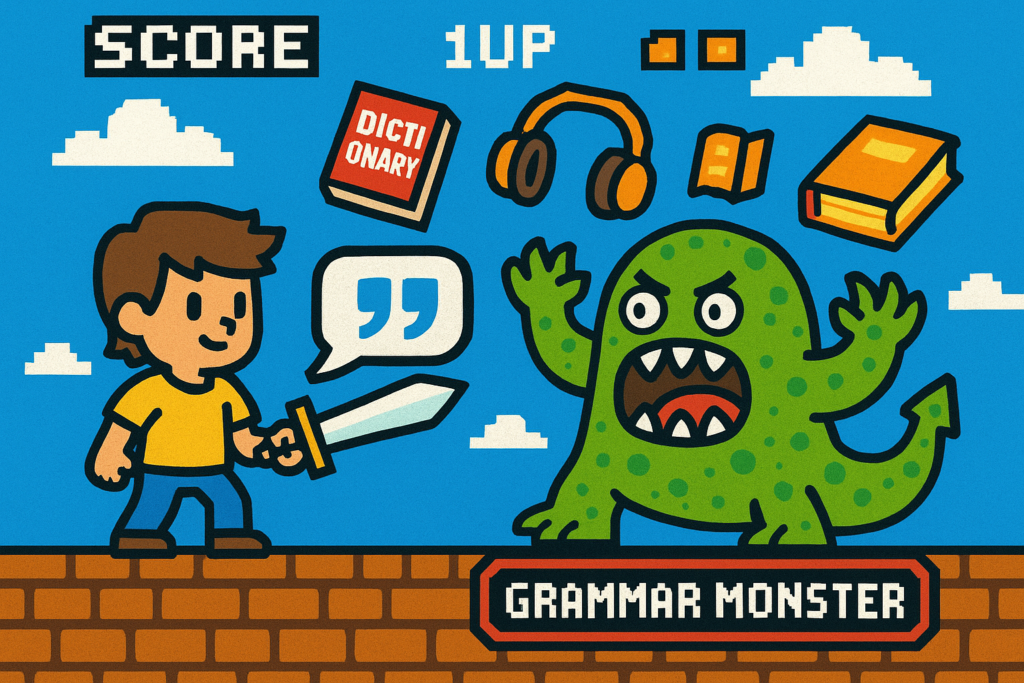
If English Were a Video Game: Levels, Power-Ups, and Hidden Bosses

Imagine stepping into a sprawling, vibrant world — an expansive universe teeming with quests, allies, hidden secrets, and formidable foes. Now picture this universe as the journey of learning English. Whether you are a novice just starting your quest or a seasoned explorer aiming for mastery, understanding this journey as a game can make your learning experience not only more engaging but also strategically rewarding.

In this blog post, we will treat English learning as if it were a captivating video game. We will map out levels of proficiency, highlight the ‘boss battles’ that challenge your skills, and reveal the power-ups that can boost your progress. So, gear up, hero! Your adventure in mastering the English language awaits.

If English Were a Video Game: Levels, Power-Ups, and Hidden Bosses Read More »

Linguistic Detectives: How to ‘Read’ People by the English They Use

Imagine walking into a room and overhearing a conversation. The words, tone, and rhythm immediately give you hints about the speakers’ backgrounds, feelings, and intentions, even if you do not understand every word. What if you could sharpen that skill? What if, as a language learner or teacher, you could become a ‘linguistic detective’, noticing subtle clues that reveal more than just the literal meaning of words?

Linguistic Detectives: How to ‘Read’ People by the English They Use Read More »

The Accent Myth: Why Sounding ‘Native’ Should Not Be Your Goal in English

In the global landscape of English language learning, one aspiration remains persistent: the desire to sound ‘native.’ Whether it is the crisp clarity of a BBC presenter, the polished accent of an American professional, or the refined diction of an Oxford scholar, many learners believe that reaching this level of ‘nativeness’ is the ultimate goal. However, what if this pursuit is misguided? What if, in trying to erase our unique voices, we are missing the true essence of effective communication?

The Accent Myth: Why Sounding ‘Native’ Should Not Be Your Goal in English Read More »

Echoes, Shadows, and Parrots: The Hidden Power of Imitation in Learning English

Imagine walking into a bustling street in Mumbai, New York, or Nairobi. Amid the hum of voices, you notice a child mimicking the gestures and intonation of a street performer, or a language learner repeating phrases after a podcast. These acts, so simple, so natural, are often dismissed as mere copying or mimicry. Yet, beneath their surface lies a profound, scientifically supported strategy for mastering English and other languages.

Echoes, Shadows, and Parrots: The Hidden Power of Imitation in Learning English Read More »

What If Shakespeare Had ChatGPT? Language Learning in Parallel Universes

Imagine for a moment that William Shakespeare, the quintessential bard of the English language, had access to a modern AI assistant, say, ChatGPT, during his lifetime. Would his mastery of words have deepened? Would his sonnets have evolved into new forms of expression? Or picture a young English learner in a post-apocalyptic world, where printed books and digital archives are relics of a bygone era. How would they navigate the complex terrain of language without the vast repositories of knowledge we take for granted today?

What If Shakespeare Had ChatGPT? Language Learning in Parallel Universes Read More »

English by Ear: What Musicians Know About Language That Learners Often Don’t

What do rappers, jazz artists, and classical musicians have in common with great English speakers? More than you’d think.
Language learning is often approached as a visual, grammatical, and vocabulary-based pursuit. Textbooks, vocabulary lists, grammar rules, and pronunciation drills form the core of most curricula. While these components are undeniably vital, an often-overlooked aspect of language acquisition is the auditory experience — specifically, the ability to ‘hear’ and process language in its natural, musical form.

English by Ear: What Musicians Know About Language That Learners Often Don’t Read More »

Level Up Your English: How Video Games Can Boost Your Language Skills

Video games can be powerful, engaging tools for language learning — especially English, the global lingua franca. With the rise of digital entertainment, millions of gamers worldwide are learning English informally, often without realising it. Whether through immersive storytelling, social interaction, or casual exposure, video games offer a dynamic environment that complements traditional language learning methods.

Level Up Your English: How Video Games Can Boost Your Language Skills Read More »