Diversity

Language as a Map: Why You Are Not Lost; You Are Just Reading the Wrong Compass

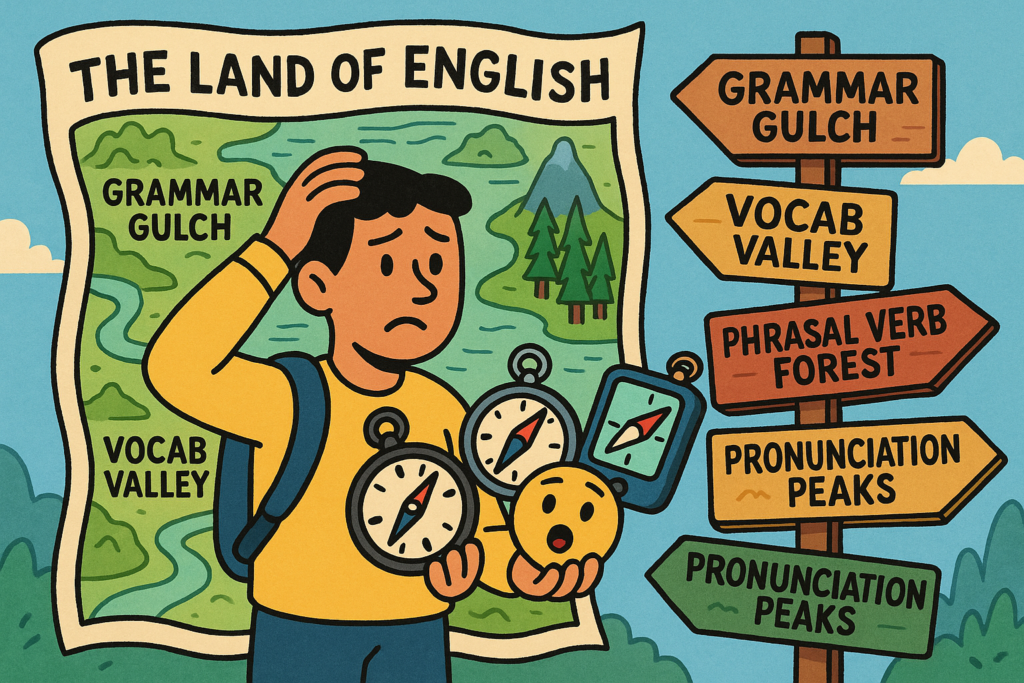
Imagine standing in the middle of a vast, unfamiliar city. You want to find your way to a famous monument, but all you have is a map that seems to show only narrow alleyways and distant landmarks. Frustrated, you might feel you are simply not cut out for navigation or perhaps the city is too complex. But what if the problem is not your ability to find your way? What if it is that you are reading the wrong map or using the wrong compass?
This metaphor captures a profound truth about language learning: it is not about climbing a mountain or conquering a peak; it is about exploring a vast, intricate landscape. If you feel lost in learning English, it is not because of a personal failure; it is because your mental map might not match the terrain you are trying to navigate.

Language as a Map: Why You Are Not Lost; You Are Just Reading the Wrong Compass Read More »

What If Shakespeare Had ChatGPT? Language Learning in Parallel Universes

Imagine for a moment that William Shakespeare, the quintessential bard of the English language, had access to a modern AI assistant, say, ChatGPT, during his lifetime. Would his mastery of words have deepened? Would his sonnets have evolved into new forms of expression? Or picture a young English learner in a post-apocalyptic world, where printed books and digital archives are relics of a bygone era. How would they navigate the complex terrain of language without the vast repositories of knowledge we take for granted today?

What If Shakespeare Had ChatGPT? Language Learning in Parallel Universes Read More »

Emoji English: Can You Really Learn a Language Through Memes, Gifs, and Emojis?

If your screen time is 6+ hours a day, your language input isn’t coming from books — it’s coming from memes and emojis. In the digital age, the way we communicate has undergone a seismic shift. A recent survey indicates that the average person spends over six hours daily immersed in screens — scrolling through social media, watching reels, or exchanging messages. Yet, paradoxically, the lion’s share of this time is spent engaging with visual language: memes, gifs, emojis, and short-form videos. These visual tools have become the lingua franca of Gen Z and Millennials alike, transcending borders and languages to form a universal dialect.

Emoji English: Can You Really Learn a Language Through Memes, Gifs, and Emojis? Read More »

English by Ear: What Musicians Know About Language That Learners Often Don’t

What do rappers, jazz artists, and classical musicians have in common with great English speakers? More than you’d think.
Language learning is often approached as a visual, grammatical, and vocabulary-based pursuit. Textbooks, vocabulary lists, grammar rules, and pronunciation drills form the core of most curricula. While these components are undeniably vital, an often-overlooked aspect of language acquisition is the auditory experience — specifically, the ability to ‘hear’ and process language in its natural, musical form.

English by Ear: What Musicians Know About Language That Learners Often Don’t Read More »

English in the Age of AI: What Learners Need to Know (and What Teachers Need to Rethink)

n recent years, the landscape of language learning has undergone a seismic shift. The advent of Artificial Intelligence (AI) tools such as ChatGPT, Grammarly, Duolingo Max, and others has not only made English learning more accessible but also more dynamic. As we stand at this crossroads, it is vital for both learners and teachers to understand how AI is transforming the way we acquire and teach English and, more importantly, how to adapt to this new paradigm effectively.

English in the Age of AI: What Learners Need to Know (and What Teachers Need to Rethink) Read More »

The Sounds of Silence: Teaching Pause, Intonation, and Rhythm in English

Imagine a conversation where every word is perfect, but the speaker’s voice sounds flat and monotonous. How does that affect your understanding? Surprisingly, research by Derwing and Munro in 2017 reveals that ‘listeners often perceive speakers with accurate prosody — meaning their intonation, rhythm, and pauses – as more fluent than those who speak grammatically correct but with a flat, unvaried tone’.
This finding shifts the common focus from just accuracy to the musicality of speech. It suggests that mastering how we say things, not just what we say, is crucial in effective communication. For language teachers and learners alike, this is a game changer: the sounds of silence — pauses, intonation, and rhythm — are just as vital as vocabulary and grammar.

The Sounds of Silence: Teaching Pause, Intonation, and Rhythm in English Read More »

What Is Translanguaging? The Secret Multilinguals Use to Master English

In this post we will explore the concept of translanguaging as a powerful tool in English language teaching. While traditional models often insist on English-only classrooms, translanguaging embraces learners’ full linguistic repertoires. It is not just code-switching — it is an intentional pedagogical approach that validates the use of all languages a learner knows to facilitate learning, foster confidence, and reflect real-world communication. The post will provide a conceptual understanding of translanguaging, distinguish it from code-switching, examine its practical implications in multilingual classrooms (especially in India and other Global South contexts), and offer actionable strategies for educators.

What Is Translanguaging? The Secret Multilinguals Use to Master English Read More »

Code-Switching and Social Adaptation: How Language Shifts Shape Who We Are

In a world where communication is increasingly transcending borders, the tendency to switch between languages or dialects — known as code-switching — has become a ubiquitous part of many multilingual or multicultural experiences. Understanding code-switching is particularly crucial for English learners as it highlights the importance of being aware of one’s audience, mastering the appropriateness of language, and developing linguistic flexibility.

Code-Switching and Social Adaptation: How Language Shifts Shape Who We Are Read More »

A flat-style digital illustration with the title 'Language and Identity' in bold navy blue text on a light beige background. Below the title, two colourful speech bubbles — one blue and one orange — contain simple profile illustrations of a man and a woman facing each other, symbolising communication and cultural identity.

Do We Think in Language? Exploring the Sapir–Whorf Hypothesis

Language is a powerful tool that shapes not only how we communicate but also how we perceive and interact with the world around us. This intricate relationship between language, thought, and culture is encapsulated in the Sapir–Whorf Hypothesis, also known as ‘linguistic relativity’. This concept posits that the structure and vocabulary of our language influence our cognition and worldview. We touched upon this topic in the last blog post. In this blog post, we will delve deep into the nuances of the Sapir–Whorf Hypothesis, exploring its implications through linguistic theory, cross-linguistic studies, and cultural cognition.

Do We Think in Language? Exploring the Sapir–Whorf Hypothesis Read More »

A flat-style digital illustration featuring four diverse human profiles inside colourful speech bubbles, symbolising the power of language in shaping identity and perception. The background is light beige, and the title 'The Power of Words' is displayed in bold navy blue text.

The Power of Words: How Language Shapes Perception and Identity

Language is more than a mere instrument for communication; it serves as a lens through which we interpret the world around us. The words we choose, the accents we bear, and even the dialects we adopt encapsulate our cultural backgrounds, our personal narratives, and our societal standing. Language not only reflects our identity but also shapes our perception of reality, influencing the way we think and interact with one another. This blog post will delve into the multifaceted relationship between language, identity, thought processes, and social relationships, shedding light on its significance in various contexts, both globally and within specific cultures such as India.

The Power of Words: How Language Shapes Perception and Identity Read More »