Grammar

When English Gets Emotional: How Grammar Expresses (and Hides) Feeling

English has long enjoyed a reputation for being a language of efficiency, logic, and emotional restraint. Unlike some languages that are celebrated for their poetic expressiveness or passionate tone, English often appears to be reserved, even stoic. It is the language of science, technology, business, and diplomacy — domains where clarity and precision are prized over raw emotion.

However, beneath this veneer of rationality lies a complex web of subtle emotional signals. What if the reason English feels so restrained is not because it lacks emotion but because it chooses to hide it, particularly in its grammar? What if the very structures of English serve as a kind of emotional filter, allowing speakers to express feelings carefully, indirectly, or even invisibly?

When English Gets Emotional: How Grammar Expresses (and Hides) Feeling Read More »

The Loneliness of English: Why the Language Prefers Separation Over Connection

English is often celebrated for its precision, efficiency, and clarity. It allows us to articulate complex ideas with a straightforwardness that many other languages envy. Yet, beneath its polished veneer lies a peculiar trait: a sense of emotional distance, a quiet reluctance to fully embrace intimacy. Strangely, English does not seem to just permit distance. It appears to prefer it.

What if this linguistic preference is not accidental? What if the structure and conventions of English are subtly designed, or at least inclined, to foster separation rather than connection? This idea invites us to look beyond superficial fluency and examine the deeper, perhaps more subtle, ways in which the language shapes our relationships with others and ourselves.

The Loneliness of English: Why the Language Prefers Separation Over Connection Read More »

The Untranslatable ‘You’: What English Reveals About the Self

Imagine a language where a single word, you, serves for everyone. No matter if you are addressing your best friend, your boss, your grandmother, or a stranger on the street, the pronoun remains unchanged. This is the reality of English. It is a language that collapses all social relationships into one pronoun, offering simplicity but sacrificing nuance.
What does it say about a language, and by extension, its speakers, when the grammatical structure refuses to mark closeness, distance, or respect explicitly? Does this linguistic choice shape how people perceive relationships, intimacy, and social hierarchy? Or does it merely reflect a cultural tendency towards neutrality?

The Untranslatable ‘You’: What English Reveals About the Self Read More »

The Secret Life of Prepositions: The Words That Actually Shape Our Worldview

In the vast landscape of language learning, we often find ourselves captivated by vocabulary lists, grammar rules, and pronunciation drills. We memorise complex verb tenses, master tricky phonemes, and obsess over the meanings of adjectives. Yet, amidst this flurry of focus, one category of words remains remarkably invisible: prepositions.

Prepositions are the silent architects of our sentences. They quietly indicate relationships of space, time, manner, and more.

What if these unassuming words do more than just connect nouns and verbs? What if prepositions are not merely grammatical glue but are, in fact, cognitive lenses that shape how we perceive and understand the world? Could they influence our worldview, our priorities, and even our cultural outlooks?

The Secret Life of Prepositions: The Words That Actually Shape Our Worldview Read More »

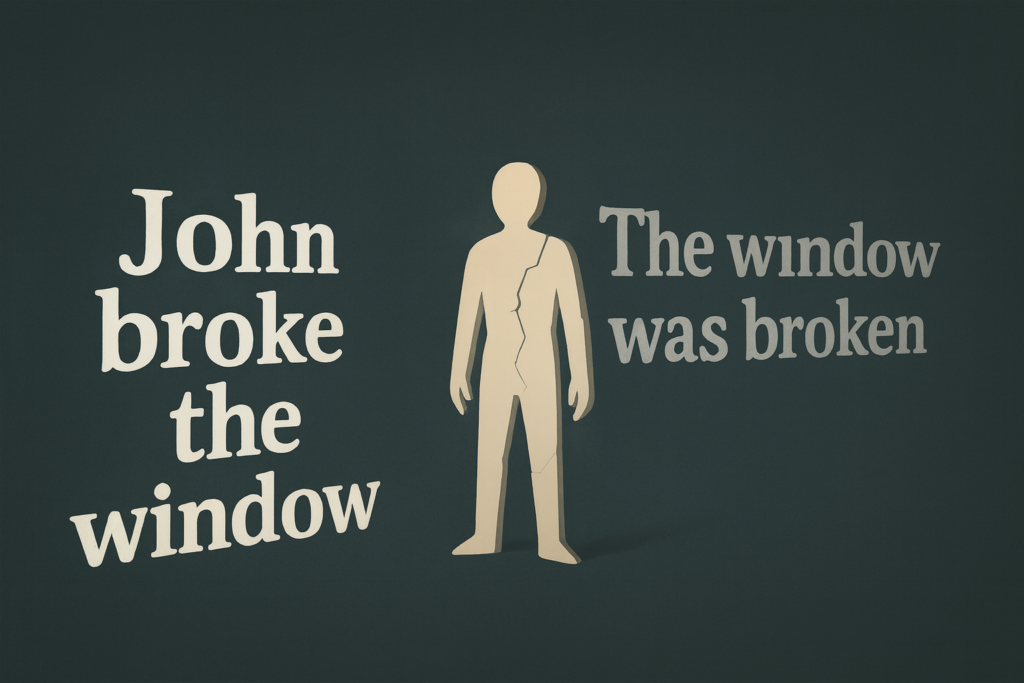
The Grammar of Blame: How Syntax Shifts Responsibility

Imagine walking into a room and accidentally knocking over a cherished vase. When you say, ‘I broke the vase,’ the words carry a weight of personal responsibility, guilt, and accountability. The emotional temperature is immediate and intense. Now, if someone else reports, ‘The vase broke,’ the tone shifts. It becomes less confrontational, more detached, almost neutral. The event remains the same, but the way it is framed through language radically alters how we perceive responsibility.

This subtle yet profound difference illustrates a vital question: how does grammar influence our attribution of blame? Beyond mere syntax, language subtly guides our moral judgements, shaping perceptions of intent, culpability, and severity.

The Grammar of Blame: How Syntax Shifts Responsibility Read More »

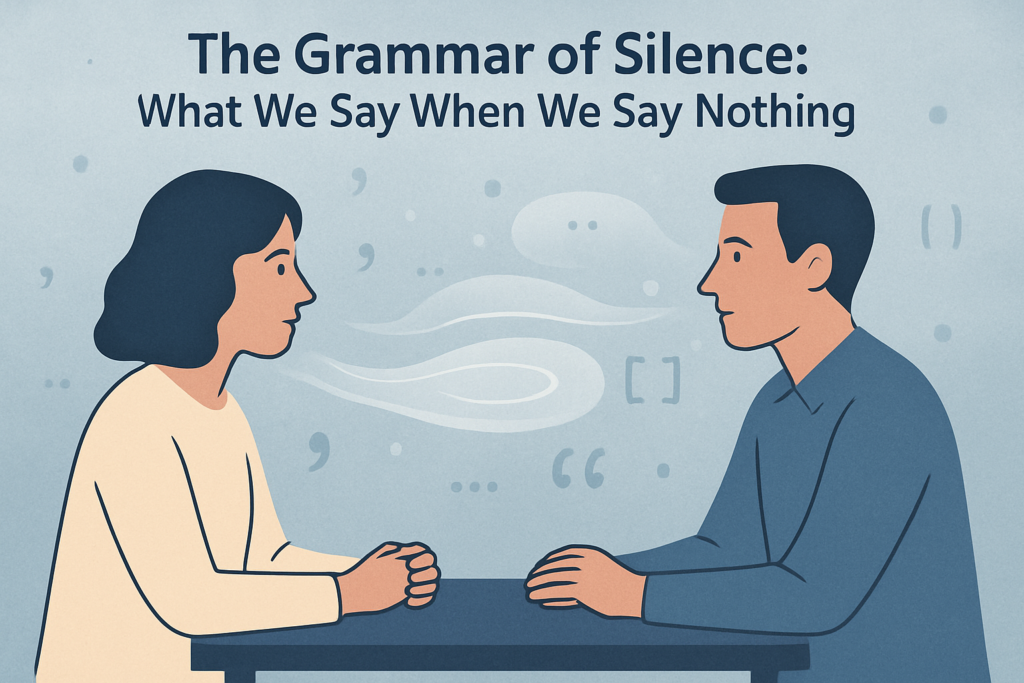
The Grammar of Silence: What We Say When We Say Nothing

Imagine a quiet room where two friends sit in a moment of shared understanding. One has just delivered difficult news, and the other responds not with words but with a gentle gaze and a lingering pause. Or picture a tense courtroom, where a witness’s silence speaks volumes, revealing truths unspoken. In these moments, silence is not mere emptiness; it is a language in its own right, capable of conveying complex, nuanced meaning that words sometimes fail to express.

Silence, in its many forms, shapes our interactions, influences our relationships, and reflects cultural norms. It can be an act of respect, a sign of disagreement, or a display of emotional restraint. But what does silence truly communicate? And how does it function within the broader grammar of human language?

This leads us to a compelling question: if language is how we communicate, what do we make of the moments when we do not speak? The answer lies in exploring what I call the ‘grammar of silence’ — a set of patterns, conventions, and meanings that govern what is left unsaid. Silence is not simply the absence of speech; it is a form of communication rich with intentionality and cultural significance. It follows its own rules, and understanding these rules allows us to listen more deeply to the unspoken stories around us.

The Grammar of Silence: What We Say When We Say Nothing Read More »

The Future Tense: What Our Grammar Reveals About How We See Time

Some languages place the future far away. Others fold it neatly into the present.

Can the way we talk about time change the way we think about it?

This question invites us into a fascinating realm where language, cognition, and culture intersect. Our grammar — the structures we use to organise our thoughts — may do more than simply describe reality. It might shape how we perceive and engage with the future. From the way we plan our careers to how we approach climate change, the language patterns embedded in our speech subtly influence our decisions.

In this post, we will explore how different languages conceptualise time, what scientific research suggests about the relationship between language and thought, and why understanding these patterns matters in our interconnected, rapidly changing world.

The Future Tense: What Our Grammar Reveals About How We See Time Read More »

If English Were a Living Creature: How the Language Evolves, Adapts, and Mutates

Imagine, for a moment, that English is not just a language, or a mere tool for communication, but a living, breathing organism. It moves, changes, and adapts in response to its environment, much like a creature in the wild. This playful analogy is not just a whimsical thought experiment; it is rooted in robust scholarly ideas from historical linguistics, memetics, and evolutionary theory. In this post, we will explore how English, as a linguistic living entity, has evolved from its embryonic origins to its current dynamic state and, crucially, how it might continue to evolve in the future.

If English Were a Living Creature: How the Language Evolves, Adapts, and Mutates Read More »

Linguistic Detectives: How to ‘Read’ People by the English They Use

Imagine walking into a room and overhearing a conversation. The words, tone, and rhythm immediately give you hints about the speakers’ backgrounds, feelings, and intentions, even if you do not understand every word. What if you could sharpen that skill? What if, as a language learner or teacher, you could become a ‘linguistic detective’, noticing subtle clues that reveal more than just the literal meaning of words?

Linguistic Detectives: How to ‘Read’ People by the English They Use Read More »

Grammar of the Gut: What Digestion Can Teach Us About Learning English

Imagine your body digesting a hearty meal. The process is seamless, often unnoticed, yet profoundly complex — an intricate dance of enzymes, gut flora, and nutrient absorption that sustains life. Now, what if I told you that learning a language, especially English, mirrors this biological process? That understanding the mechanics of digestion can shed light on how we acquire, internalise, and eventually fluently use a language?
In this blog post, we explore the idea that grammar is the ‘gut flora’ of language learning and that the entire process of acquiring English can be viewed through the lens of digestion. This metaphor is not just playful; it is rooted in cognitive science, educational theory, and real-world language learning experiences.

Grammar of the Gut: What Digestion Can Teach Us About Learning English Read More »