Grammar

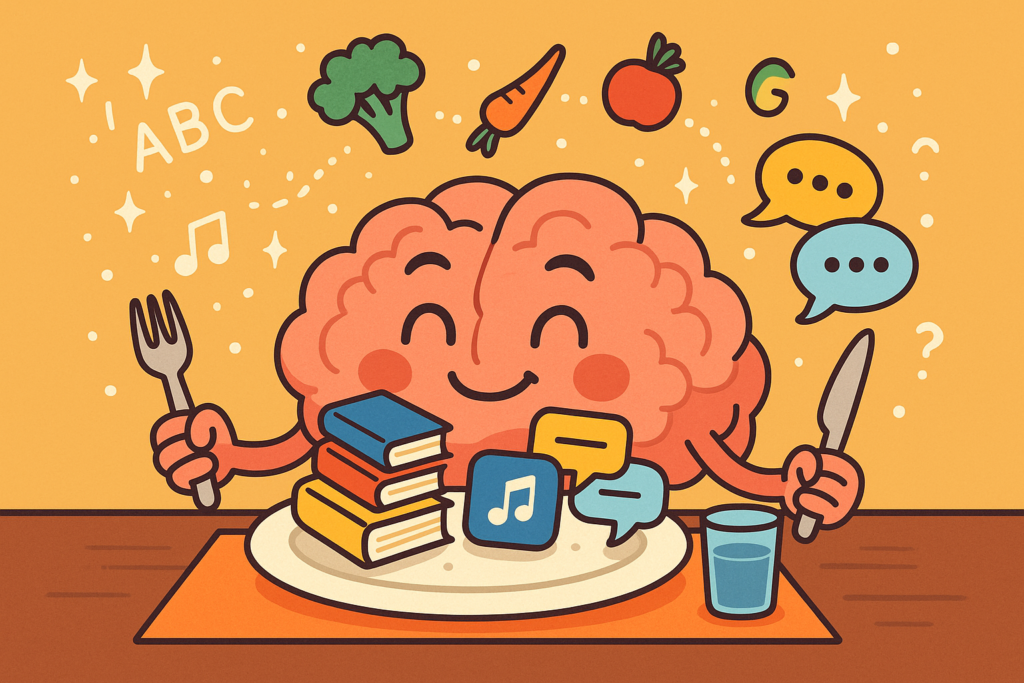
Grammar of the Gut: What Digestion Can Teach Us About Learning English

Imagine your body digesting a hearty meal. The process is seamless, often unnoticed, yet profoundly complex — an intricate dance of enzymes, gut flora, and nutrient absorption that sustains life. Now, what if I told you that learning a language, especially English, mirrors this biological process? That understanding the mechanics of digestion can shed light on how we acquire, internalise, and eventually fluently use a language?
In this blog post, we explore the idea that grammar is the ‘gut flora’ of language learning and that the entire process of acquiring English can be viewed through the lens of digestion. This metaphor is not just playful; it is rooted in cognitive science, educational theory, and real-world language learning experiences.

Grammar of the Gut: What Digestion Can Teach Us About Learning English Read More »

A flat-style digital illustration with the title 'Language and Identity' in bold navy blue text on a light beige background. Below the title, two colourful speech bubbles — one blue and one orange — contain simple profile illustrations of a man and a woman facing each other, symbolising communication and cultural identity.

Do We Think in Language? Exploring the Sapir–Whorf Hypothesis

Language is a powerful tool that shapes not only how we communicate but also how we perceive and interact with the world around us. This intricate relationship between language, thought, and culture is encapsulated in the Sapir–Whorf Hypothesis, also known as ‘linguistic relativity’. This concept posits that the structure and vocabulary of our language influence our cognition and worldview. We touched upon this topic in the last blog post. In this blog post, we will delve deep into the nuances of the Sapir–Whorf Hypothesis, exploring its implications through linguistic theory, cross-linguistic studies, and cultural cognition.

Do We Think in Language? Exploring the Sapir–Whorf Hypothesis Read More »

The Joy of ‘Wordplay’: How Puns and Playful Language Can Boost Your English Skills

As language learners, we’re always on the lookout for ways to improve our skills and enhance our understanding of the English language. While grammar rules and vocabulary lists can be helpful, we often overlook one of the most powerful tools in the language learner’s toolkit: wordplay.

From puns and double meanings to clever turns of phrase, wordplay isn’t just a humorous distraction. It’s a dynamic way to stretch our creative muscles, grasp new idioms, and sharpen our understanding of the English syntax.

In this blog post, we will explore how wordplay can help language learners in a fun and interactive way. We will examine examples from pop culture, literature, and everyday conversation to show how wordplay can be used to convey meaning, build relationships, and even make complex ideas more accessible.

The Joy of ‘Wordplay’: How Puns and Playful Language Can Boost Your English Skills Read More »

Unlocking the Local: Understanding Regional Variations in English around the World

As English language learners, we often focus on mastering the standard, ‘neutral’ accent and vocabulary of English as a global language. However, English is not a monolithic entity but a diverse and dynamic language that has evolved over centuries through contact with various cultures and societies around the world. Understanding these regional variations can enhance our language skills and deepen our connection with the cultures behind the words.

Unlocking the Local: Understanding Regional Variations in English around the World Read More »

Breaking Barriers: The Role of Technology in Language Learning and Cross-Cultural Communication

In an increasingly interconnected world, the inability to communicate across language barriers can be both a personal and a professional hindrance. As globalisation continues to shape our interactions, the importance of mastering languages is becoming paramount. Thankfully, we live in an age where technology is reshaping the landscape of language learning and cross-cultural communication in unprecedented ways. This blog post delves into how technology serves not only as an enabler of language acquisition but also as a facilitator of intercultural dialogue, effectively ‘breaking barriers’ that once seemed insurmountable.

Breaking Barriers: The Role of Technology in Language Learning and Cross-Cultural Communication Read More »

The Politics of Language Standardisation: Navigating the Tensions between Formal Language, Linguistic Diversity, and Social Justice

Language is much more than a mere tool for communication; it embodies culture, identity, and community. More than 7,000 languages are spoken worldwide, each carrying its own wealth of history, nuances, and social implications. As diverse as these languages are, the drive towards language standardisation remains a significant force, often at the expense of linguistic diversity. In this post, we are going to discuss the intricacies of language standardisation and its social ramifications by focusing on the tensions between formal language norms, linguistic diversity, and social justice.

The Politics of Language Standardisation: Navigating the Tensions between Formal Language, Linguistic Diversity, and Social Justice Read More »

The Evolution of English Slang: Understanding Informal Language and How It Reflects Changing Social Trends

Language is a living entity, constantly evolving in response to the world around it. One of the most dynamic facets of language is slang — informal words and phrases that reflect cultural trends, social attitudes, and the zeitgeist of the moment. In this post, we will explore the evolution of English slang, examining how it mirrors societal changes, varies across demographics and regions, and the ways in which it can enrich our understanding of identity and communication. Our journey will weave in global contexts with relatable references for our Indian audience, highlighting the interconnectedness of language and culture.

The Evolution of English Slang: Understanding Informal Language and How It Reflects Changing Social Trends Read More »

Unlocking Vocabulary: Effective Strategies for Rapid Language Acquisition

Learning a new language can be an exciting journey filled with challenges and rewards. As you navigate through the intricacies of English, one of the most essential skills you’ll need to develop is a robust vocabulary. A well-rounded vocabulary opens doors to effective communication, enhances comprehension, and boosts your confidence as a language learner. In this blog post, we’ll explore effective strategies for rapidly expanding your English vocabulary and making the learning process enjoyable and manageable.

Unlocking Vocabulary: Effective Strategies for Rapid Language Acquisition Read More »

Top Phrases That Will Make You Sound Like a Native English Speaker

Whether you are looking to refine your skills or pick up some new lingo, mastering the phrases and idiomatic expressions used by native speakers can significantly enhance your fluency and confidence. In this post, we are going to explore some common phrases, idioms, and colloquialisms that will help you sound like a native English speaker.

Top Phrases That Will Make You Sound Like a Native English Speaker Read More »

12 English Proverbs to Help You Overcome Tough Times

Life is a journey filled with ups and downs. From the exhilarating heights of joy to the crushing lows of disappointment, we all face challenging times that test not only our resilience but also our perspective. One of the most enriching ways to navigate these tough moments is through the wisdom of proverbs. These simple, profound statements often reflect generations of experience and offer insights that are not only comforting but also enlightening. In this post, we will explore a selection of English proverbs that can help you get through tough times and provide you with a different outlook.

12 English Proverbs to Help You Overcome Tough Times Read More »