Technology

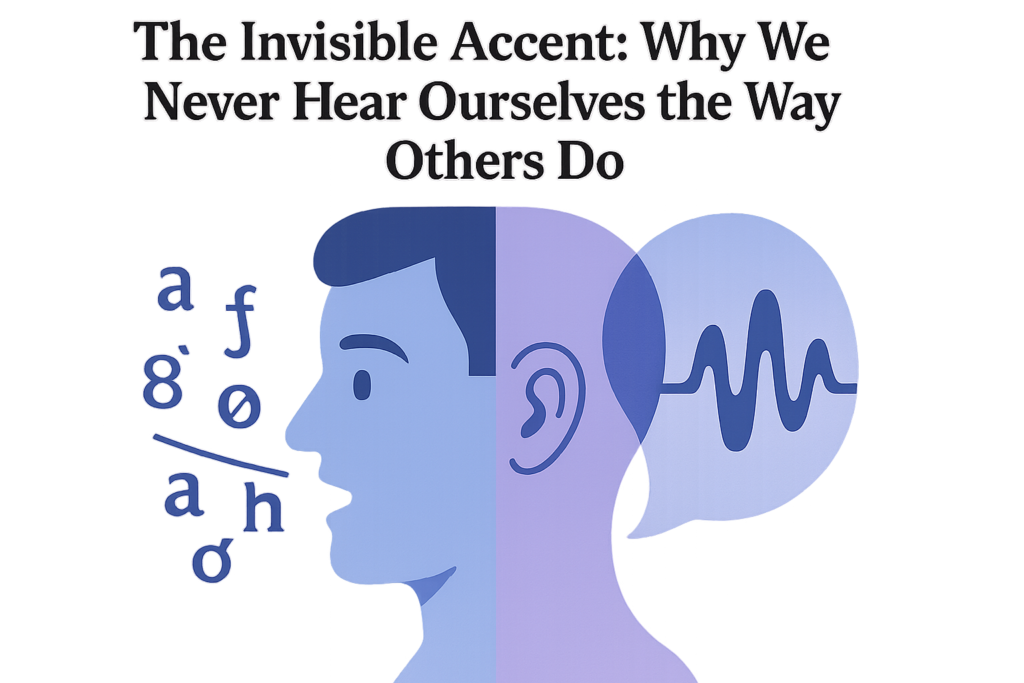
The Invisible Accent: Why We Never Hear Ourselves the Way Others Do

Imagine this: you record a voice message or listen to a video of yourself speaking. Instantly, you notice something strange. You sound different from what you thought you sounded like. Maybe your voice sounds nasal, nasal, or foreign. Perhaps you are surprised at the accent that emerges, one you have never consciously noticed before. This experience is universal. Most of us believe we have no accent, until we hear ourselves objectively, and suddenly, everything sounds different.

This paradox is rooted in a fascinating linguistic and psychological phenomenon: ‘everyone has an accent’, yet most individuals perceive theirs as ‘neutral’ or ‘standard’. It is as if our own voice and speech are invisible, hidden behind a mental veil that filters how we perceive ourselves versus how others perceive us. The question then arises: why does our brain treat our own accent differently from how others hear it?

The Invisible Accent: Why We Never Hear Ourselves the Way Others Do Read More »

The Half-Life of Words: Why Some English Words Disappear (And Others Never Die)

Language is a living, breathing entity that is constantly evolving, adapting, and reshaping itself over time. Just as species in nature have lifespans, so do the words we use to communicate. Some words fade into obscurity, like ancient relics, while others remain as vital today as they were centuries ago. This fascinating dynamic raises an intriguing question: what determines the ‘half-life’ of a word? Why do some disappear entirely, some linger in fixed expressions, and others persist across generations?

In this blog post, we will explore this linguistic phenomenon through an engaging metaphor borrowed from physics: the concept of ‘half-life’. We will examine the life cycle of English words, from their rise and fall to their potential resurrection. Whether you are a language learner, a linguist, or simply a curious reader, understanding why words come and go can deepen your appreciation of the English language and help you become a more conscious communicator.

The Half-Life of Words: Why Some English Words Disappear (And Others Never Die) Read More »

If English Were a Living Creature: How the Language Evolves, Adapts, and Mutates

Imagine, for a moment, that English is not just a language, or a mere tool for communication, but a living, breathing organism. It moves, changes, and adapts in response to its environment, much like a creature in the wild. This playful analogy is not just a whimsical thought experiment; it is rooted in robust scholarly ideas from historical linguistics, memetics, and evolutionary theory. In this post, we will explore how English, as a linguistic living entity, has evolved from its embryonic origins to its current dynamic state and, crucially, how it might continue to evolve in the future.

If English Were a Living Creature: How the Language Evolves, Adapts, and Mutates Read More »

If English Were a Video Game: Levels, Power-Ups, and Hidden Bosses

Imagine stepping into a sprawling, vibrant world — an expansive universe teeming with quests, allies, hidden secrets, and formidable foes. Now picture this universe as the journey of learning English. Whether you are a novice just starting your quest or a seasoned explorer aiming for mastery, understanding this journey as a game can make your learning experience not only more engaging but also strategically rewarding.

In this blog post, we will treat English learning as if it were a captivating video game. We will map out levels of proficiency, highlight the ‘boss battles’ that challenge your skills, and reveal the power-ups that can boost your progress. So, gear up, hero! Your adventure in mastering the English language awaits.

If English Were a Video Game: Levels, Power-Ups, and Hidden Bosses Read More »

Language as a Map: Why You Are Not Lost; You Are Just Reading the Wrong Compass

Imagine standing in the middle of a vast, unfamiliar city. You want to find your way to a famous monument, but all you have is a map that seems to show only narrow alleyways and distant landmarks. Frustrated, you might feel you are simply not cut out for navigation or perhaps the city is too complex. But what if the problem is not your ability to find your way? What if it is that you are reading the wrong map or using the wrong compass?
This metaphor captures a profound truth about language learning: it is not about climbing a mountain or conquering a peak; it is about exploring a vast, intricate landscape. If you feel lost in learning English, it is not because of a personal failure; it is because your mental map might not match the terrain you are trying to navigate.

Language as a Map: Why You Are Not Lost; You Are Just Reading the Wrong Compass Read More »

What If Shakespeare Had ChatGPT? Language Learning in Parallel Universes

Imagine for a moment that William Shakespeare, the quintessential bard of the English language, had access to a modern AI assistant, say, ChatGPT, during his lifetime. Would his mastery of words have deepened? Would his sonnets have evolved into new forms of expression? Or picture a young English learner in a post-apocalyptic world, where printed books and digital archives are relics of a bygone era. How would they navigate the complex terrain of language without the vast repositories of knowledge we take for granted today?

What If Shakespeare Had ChatGPT? Language Learning in Parallel Universes Read More »

What Your Netflix Subtitles Are Teaching You (and What They’re Getting Totally Wrong)

In an era where streaming platforms such as Netflix, Amazon Prime, and Disney+ have become the primary sources of visual entertainment, the way we consume content has radically transformed. Streaming services have democratised access to a multitude of cultures, languages, and storytelling styles, making the world more accessible than ever before. 

One of the most subtle yet influential features of this digital revolution is subtitles — the textual translations that appear at the bottom of your screen. Whether you are a casual viewer, a language learner, or a linguistic researcher, subtitles have become an integral part of the viewing experience. But have you ever paused to think about what your subtitles are teaching you? Are they accurate representations of the original dialogue? And, more importantly, what are they ‘getting wrong’?

What Your Netflix Subtitles Are Teaching You (and What They’re Getting Totally Wrong) Read More »

Emoji English: Can You Really Learn a Language Through Memes, Gifs, and Emojis?

If your screen time is 6+ hours a day, your language input isn’t coming from books — it’s coming from memes and emojis. In the digital age, the way we communicate has undergone a seismic shift. A recent survey indicates that the average person spends over six hours daily immersed in screens — scrolling through social media, watching reels, or exchanging messages. Yet, paradoxically, the lion’s share of this time is spent engaging with visual language: memes, gifs, emojis, and short-form videos. These visual tools have become the lingua franca of Gen Z and Millennials alike, transcending borders and languages to form a universal dialect.

Emoji English: Can You Really Learn a Language Through Memes, Gifs, and Emojis? Read More »

English by Ear: What Musicians Know About Language That Learners Often Don’t

What do rappers, jazz artists, and classical musicians have in common with great English speakers? More than you’d think.
Language learning is often approached as a visual, grammatical, and vocabulary-based pursuit. Textbooks, vocabulary lists, grammar rules, and pronunciation drills form the core of most curricula. While these components are undeniably vital, an often-overlooked aspect of language acquisition is the auditory experience — specifically, the ability to ‘hear’ and process language in its natural, musical form.

English by Ear: What Musicians Know About Language That Learners Often Don’t Read More »

Level Up Your English: How Video Games Can Boost Your Language Skills

Video games can be powerful, engaging tools for language learning — especially English, the global lingua franca. With the rise of digital entertainment, millions of gamers worldwide are learning English informally, often without realising it. Whether through immersive storytelling, social interaction, or casual exposure, video games offer a dynamic environment that complements traditional language learning methods.

Level Up Your English: How Video Games Can Boost Your Language Skills Read More »