Vocabulary

Why Some Words Feel Heavy: The Psychology of Lexical Weight

Imagine standing at a crossroads of language, holding two words in your mind: ‘I’m sad’ and ‘I’m devastated’. Both express sorrow; yet the second phrase weighs heavier, sinking into your mental landscape with a sense of gravity and depth. The difference is not just in the dictionary definition but in the subtle emotional and cultural layers that each word evokes.

This phenomenon, where words seem to carry emotional, moral, or cultural weight, is a fascinating aspect of human language. Some words seem to press down on us, resonating with sombre, poetic, or profound tones, whereas others evoke lightness and joy. Why does this happen? How can two words mean roughly the same thing yet feel worlds apart in their emotional heft?

Why Some Words Feel Heavy: The Psychology of Lexical Weight Read More »
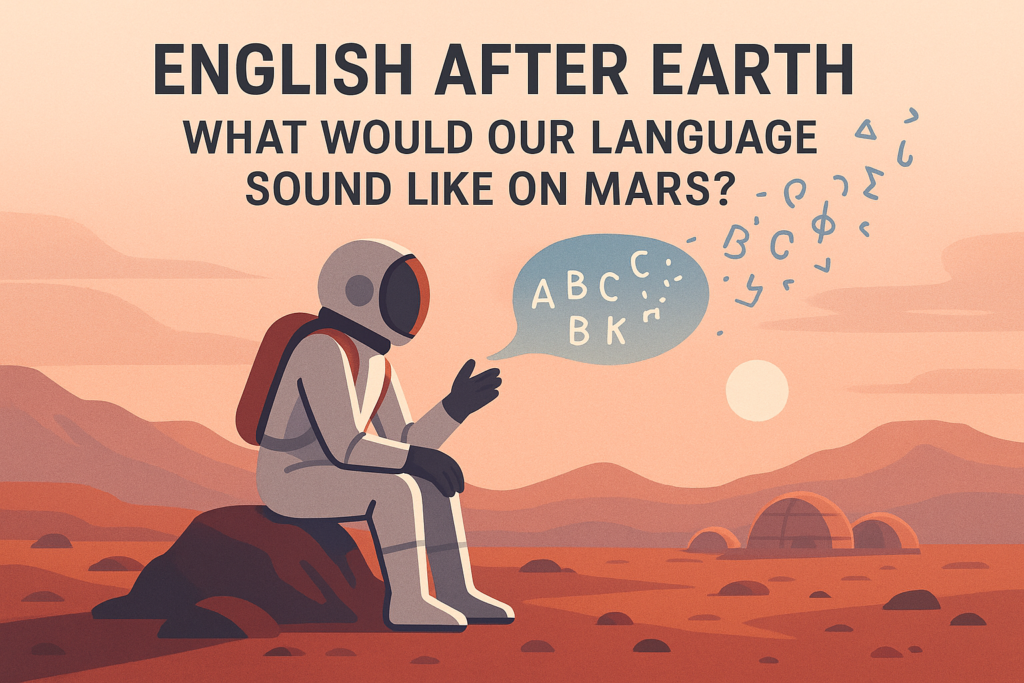
English After Earth: What Would Our Language Sound Like on Mars?

Imagine standing inside a transparent dome on the red plains of Mars, gazing out at a landscape of rust-coloured rocks and dust storms swirling in the thin atmosphere. Inside, children in space suits sit cross-legged on modular seats, their voices muffled yet eager, reciting words in English that carry a faint, unfamiliar echo, almost like a distant memory. The teacher gestures animatedly, and their speech, though rooted in familiar language, sounds subtly altered by the environment.

This scene, though speculative, prompts a compelling question: if humans colonise other planets, will our language change too? For centuries, linguists and anthropologists have observed how language is inherently intertwined with environment and culture. When a community moves into a new physical space, especially one as radically different as Mars, it is natural to wonder how their language might evolve. Would it remain recognisable, or would it transform into something unrecognisably new?

English After Earth: What Would Our Language Sound Like on Mars? Read More »

The Future Tense: What Our Grammar Reveals About How We See Time

Some languages place the future far away. Others fold it neatly into the present.

Can the way we talk about time change the way we think about it?

This question invites us into a fascinating realm where language, cognition, and culture intersect. Our grammar — the structures we use to organise our thoughts — may do more than simply describe reality. It might shape how we perceive and engage with the future. From the way we plan our careers to how we approach climate change, the language patterns embedded in our speech subtly influence our decisions.

In this post, we will explore how different languages conceptualise time, what scientific research suggests about the relationship between language and thought, and why understanding these patterns matters in our interconnected, rapidly changing world.

The Future Tense: What Our Grammar Reveals About How We See Time Read More »

The Secret Life of Idioms: How English Hides History in Everyday Phrases

Language is a living, breathing tapestry woven from the threads of history, culture, and human experience. Among the most fascinating aspects of any language are idioms, those colourful, often perplexing expressions that pepper our daily conversations. Everyone uses idioms; yet few pause to consider their origins. Have you ever wondered why we say ‘bite the bullet’ or ‘break the ice’? What stories are hidden behind these phrases? In this blog post, we will explore the intriguing world of idioms, especially how they serve as cultural fossils, preserving centuries-old histories and traditions. Understanding these idiomatic expressions not only enriches your vocabulary but also offers a glimpse into the fascinating past of the English language.

The Secret Life of Idioms: How English Hides History in Everyday Phrases Read More »

The Half-Life of Words: Why Some English Words Disappear (And Others Never Die)

Language is a living, breathing entity that is constantly evolving, adapting, and reshaping itself over time. Just as species in nature have lifespans, so do the words we use to communicate. Some words fade into obscurity, like ancient relics, while others remain as vital today as they were centuries ago. This fascinating dynamic raises an intriguing question: what determines the ‘half-life’ of a word? Why do some disappear entirely, some linger in fixed expressions, and others persist across generations?

In this blog post, we will explore this linguistic phenomenon through an engaging metaphor borrowed from physics: the concept of ‘half-life’. We will examine the life cycle of English words, from their rise and fall to their potential resurrection. Whether you are a language learner, a linguist, or simply a curious reader, understanding why words come and go can deepen your appreciation of the English language and help you become a more conscious communicator.

The Half-Life of Words: Why Some English Words Disappear (And Others Never Die) Read More »

Lost in Translation: The English Words We Cannot Translate (And Why That Matters)

Imagine this: you are sitting in a bustling café, sipping your favourite chai, and a friend excitedly exclaims, ‘I was so schadenfreude when I saw my rival trip over his shoelaces!’ You nod but secretly wonder: what exactly is ‘schadenfreude’? It is a German word that English has borrowed; yet it still feels like a foreign concept. But here is a twist: English itself, despite being the global lingua franca, is not immune to ‘gaps’, untranslatable words, or concepts that slip through its vocabulary cracks. 

Yes, the myth of English as a ‘complete’ language is just that — a myth. While English’s rich history of borrowing has made it remarkably adaptable, it still cannot perfectly encapsulate every nuance of human emotion, culture, or worldview. In this post, we will explore the fascinating realm of untranslatable words within English itself and what they reveal about language, culture, and the art of communication.

Lost in Translation: The English Words We Cannot Translate (And Why That Matters) Read More »

If English Were a Living Creature: How the Language Evolves, Adapts, and Mutates

Imagine, for a moment, that English is not just a language, or a mere tool for communication, but a living, breathing organism. It moves, changes, and adapts in response to its environment, much like a creature in the wild. This playful analogy is not just a whimsical thought experiment; it is rooted in robust scholarly ideas from historical linguistics, memetics, and evolutionary theory. In this post, we will explore how English, as a linguistic living entity, has evolved from its embryonic origins to its current dynamic state and, crucially, how it might continue to evolve in the future.

If English Were a Living Creature: How the Language Evolves, Adapts, and Mutates Read More »

Why English Feels Easy One Day and Impossible the Next

Imagine this: you are confidently chatting in English, perhaps telling a funny story or expressing your thoughts with ease. The words flow; your pronunciation feels natural; and you are riding high on a linguistic wave of accomplishment. Then, suddenly, the next day, or even just a few hours later, you find yourself staring blankly at a sentence, struggling to recall simple vocabulary, and feeling like your brain has hit a brick wall. Welcome to the wild, unpredictable rollercoaster of learning English.

If this scenario sounds familiar, you are not alone. The emotional highs and lows of acquiring a second language are universal, often leaving learners feeling both frustrated and strangely hopeful. But what is really happening beneath the surface? Why does English sometimes feel like an effortless breeze and other times a daunting mountain? In this blog post, we will explore the fascinating science and psychology behind this phenomenon, along with practical strategies to ride the rollercoaster with confidence.

Why English Feels Easy One Day and Impossible the Next Read More »

If English Were a Video Game: Levels, Power-Ups, and Hidden Bosses

Imagine stepping into a sprawling, vibrant world — an expansive universe teeming with quests, allies, hidden secrets, and formidable foes. Now picture this universe as the journey of learning English. Whether you are a novice just starting your quest or a seasoned explorer aiming for mastery, understanding this journey as a game can make your learning experience not only more engaging but also strategically rewarding.

In this blog post, we will treat English learning as if it were a captivating video game. We will map out levels of proficiency, highlight the ‘boss battles’ that challenge your skills, and reveal the power-ups that can boost your progress. So, gear up, hero! Your adventure in mastering the English language awaits.

If English Were a Video Game: Levels, Power-Ups, and Hidden Bosses Read More »

Linguistic Detectives: How to ‘Read’ People by the English They Use

Imagine walking into a room and overhearing a conversation. The words, tone, and rhythm immediately give you hints about the speakers’ backgrounds, feelings, and intentions, even if you do not understand every word. What if you could sharpen that skill? What if, as a language learner or teacher, you could become a ‘linguistic detective’, noticing subtle clues that reveal more than just the literal meaning of words?

Linguistic Detectives: How to ‘Read’ People by the English They Use Read More »