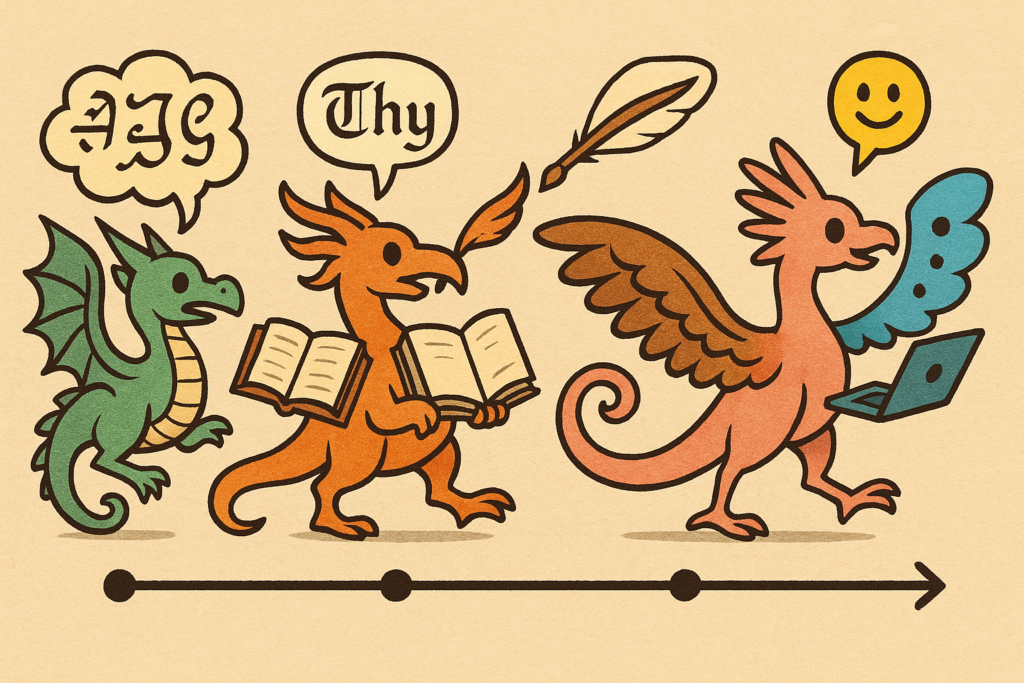
Imagine, for a moment, that English is not just a language, or a mere tool for communication, but a living, breathing organism. It moves, changes, and adapts in response to its environment, much like a creature in the wild. This playful analogy is not just a whimsical thought experiment; it is rooted in robust scholarly ideas from historical linguistics, memetics, and evolutionary theory. In this post, we will explore how English, as a linguistic living entity, has evolved from its embryonic origins to its current dynamic state and, crucially, how it might continue to evolve in the future.
In a world where language often feels static, that is, fixed in dictionaries and grammar rules, reimagining English as an organism highlights its fluidity and resilience. It invites us to see language not just as a set of tools but as a living system that breathes, adapts, and even mutates in response to social pressures, technological innovations, and contact with other languages and cultures.
How does a language ‘survive’ and ‘evolve’, and what might its next ‘mutation’ look like? Understanding these processes can deepen our appreciation for English and enhance our teaching strategies, especially in a globalised, digitally connected world.
The Birth of a Creature: The Origins of English
Every living organism begins as an embryo, and English’s story starts with ancient roots. The earliest form of what we now call English was Old English, spoken around the 5th to 11th centuries CE. Think of this as the ’embryo’ stage — a fragile, rudimentary organism, heavily influenced by the Germanic tribes such as the Angles, Saxons, and Jutes who crossed into Britain.
Old English was a complex, inflected language, rich with grammatical cases, gender distinctions, and a vocabulary that reflected the everyday life of its speakers. It was akin to a tiny, vulnerable creature still developing its basic features. For example, words such as cyning (king), hlaford (lord), and sunn (sun) formed the core of this early linguistic life form.
Then, around the 11th century, a seismic event occurred: the Norman Conquest. The Normans brought with them Old Norman, a Romance language, which blended with Old English to create a hybrid that was initially unstable but eventually fertile ground for new growth. This was the organism’s adolescence: a period of upheaval, mutation, and diversification.
Middle English (11th to 15th centuries) saw this hybridisation, with vocabulary swelling from Latin, Norman French, and Old English sources. Chaucer’s Canterbury Tales exemplifies a language that was lively, variegated, and teeming with hybrid vigour. Think of it as a teenage stage, full of experimentation, identity crises, and the emergence of new features.
Modern English, from the late 15th century onwards, marks the organism’s maturity, a more resilient, adaptable form capable of further mutation and expansion. The advent of the printing press helped stabilise spelling and grammar, while global exploration and colonisation spread English across continents, turning it into a truly global species.
Survival of the Fittest Words: Which Words Thrive, Which Die Out?
In the evolutionary landscape, not all genes (or words) are equally successful. Some survive for centuries, while others fade into obscurity. This is the principle of ‘survival of the fittest’, applied to vocabulary.
Take the pronoun thou, which was used extensively in Middle English and early Modern English, especially in religious or poetic contexts. Over time, thou was replaced by you in everyday speech, reflecting social and cultural shifts, much like a gene that becomes less fit because it no longer offers survival advantages.
In contrast, words such as computer or internet have undergone rapid proliferation. They are the ‘fittest’ in today’s environment, crucial for navigating modern life. Their success is driven by technological innovation, making them analogous to advantageous mutations that confer survival benefits.
In India, for instance, the proliferation of English loanwords such as jungle, bungalow, or pundit illustrates how external influences, akin to cross-breeding, introduce new ‘genes’ into the linguistic pool, enriching its genetic diversity.
Mutation and Hybridisation: The Genetic Diversity of English
Mutation is the engine of evolution. In language, mutations manifest as slang, neologisms, borrowings, and internet memes, which are rapid, often-unpredictable changes that can eventually become standard.
Loanwords from other languages are prime examples of hybridisation. English has absorbed words from Latin, Greek, French, Hindi, and countless other tongues, each adding new ‘genes’. For example, the Hindi words guru (teacher or expert) and chutney (a type of condiment) have become integrated into English, enriching its vocabulary and adaptability.
Slang and internet language represent quick mutations, for example viral memes, abbreviations such as LOL or OMG, and new idioms. These are like genetic mutations that can either die out or become part of the organism’s core, such as ‘cool’, ‘selfie’, or ‘hashtag’, which have now become standard parts of the language.
This genetic diversity allows English to thrive across diverse environments, from the formal halls of academia to the vibrant streets of Mumbai or New York City’s digital spaces.
Adaptation in New Environments: English’s Plasticity
A key trait of any successful organism is adaptability. English has shown remarkable flexibility in new environments, be it online spaces, multilingual settings, or AI interfaces.
Online Spaces: The internet has been a breeding ground for linguistic innovation. Emojis, memes, GIFs, and abbreviations have transformed how we communicate. English adapts by incorporating visual and digital elements, turning text into multimodal signals.
Multilingual Societies: In countries such as India, where English coexists with Hindi, Marathi, Bengali, and many regional languages, English adapts through code-switching, hybrid phrases, and localised slang. This linguistic plasticity enhances its survival prospects, allowing it to thrive alongside other languages rather than replace them.
AI and Machine Learning: As AI interfaces become more prevalent, English is adapting to new forms of interaction — voice commands, chatbots, and virtual assistants such as Siri or Alexa. These adaptations require the language to be both precise and flexible, evolving new syntactic and semantic patterns for machines to understand.
The Future Species of English: Will It Split or Merge?
The evolutionary trajectory of English raises a tantalising question: Will it continue to mutate into multiple ‘species,’ or will it converge into a more homogenised form?
Speciation of English: Just as biological species diverge into distinct lineages, English may split into mutually intelligible varieties that evolve independently. For example, Indian English, with its unique phonology, vocabulary, and idioms, is already a distinct ‘species’, much like a subspecies in biology. It coexists with American, British, Australian, and other varieties, each adapted to its environment but still recognisable as English.
Global English or Lingua Franca: Alternatively, English might continue to serve as a global lingua franca, a hybrid ‘species’ that absorbs influences from all over the world, becoming more diverse but less genetically distinct.
The possibility of ‘new species’ emerging, such as a simplified global English for AI interfaces, raises questions about intelligibility, cultural identity, and linguistic diversity. Will future Englishes be more like dialects of a single species, or will they diverge into entirely new languages, like the evolution of Latin into the Romance languages?
Final Reflection: What Does the Future Hold?
If English truly is a living creature, its future depends on environmental pressures: technological, cultural, political, and social. It will continue to mutate, hybridise, and adapt, ensuring its survival in a rapidly changing world.
Will it become a single, global species, or will it diversify into multiple ‘species’ that reflect local identities? Perhaps both. The key takeaway is that English’s adaptability is its greatest strength, which is its ability to mutate and survive in the face of change.
Now, I turn the question to you: if English were a living creature, what animal or creature would it be? A chameleon, constantly shifting colours? A phoenix, reborn from its ashes? Or perhaps a sprawling banyan tree, its roots deep, its branches ever-growing?
Remember: language is not just a tool; it is a living, evolving organism that reflects the richness of human culture and innovation. Embrace its mutations; celebrate its diversity; and participate in its ongoing evolution.
Discover more from Methods and Musings
Subscribe to get the latest posts sent to your email.