Technology

Why English Loves Straight Lines: How the Language Trains Us to Think Clearly — and Coldly

Imagine reading a sentence in English. It begins with a subject, then a verb, then an object — straightforward, unambiguous, progressing in a single direction. From the earliest lessons in school, we learn that sentences should flow from beginning to middle to end, each part building upon the last in a neat, linear fashion. This structural simplicity makes English remarkably efficient for communication: ideas are presented in an order that clarifies cause and effect, responsibility, and progression.

But what if this architectural elegance of English extends beyond grammar and vocabulary? What if the very way the language is built influences not just how we communicate but how we think, shaping our perceptions of time, responsibility, emotion, and connection?

Why English Loves Straight Lines: How the Language Trains Us to Think Clearly — and Coldly Read More »

When English Gets Emotional: How Grammar Expresses (and Hides) Feeling

English has long enjoyed a reputation for being a language of efficiency, logic, and emotional restraint. Unlike some languages that are celebrated for their poetic expressiveness or passionate tone, English often appears to be reserved, even stoic. It is the language of science, technology, business, and diplomacy — domains where clarity and precision are prized over raw emotion.

However, beneath this veneer of rationality lies a complex web of subtle emotional signals. What if the reason English feels so restrained is not because it lacks emotion but because it chooses to hide it, particularly in its grammar? What if the very structures of English serve as a kind of emotional filter, allowing speakers to express feelings carefully, indirectly, or even invisibly?

When English Gets Emotional: How Grammar Expresses (and Hides) Feeling Read More »

The Loneliness of English: Why the Language Prefers Separation Over Connection

English is often celebrated for its precision, efficiency, and clarity. It allows us to articulate complex ideas with a straightforwardness that many other languages envy. Yet, beneath its polished veneer lies a peculiar trait: a sense of emotional distance, a quiet reluctance to fully embrace intimacy. Strangely, English does not seem to just permit distance. It appears to prefer it.

What if this linguistic preference is not accidental? What if the structure and conventions of English are subtly designed, or at least inclined, to foster separation rather than connection? This idea invites us to look beyond superficial fluency and examine the deeper, perhaps more subtle, ways in which the language shapes our relationships with others and ourselves.

The Loneliness of English: Why the Language Prefers Separation Over Connection Read More »

The Untranslatable ‘You’: What English Reveals About the Self

Imagine a language where a single word, you, serves for everyone. No matter if you are addressing your best friend, your boss, your grandmother, or a stranger on the street, the pronoun remains unchanged. This is the reality of English. It is a language that collapses all social relationships into one pronoun, offering simplicity but sacrificing nuance.
What does it say about a language, and by extension, its speakers, when the grammatical structure refuses to mark closeness, distance, or respect explicitly? Does this linguistic choice shape how people perceive relationships, intimacy, and social hierarchy? Or does it merely reflect a cultural tendency towards neutrality?

The Untranslatable ‘You’: What English Reveals About the Self Read More »

The Grammar of Blame: How Syntax Shifts Responsibility

Imagine walking into a room and accidentally knocking over a cherished vase. When you say, ‘I broke the vase,’ the words carry a weight of personal responsibility, guilt, and accountability. The emotional temperature is immediate and intense. Now, if someone else reports, ‘The vase broke,’ the tone shifts. It becomes less confrontational, more detached, almost neutral. The event remains the same, but the way it is framed through language radically alters how we perceive responsibility.

This subtle yet profound difference illustrates a vital question: how does grammar influence our attribution of blame? Beyond mere syntax, language subtly guides our moral judgements, shaping perceptions of intent, culpability, and severity.

The Grammar of Blame: How Syntax Shifts Responsibility Read More »

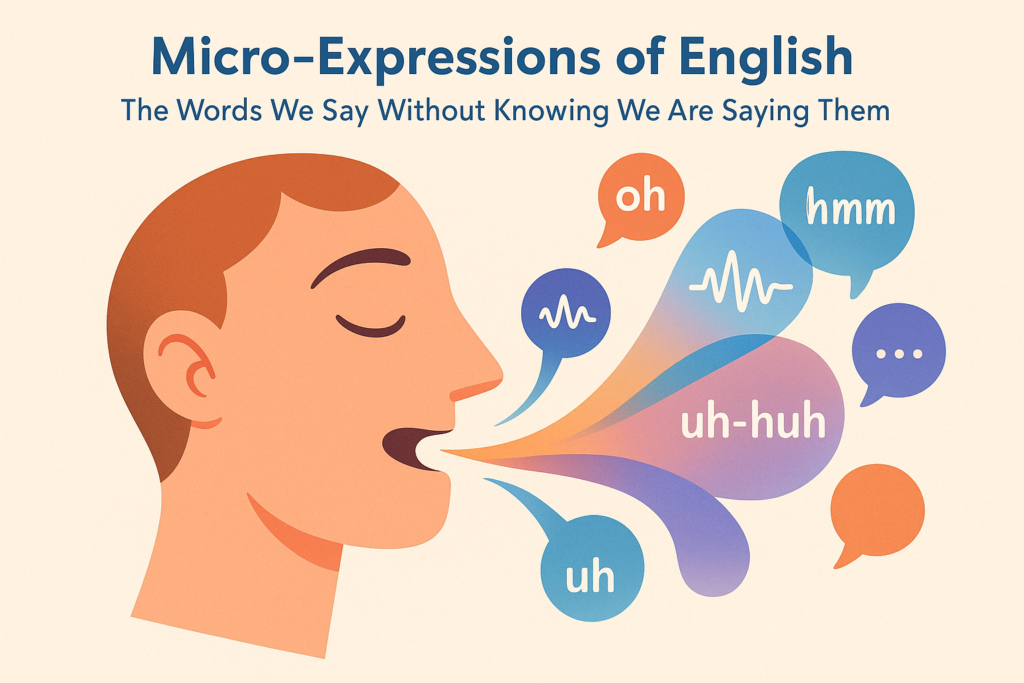
Micro-Expressions of English: The Words We Say Without Knowing We Are Saying Them

Before we speak in full sentences, before we articulate complex thoughts, there exists a subtle layer of communication that often goes unnoticed: the tiny sounds and utterances we produce, those fleeting syllables, sounds, and cues that are so ingrained in our speech that they pass by almost invisibly. These micro-expressions of language form a hidden fabric woven into our everyday conversations, shaping meaning, emotion, and social connection in ways that words alone cannot fully capture.

Micro-Expressions of English: The Words We Say Without Knowing We Are Saying Them Read More »

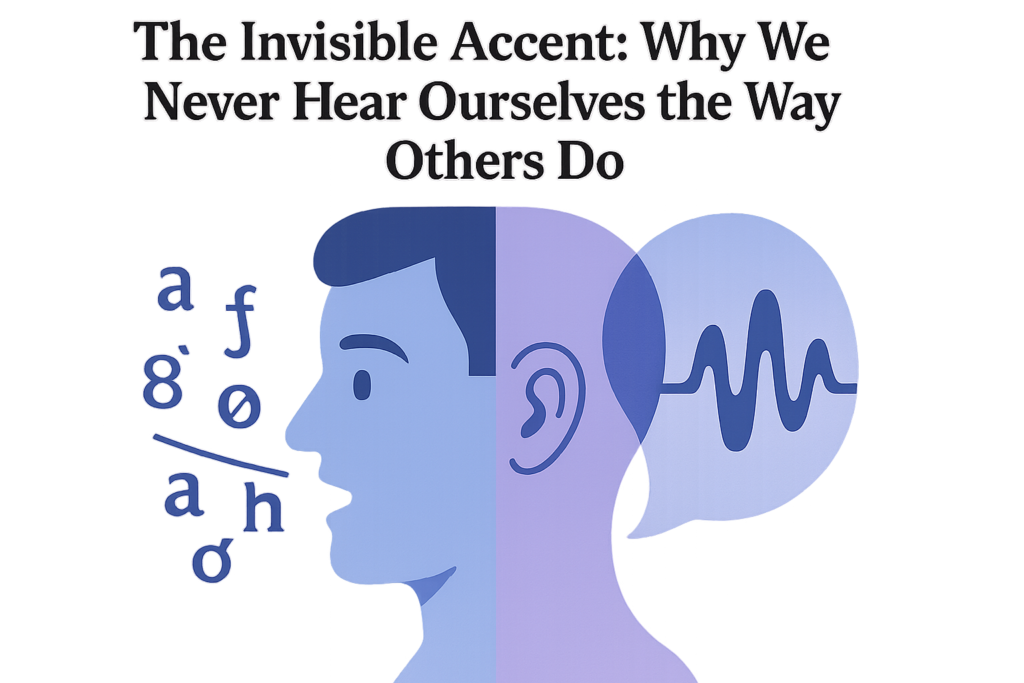
The Invisible Accent: Why We Never Hear Ourselves the Way Others Do

Imagine this: you record a voice message or listen to a video of yourself speaking. Instantly, you notice something strange. You sound different from what you thought you sounded like. Maybe your voice sounds nasal, nasal, or foreign. Perhaps you are surprised at the accent that emerges, one you have never consciously noticed before. This experience is universal. Most of us believe we have no accent, until we hear ourselves objectively, and suddenly, everything sounds different.

This paradox is rooted in a fascinating linguistic and psychological phenomenon: ‘everyone has an accent’, yet most individuals perceive theirs as ‘neutral’ or ‘standard’. It is as if our own voice and speech are invisible, hidden behind a mental veil that filters how we perceive ourselves versus how others perceive us. The question then arises: why does our brain treat our own accent differently from how others hear it?

The Invisible Accent: Why We Never Hear Ourselves the Way Others Do Read More »

The Half-Life of Words: Why Some English Words Disappear (And Others Never Die)

Language is a living, breathing entity that is constantly evolving, adapting, and reshaping itself over time. Just as species in nature have lifespans, so do the words we use to communicate. Some words fade into obscurity, like ancient relics, while others remain as vital today as they were centuries ago. This fascinating dynamic raises an intriguing question: what determines the ‘half-life’ of a word? Why do some disappear entirely, some linger in fixed expressions, and others persist across generations?

In this blog post, we will explore this linguistic phenomenon through an engaging metaphor borrowed from physics: the concept of ‘half-life’. We will examine the life cycle of English words, from their rise and fall to their potential resurrection. Whether you are a language learner, a linguist, or simply a curious reader, understanding why words come and go can deepen your appreciation of the English language and help you become a more conscious communicator.

The Half-Life of Words: Why Some English Words Disappear (And Others Never Die) Read More »

If English Were a Living Creature: How the Language Evolves, Adapts, and Mutates

Imagine, for a moment, that English is not just a language, or a mere tool for communication, but a living, breathing organism. It moves, changes, and adapts in response to its environment, much like a creature in the wild. This playful analogy is not just a whimsical thought experiment; it is rooted in robust scholarly ideas from historical linguistics, memetics, and evolutionary theory. In this post, we will explore how English, as a linguistic living entity, has evolved from its embryonic origins to its current dynamic state and, crucially, how it might continue to evolve in the future.

If English Were a Living Creature: How the Language Evolves, Adapts, and Mutates Read More »

If English Were a Video Game: Levels, Power-Ups, and Hidden Bosses

Imagine stepping into a sprawling, vibrant world — an expansive universe teeming with quests, allies, hidden secrets, and formidable foes. Now picture this universe as the journey of learning English. Whether you are a novice just starting your quest or a seasoned explorer aiming for mastery, understanding this journey as a game can make your learning experience not only more engaging but also strategically rewarding.

In this blog post, we will treat English learning as if it were a captivating video game. We will map out levels of proficiency, highlight the ‘boss battles’ that challenge your skills, and reveal the power-ups that can boost your progress. So, gear up, hero! Your adventure in mastering the English language awaits.

If English Were a Video Game: Levels, Power-Ups, and Hidden Bosses Read More »